



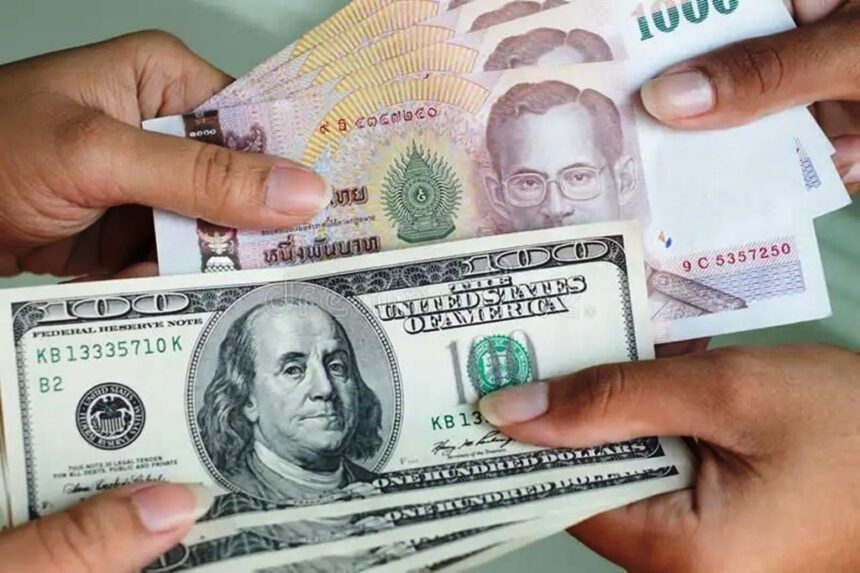
BANGKOK– Thailand’s financial regulators have rolled out a three-part plan to slow the sharp rise of the baht. Officials say the country’s fast-growing online gold trade has pulled in large foreign currency inflows and helped push the baht to its strongest point in years.
The baht has gained more than 9.4% against the US dollar this year. A large share of that jump came in December, with a 4.2% rise that beat nearby currencies such as the Malaysian ringgit. By late December, the exchange rate sat close to 31 baht per dollar, the strongest level in over four years.
Bank of Thailand (BOT) Governor Vitai Ratanakorn has warned several times that the pace of the rise doesn’t match Thailand’s slow economic recovery. He has said the currency is acting like a “shock amplifier”, rather than easing pressure on the economy.
Gold Trading Fuels Baht’s Rise
Authorities are focusing on Thailand’s busy gold market, with online trading platforms seeing especially large volumes. Global gold prices have climbed more than 70% in 2025, helped by geopolitical tensions and a weaker US dollar. Thai dealers have responded by shipping out more gold, receiving dollars, and then converting those dollars back into baht.
The BOT estimates that on the busiest days, gold-linked trades make up as much as half of the foreign exchange flows that are lifting the baht. Officials point to a small group of major traders, about 14 large players involved in imports, exports, and online trades. Together, their activity is said to be equivalent to around 50% of GDP.
This has created a feedback loop. Higher gold prices encourage more exports and dollar receipts, then quick conversions into baht increase upward pressure on the currency.
A Three-Step Plan Aimed at Online Gold Trades
At a joint press briefing on 23 December, the Ministry of Finance, the BOT, and the Securities and Exchange Commission (SEC) announced three urgent steps to reduce these flows, without bringing in broad capital controls.
First, the Finance Ministry is reviewing a specific business tax on online gold transactions. It is also looking at stricter reporting rules for platforms, similar to the data reporting required in e-commerce.
Second, the BOT plans to set volume limits for trading by major dealers. These caps are expected to start by mid-January 2026. The aim is to reduce sudden, large bursts of dollar selling that can swing the exchange rate.
Third, regulators will increase monitoring. Large gold traders will have to file fuller transaction reports, and commercial banks will tighten checks on dollar-to-baht conversions tied to gold deals.
Governor Vitai said the measures are designed to target large online trades, not traditional gold shops or everyday buyers. He said officials expect the steps to help soften the baht’s strength, and he ruled out harsh taxes on overall inflows or outflows.
Exporters Feel the Strain as Costs Rise
A stronger baht has hurt exporters, a major part of Thailand’s economy that contributes over 60% to GDP. Companies selling electronics, car parts, and farm goods face higher prices abroad when the baht rises. That squeezes profit margins and makes it harder to compete with rivals in countries such as Viet Nam and Indonesia.
Kriengkrai Thiennukul, chairman of the Federation of Thai Industries, has warned that a long period of baht strength could lead to factory shutdowns and job losses. He said earlier this year that if the issue isn’t addressed, confidence in exports will drop. Net exports, once a support for growth, have started to weigh on performance as buyers look for cheaper suppliers.
Tourism, another major source of income, is also exposed. Thailand is aiming for more than 33 million visitors in 2025, but a stronger baht makes trips more expensive for many travellers, including those from the US and Europe.
Arrivals have already slipped in some segments, with travellers comparing prices with destinations such as Japan, helped by a weak yen, and Viet Nam. The Tourism Authority of Thailand estimates the strong baht could cut revenue by 15% to 17%, as visitors view the country as “more expensive”. Some hotel areas are holding up, yet long-haul visitors who spend more are starting to hold back. That adds to the strain of the post-pandemic recovery and wider safety concerns in the region.
Pushback From Traders and Wider Debate
Gold traders have criticised the new approach. They argue that taxes or trading caps could weaken Thailand’s role as a regional gold centre and push more activity off the books. Jitti Tangsitpakdee, president of the Gold Traders Association, says gold flows explain only 7% to 8% of baht moves, with most of the shift linked to broad US dollar weakness.
Some analysts have raised concerns that illegal funds or money laundering through gold and crypto could also be part of the picture, although the SEC has played down the role of stablecoins.
With interest rates already cut several times and limited room left for monetary policy, the BOT is placing weight on these gold-focused measures to cool the baht into 2026. Prime Minister Anutin Charnvirakul has called for quick action, saying the currency’s strength threatens the recovery.
For an open economy that relies on exports and tourism, keeping the baht in check is rarely simple. In the months ahead, workers in factories, hotels, and local markets will see whether this three-part plan can reduce pressure, or whether the surge in gold trading continues to keep the baht too strong.