



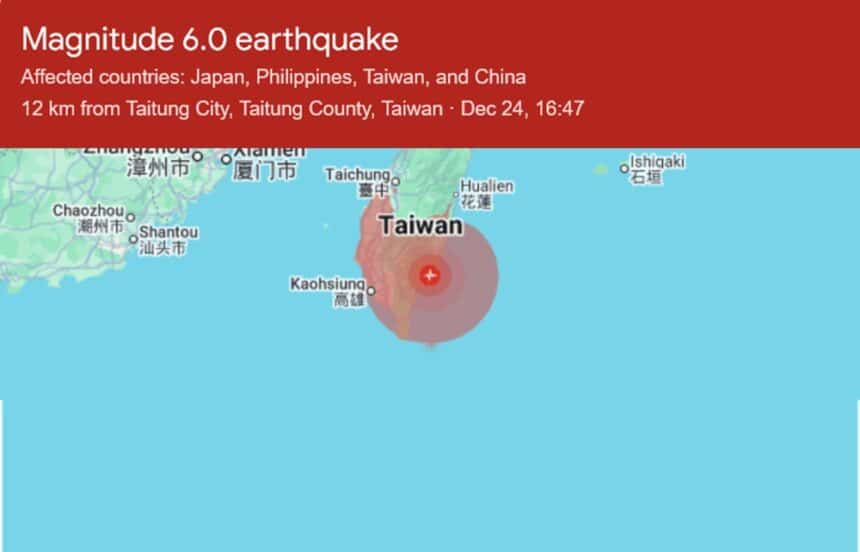
TAIPEI – A strong magnitude 6.1 earthquake struck Taiwan’s south-eastern coast in Taitung County on Wednesday evening. The shaking was felt across the island, with buildings moving even in Taipei. Early checks found no reports of serious damage or injuries, a sign of how used to earthquakes Taiwan has become.
Taiwan’s Central Weather Administration (CWA) said the quake hit at 5:47 pm local time. The epicentre was about 10.1 kilometres north of Taitung County Hall, and the quake was shallow at 11.9 kilometres deep. That shallow depth made the shaking feel stronger on the ground.
The highest intensity reported was level 5- on Taiwan’s 1 to 7 scale, recorded in Beinan Township. Parts of Taitung, Hualien, and Pingtung reached level 4. Lighter shaking, level 3 or below, spread to cities such as Kaohsiung, Tainan, and Taipei.
People in Taitung spoke of a sharp jolt that lasted around 30 to 40 seconds. Local TV showed supermarket shelves rattling hard, with bottles and tins falling to the floor. One widely shared clip from a store in Taitung showed shoppers crouching as goods smashed nearby. A resident in Beinan told local media it felt like the ground shifted underfoot, so they grabbed their child and headed outside.
In Taipei, more than 200 kilometres away, some tall buildings swayed. A number of office workers stepped out for a short time. Phone alerts sounded across the island, part of Taiwan’s earthquake warning system that gives people a brief head start.
No Major Damage, but Some Services Paused
As Christmas Eve evening went on, officials carried out early inspections and reported no major structural damage or casualties. The National Fire Agency said call-outs were limited and response teams stayed on standby.
Taiwan Semiconductor Manufacturing Company (TSMC) said the quake did not lead to factory evacuations, as it stayed below the level that would trigger a shutdown. Production continued as normal, easing worries for a sector that supports electronics supply chains worldwide.
Some rail services were interrupted while tracks were checked. Trains between Taitung and parts of the south were stopped for safety inspections, then many lines restarted later that evening. A few sections stayed suspended while checks continued. Power cuts were small and scattered, and officials did not report landslides or tsunami warnings despite the coastal location.
Authorities also warned that aftershocks could follow, including tremors of magnitude 5.5 or higher over the next week. Residents were urged to secure heavy furniture and keep basic emergency supplies ready.
Why Earthquakes Are Common in Taiwan
Taiwan lies where the Philippine Sea Plate meets the Eurasian Plate, along the Pacific Ring of Fire. The island records thousands of earthquakes each year, though most are too small to cause harm.
Wednesday’s quake also brought back memories of past disasters. The 1999 Chi-Chi earthquake, measured at 7.3, killed more than 2,000 people and led to tighter building rules and major updates to disaster planning. A 2016 quake in southern Taiwan killed more than 100. In April 2024, a magnitude 7.4 earthquake in Hualien caused serious damage, but the death toll was lower than in many places with weaker building standards.
Engineers and officials often point to long-term work on safer construction. Many newer buildings are built to cope with strong shaking, using designs that flex and systems such as base isolators. Public training is also common, with schoolchildren practising “drop, cover, and hold on”. The early warning network uses a dense spread of sensors, and it can help slow or stop trains while sending alerts to residents.
Reactions, Aftershocks, and Ongoing Checks
Online posts and local interviews showed a mix of nerves and calm. One Taipei resident wrote that people are used to earthquakes, but a 6.1 still feels serious, especially on Christmas Eve. In Taitung, some families stepped outside for a short time, then went back in once the shaking stopped. Holiday plans paused, then carried on.
CWA seismologists kept monitoring the area through Wednesday night. They noted that shallow quakes often hit harder nearby, but the energy can drop off quickly with distance. Several smaller aftershocks were recorded later, including one of around magnitude 4.
The earthquake was a clear reminder of how quickly the ground can move in Taiwan. It also showed how preparation, safer buildings, and fast alerts can keep disruption low when a strong quake hits.