





Midnight doesn’t arrive once, it comes as a moving wave. It starts in the far Pacific, then rolls through Asia, Africa, Europe, and finally the Americas. That’s why the “first places to celebrate” can feel like the opening scene of a long, shared night.
New Year celebrations around the world look joyful in one city, quiet in another, and in some places, they include a pause for remembrance alongside the countdown.
What follows is a photo-essay-style tour of New Year 2026, with practical context on time zones, traditions, security, costs, environmental trade-offs, and travel planning.
New Year 2026 in one moving wave: why time zones decide who celebrates first
Time zones exist because Earth turns. As the planet rotates, different places face the sun at different times. Midnight is just a line on the clock, but it lands in different countries in a clear order.
That order is why live TV and social media “chase midnight,” hopping east to west to keep the party going for hours.
A simple mini glossary helps:
- UTC (Coordinated Universal Time): The world’s reference clock. Many time zones are described as “UTC plus” or “UTC minus.”
- Local time: The time on the clocks where you are, set by the country or region.
- International Date Line: An imaginary line in the Pacific where the calendar date changes. Some islands close to it sit on time zones that push them into the New Year first.
For a quick view of the global order and why it takes so long, time zone trackers like timeanddate’s “first New Year” guide note that the world uses many local times and that it can take about 26 hours for the New Year to sweep across them.
Timeline: first to last, from the Pacific islands to the Americas
This is the rough “follow-the-clock” path for New Year 2026, focusing on order and what makes each stop recognizable.
- Kiritimati (Christmas Island), Kiribati: A well-known early marker for the New Year because of its far-ahead time zone in the Pacific.
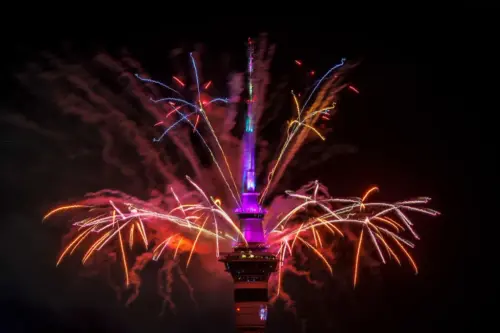
- New Zealand (Auckland): Large city countdown energy with skyline fireworks centered on the Sky Tower.
- Australia (Sydney): One of the most watched harbor celebrations, built for wide TV views and packed vantage points.
Then the wave runs through Asia, where the mix changes fast:
- Japan: Temple and shrine visits sit alongside city countdowns.
- China (major cities and Hong Kong-style harbor displays): Big crowds along the waterfront and tall buildings in the background.
- Thailand: Riverfront countdown scenes in Bangkok and tourist centers.
- India: Late dinners, concerts, and bright public spaces in major cities.
Next comes the Middle East and Africa:

- UAE (Dubai): Large-scale light and fireworks shows planned with heavy logistics.
- South Africa (Cape Town and other cities): Summer outdoor events that feel like an open-air festival.
Then Europe:
- France: Big-city gatherings and, in some coastal areas, traditional New Year sea dips.
- UK (London): A globally familiar riverfront midnight moment.
- Germany (Berlin-style public parties): Large public crowds in central areas, with regional variation.
- Denmark, Netherlands, Poland: Smaller city traditions and local customs that keep the night distinct.
Finally, the Americas:

- Brazil (Rio de Janeiro-style beach countdowns): Massive sand-and-sea celebrations in warm weather.
- United States (New York and beyond): The Times Square ball drop as a late, widely broadcast “final act” for many viewers.
For another skimmable world-order view, timeanddate’s rolling “first into 2026” list is often used by broadcasters and viewers tracking the wave.
What a “first midnight” feels like: remote beaches vs mega-city skylines
In the Pacific, “first midnight” can be quiet. Picture a dark shoreline, a few families, phone screens glowing, and the ocean doing most of the talking. There’s space to hear individual voices count down.
In a megacity, midnight is built like a stadium show. People pack transit lines, shuffle through checkpoints, and wait for a skyline cue. The sound hits in layers: speakers, cheers, then fireworks or a light show bouncing off towers.
Both scenes matter. A remote atoll can symbolize the start of the global calendar. A big city can turn New Year 2026 into a shared broadcast that pulls millions into the exact moment.
New Year celebrations around the world: standout traditions by region (with quick context)

This is the fast tour, written like snapshots. Each stop gets one or two traditions, plus one practical note about meaning or how people join in.
Oceania highlights: Kiritimati, Auckland, and Sydney’s bright sky and quiet tribute.
Kiritimati is often treated like a signpost for “the first New Year.” The celebration can be modest compared with global capitals, but the symbolism is big: the calendar flips here early, while much of the world is still in the prior day.
Auckland typically turns its tallest structure into the focal point. A widely cited example from New Year 2026 coverage described fireworks launched from the Sky Tower. It noted the tower’s height at 787 feet, with a report of 3,500 fireworks in one display, even as weather disrupted some local plans (CBS News photo coverage).
Sydney’s harbor show is designed for viewing from shorelines, boats, and broadcast cameras at a distance. Organizers describe the event as watched by hundreds of millions worldwide, with SydNYE calling it “enjoyed by more than 425 million people” worldwide (Sydney New Year’s Eve official site). Local reporting has also highlighted the physical scale, including a claim of 9 tonnes of fireworks prepared for the harbor (The Sydney Morning Herald).
Sydney’s New Year 2026 night also carried a respectful tone in parts of the program. International reporting described a more subdued celebration that included a memorial moment linked to the Bondi attack, with a pause and visible gestures of unity (NBC News). Cities can celebrate and still make room for grief.
For travelers, Sydney’s logistics often matter as much as the show. Government guidance around harbor management and major-event rules is regularly updated for the night (NSW Government event information).
Asia highlights: shrine bells in Japan, skyline countdowns in China, river fireworks in Thailand, and India’s city nights
Japan’s New Year traditions often lean quieter than a street party. Many people visit temples and shrines, and some communities mark the moment with bells and prayers. The point is reset and reflection, not just noise.
In parts of China, New Year’s Eve can look like a postcard of skyline light and waterfront crowd lines. In places with famous harbors, the view becomes the “stage,” even when celebrations vary widely by city rules.
Thailand often frames the night around riverfront views and large public countdowns in Bangkok. It’s also a good reminder that “New Year” isn’t a single cultural date. Thailand’s traditional New Year, Songkran, arrives in April, with its own rituals and local crafts. Northern Thai preparations, including ceremonial items used at temples, show how different the “new year” can be depending on the calendar and faith (Traditional Mai Kham Bo crafting for Thai New Year).
India’s big cities often blend private and public life on New Year’s Eve: family meals, concerts, hotel events, and well-lit public spaces. The details shift by region, religion, and city rules, so visitors usually plan around the specific neighborhood, not just the city name.
Middle East and Africa highlights: Dubai’s mega-displays and South Africa’s summer street energy
Dubai has built a reputation for large-scale countdown shows, sometimes combining fireworks, lighting, and coordinated timing across multiple sites. These nights require heavy planning, which is why crowd routing and transport rules can shape the experience as much as the visuals.
South Africa celebrates in summer, which changes the feel. Outdoor concerts and waterfront gatherings often stretch later because the weather supports it. That seasonal contrast is easy to forget when watching global clips back-to-back: Europe shivers in coats while parts of Africa and Australia celebrate in warm air.
Europe highlights: sea dips, city squares, and old traditions that still boom.
Europe’s New Year traditions often mix ancient customs with modern crowd scenes.
France’s New Year can be big-city centered, but coastal dips are also part of the folklore in some towns. Cap d’Agde is often cited in popular travel chatter for its sea-dip tradition, with participation norms ranging from bundled-up swimmers to unclothed plunges, depending on local culture and rules.
Denmark’s Copenhagen has a winter “Nytaarsbad” cold-plunge vibe in some communities, a brisk tradition that treats the sea like a reset button.
The Netherlands has a louder rural tradition in places like Ommen: carbide shooting, where milk cans are used like small cannons. It’s a reminder that not all New Year noise comes from New Year fireworks.
Poland offers a different angle with New Year runs in some cities, including costume fun. Krakow is one commonly mentioned example in regional roundups, where athletic tradition replaces the midnight-only focus.
Mainstream city scenes still dominate the global feed. London’s riverfront moment is a familiar late-night image, and Germany’s largest public parties tend to cluster in major city centers, with local rules shaping what’s allowed.
Americas highlights: Brazil’s beach countdowns and the US midnight icons
Brazil’s coastal celebrations can feel like a giant outdoor living room. Rio’s beach setting is often treated as a symbol of South American New Year energy: music, long walks on the sand, and fireworks over water. In many places, people wear white as a sign of peace or good luck, though customs vary by region and community.
In the United States, Times Square remains the best-known “late-night” marker for global viewers. By the time New York hits midnight, much of the world has already posted sunrise photos. That timing is why the Americas often play like the closing scene of New Year 2026.
For viewers following from home, long livestreams that run across time zones have become common, including all-night compilations that track city after city (around-the-world countdown streams).
What changed this year: more drone shows, tighter security, and more family-friendly plans
Across New Year 2026 planning, three trends stand out in many cities:
- More drones and projection mapping as alternatives or add-ons to fireworks.
- Tighter security perimeters around signature viewing areas.
- More early-evening programming so families can attend without waiting for midnight.
Not every city made the same choices, and many still center the night on fireworks. But the direction is clear: public events keep adapting to safety risk, cost pressure, and air quality concerns.
Fireworks vs drone shows New Year: why some cities are switching

Drone shows New Year programs can reduce smoke and fire risk. They also allow precise shapes and logos that read well on camera. Projection mapping can turn a building into a moving canvas without launching anything into the sky.
There are tradeoffs:
- Drones can be limited by wind and rain.
- Large fleets can cost more than people expect.
- Fireworks still deliver the sound and shockwave people associate with tradition.
That’s why many places choose a hybrid: fireworks for the emotional punch, drones or lighting for cleaner visuals and tighter control.
Security and crowd control: how big nights are planned to avoid chaos
New Year crowd management looks similar across continents because the risks are similar: congestion, crushing, confusion at exits, and delayed emergency response.
Common planning steps include:
- Timed entry and fenced zones for key viewing areas
- Bag checks and restrictions on glass, fireworks, or alcohol
- Clear emergency lanes that stay open even when crowds surge
- Transit crowd management, including extra staff, closed stations, or one-way flows
- Visible policing and medical teams to speed response
Memorial moments add another layer. Cities have to keep crowds calm and respectful during pauses, then restart the celebration without bottlenecks.
The price of midnight: tourism wins, local business boosts, and the environmental bill
A signature New Year’s show is not just a party. It’s a marketing tool, a test of city services, and a major economic night for hospitality.
But it also creates waste, noise, and cleanup costs. The question many cities face is simple: how to keep the benefits while cutting the harm.
Economics: why cities fund big shows (and who benefits)
Cities back New Year events for reasons that go beyond ticket sales.
Tourism and branding are key. A skyline clip can travel worldwide in minutes, and that attention can shape future travel choices. For cities with strong broadcast reach, the global audience becomes part of the value, as Sydney’s organizers emphasize with international viewing claims (SydNYE).
There’s also local impact:
- Hotels often see peak demand.
- Restaurants, bars, and street vendors get a high-volume night.
- Transit agencies collect fares and justify extended service.
Costs can be controversial. Overtime staffing, security, traffic control, and cleanup compete with other city needs. Public debate often increases after any safety incident or budget crunch.
A useful comparison point comes from a different New Year season entirely. Thailand’s Songkran (traditional Thai New Year) has grown into a major tourism and spending period, with large, family-friendly zones and big visitor projections in Bangkok events (ICONSIAM festival details). It shows how “New Year traditions” can become long-running tourism engines, even when the date is not December 31.
Environment and travel tips: cleaner choices, more thoughtful planning, safer nights
Fireworks can leave smoke, debris, and noise that lingers into the early hours. Waterfront areas also face litter problems fast because crowds are dense and bins fill early. That’s part of why some places limit personal fireworks and encourage spectators to attend controlled public shows.
Practical New Year travel tips that hold up in most cities:
- Arrive early and treat transit delays as usual.
- Use public transit when possible; parking can be a dead end.
- Pick a clear meeting point in case phones can’t load messages.
- Carry water and a backup charger; crowds drain both.
- Dress for the real weather, not the photo on the website.
- Follow posted rules on bags, bottles, and viewing zones.
- Know the most straightforward exit route before midnight.
For staying home, following the global “midnight wave” has never been easier. Time zone trackers and rolling lists make it easy to align the order and jump between livestreams (time zone order tools).
Conclusion
New Year 2026 moved across the planet like a spotlight, landing first on Pacific islands and ending hours later in the Americas. The scenes looked different, from quiet shorelines to packed city centers, but the core ritual stayed the same: people marking time together. Some cities also made space for remembrance, proving celebration and respect can share the same clock. The next New Year will bring new weather, new rules, and new tech, but the wave of midnight will still arrive right on time.
- Time zones shape the whole story, and the New Year “wave” can take about a day to complete.
- The first celebrations often begin in Kiribati, then roll through Oceania, Asia, Europe, and the Americas.
- New Year traditions can be spiritual, playful, athletic, or community-based, depending on place and culture.
- Cities keep adjusting with drone shows New Year add-ons, stricter security, and more family-friendly timing.
- Good planning matters: transit, meeting points, and rules make or break a safe night.


