





CARACAS, Venezuela – A sharp new turn in the long-running clash between the United States and Venezuela unfolded early Saturday, after President Donald Trump said US forces had taken Venezuelan President Nicolás Maduro into custody, along with his wife, Cilia Flores. Trump described the action as a “large scale strike” focused on Caracas and nearby areas, carried out with support from US law enforcement.
Reports of explosions and aircraft over the Venezuelan capital spread quickly, fueling confusion on the ground and drawing immediate reaction abroad. If confirmed in full, the operation would rank among the boldest US military actions in Latin America in decades.
Trump posted the claim on Truth Social in the early hours, writing: “The United States of America has successfully carried out a large scale strike against Venezuela and its leader, President Nicolas Maduro, who has been, along with his wife, captured and flown out of the country.”
The message appeared soon after the first reports of strikes around 2:00 a.m. local time. Within minutes, governments and officials across the world were trying to make sense of what looked like an attempt to remove a sitting leader.

Explosions and confusion in Caracas Venezuela
People in Caracas said they were woken by loud blasts and the sound of low-flying aircraft. Witnesses described at least seven explosions across the capital and nearby areas, with several reports pointing to military-related locations, including Fuerte Tiuna and La Carlota.
One resident told CNN the “sky turned red” during the blasts. Video shared online showed fires near an airport in Higuerote and plumes of smoke rising from different parts of the city. Dual-rotor helicopters were also seen overhead, and vehicles were filmed leaving areas close to key military sites.
CBS News said the strikes hit Venezuelan military targets as part of the Trump administration’s campaign against Maduro’s government. Venezuela’s defense minister condemned the action as attacks on urban zones and promised resistance against what he called an “invasion”. The government announced emergency measures, while some areas reported power cuts and parts of the capital fell quiet after the first wave of strikes.
BBC News described a sudden start to the assault, with a correspondent noting loud bangs and aircraft activity from about 02:00 local time. Several reports also claimed US forces had been building up in the Caribbean for months. The Federal Aviation Administration (FAA) barred US aircraft from Venezuelan airspace as events unfolded, adding to the sense of a major operation under way.
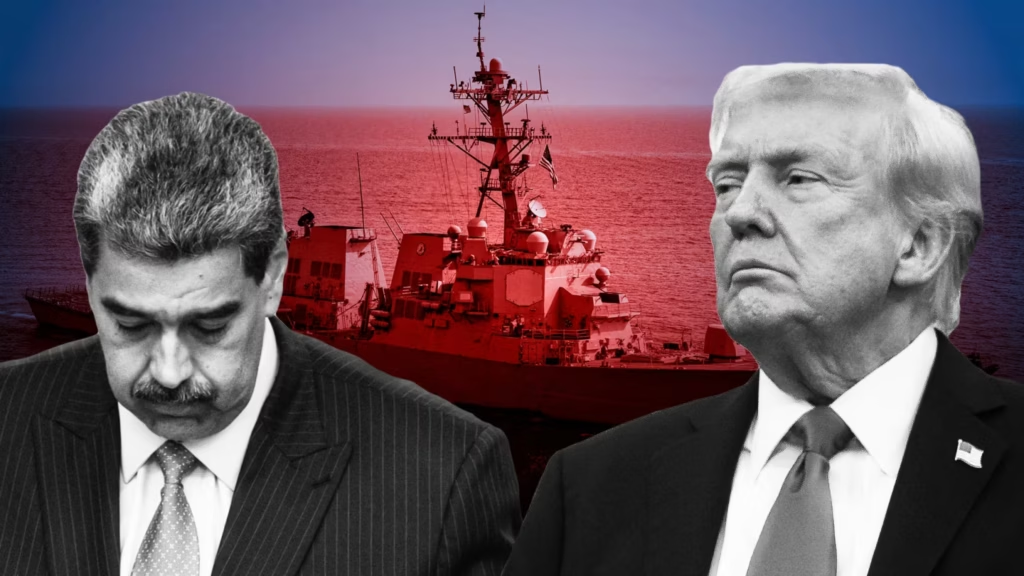
Trump’s claim and early official statements
Trump’s post acted as the first public signal that Maduro had been detained. He framed it as a win against a leader the US has long labelled a dictator and accused of serious crimes.
Maduro was indicted in 2020 in the United States on narco-terrorism charges. Washington has also accused him of human rights abuses and of undermining democratic rule. Over several years, US policy has included sanctions, diplomatic pressure, and military signalling aimed at weakening his grip on power.
Secretary of State Marco Rubio added more detail in comments relayed to US Senator Mike Lee, saying Maduro had been arrested by US personnel and would face trial in the United States. Rubio said force was used to protect those carrying out the arrest warrant.
On the Venezuelan side, a vice president said the government did not know Maduro’s location, a remark that added to speculation about how far the operation had succeeded. A Venezuelan official also claimed the US mission only met its goals “partially”.
Reuters reported that overnight strikes were followed by Maduro’s capture, after months of rising US pressure linked to alleged drug-running. The New York Times also reported that Maduro and his wife were being flown out of the country, presenting the moment as the peak of a long effort to remove him.

Global reaction and diplomatic shockwaves
International response was swift and tense. Russia, one of Maduro’s key backers, said it stood with Venezuela and called the US action an “act of armed aggression”, urging talks instead. Iran condemned the attack. Cuba and Colombia raised alarm, and Colombia’s president called for an urgent United Nations meeting. Venezuela requested an emergency session of the UN Security Council.
In the United States, reaction split along political lines. The Senate Armed Services Committee said it had not been notified ahead of the strikes, raising concerns about oversight. Democratic Senator Brian Schatz warned that the US has “no vital national interests” in Venezuela, signalling a fight at home over the legal and political basis for the action. Venezuelan opposition figures largely avoided public comment as events moved quickly.
The Telegraph described aircraft flying low over Caracas amid explosions, matching footage and accounts shared overnight. CNN live coverage portrayed a city under strain, with reports of blasts near ports and military facilities and helicopters dominating the skyline. The network called it Trump’s most aggressive foreign military action, with the potential to reshape US relations across Latin America.
How tensions reached this point
The reported raid followed months of harder US policy towards Maduro. During that period, the Trump administration designated Maduro’s government a terrorist regime, tightened sanctions on oil-linked business, and carried out strikes in the Caribbean linked to alleged drug trafficking. The detention of Americans in Venezuela was also seen by US officials as part of the pressure campaign, as Washington increased its military posture nearby.
Just days earlier, Maduro had signalled interest in talks on drug trafficking and oil. That did not stop Washington from pushing forward with what it described as maximum pressure.
Venezuela holds the world’s largest oil reserves, but it has faced years of economic crisis under Maduro. The dispute over his leadership deepened after the contested 2018 re-election. In 2019, the US recognised opposition leader Juan Guaidó as interim president, while Maduro stayed in control with support from Russia, China, and Iran. Trump’s return to office in 2025 revived tougher measures, including a $50 million reward linked to Maduro.
What happens next
With Maduro reportedly being taken to the US to face trial, Venezuela’s next steps remain unclear. The Pentagon has directed queries to the White House, while Trump has promised an 11 a.m. ET press briefing with more details.
Analysts have warned of blowback, including responses from Maduro’s allies and a possible rise in migration pressures. The move could also boost Trump’s image among supporters who favour decisive action abroad, while increasing the risk of a longer conflict.
The Guardian reported similar claims, including Trump’s statement that Maduro was captured after blasts in Caracas and in states such as Miranda, La Guaira, and Aragua. NBC News and Euronews also echoed reports that Maduro had been removed amid US strikes.