



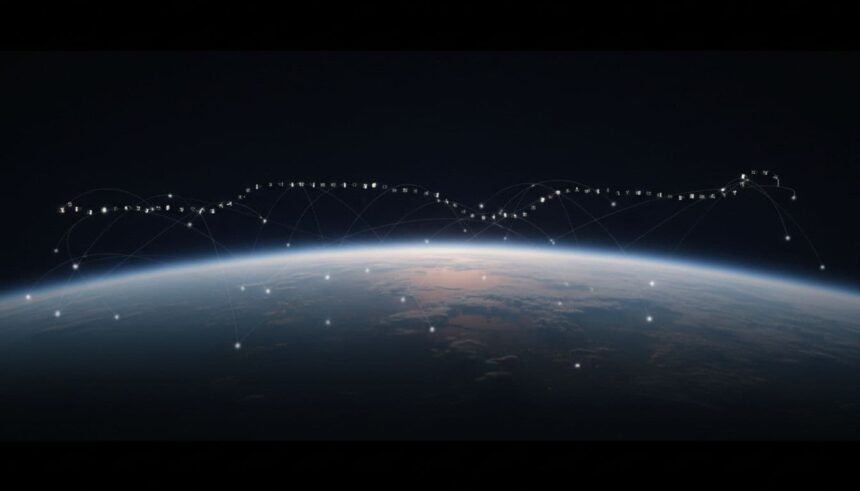
A new filing has put an eye-popping number on the table: SpaceX plans to deploy 1 million satellites. As reported by the BBC, the company has applied to the US Federal Communications Commission (FCC) for permission tied to a space-based computing network, a concept described as “orbital data centres” aimed at rising AI demand.
This is a request, not an approved plan, and no timeline has been given in the reporting. The details matter because this sits at the intersection of spectrum rules, space safety, and what remains visible in the night sky. This explainer covers what was filed, what “orbital data centre” means, why it’s being proposed, the biggest concerns, and what happens next.
What SpaceX filed with the FCC, and what we know so far

Photo by SpaceX
An FCC application is not a launch permit. It’s primarily about communications authority: permission to use the radio spectrum, coordinate with other satellite systems, and operate a satellite network in accordance with specific technical rules. It’s the paperwork that determines whether a satellite system is permitted to transmit, where, and under what conditions.
In this case, the filing is described (in reporting about the application) as seeking authorization for up to one million solar-powered satellites in low Earth orbit (roughly 500 to 2,000 km). The satellites are framed as “orbital data centres,” intended to provide computing capacity for very large numbers of users, rather than just passing internet traffic.
What’s confirmed from public reporting is the existence of the application and the headline scale. Many specifics remain unclear, including the final satellite design, the amount of computing power each spacecraft would carry, and the system’s staging. For context, Starlink already operates at a scale that would have sounded unreal a decade ago. Public tracking databases indicate approximately 10,000 active Starlink satellites as of late January 2026, and this proposal would be far larger.
A separate tech report on the same news also summarizes the filing’s broad strokes, including proposed altitudes and the “orbital data center” framing, in PCMag’s report on the filing.
Quick definitions box (FCC, constellation, orbital data centre, AI inference)
- FCC: A US agency that regulates communications, including licensing and spectrum rules for satellites.
- Satellite constellation: A large group of satellites that work together as one network.
- Orbital data centre: Computers in orbit that process and store data, instead of doing all computing on Earth.
- AI inference: When an AI model uses what it learned to answer questions or make predictions.
What’s new vs Starlink internet satellites
Starlink is mainly about connectivity, getting data from one point to another. The new idea described in the reporting is different: placing data processing in orbit, so some computing occurs before results are sent back down.
That shift matters because it changes what the satellites are for and what they might need: more onboard power, a different thermal design, and new traffic patterns up and down from Earth. It also changes the public debate, since Starlink expansion plans are already controversial in astronomy and space safety circles, even before adding a large computing layer.
Some claims remain difficult to evaluate from the outside. The filing reportedly disputes the claim that the company is “crowding space,” but regulators and researchers must still assess congestion, collision-avoidance plans, and spectrum sharing.
Orbital data centres explained in everyday terms
A normal data center is like a warehouse packed with computers, fans, and wiring. An orbital data center is like splitting that warehouse into thousands of small computer rooms, placing each one on a satellite, and connecting them with high-speed links.
At a high level, the pitch is simple: satellites receive steady solar power, exchange data with one another, run computing jobs in orbit, and then send results back to Earth. The hard part is everything hidden behind that sentence, including cooling electronics in a vacuum, keeping radios from interfering with other systems, and building spacecraft that can compute reliably for years.
This is the one place where it helps to name the concept directly: the reported proposal reads like a SpaceX orbital data center network, except spread across many satellites rather than a single platform.
Why companies are even considering computing in orbit
The driver is in demand. AI workloads continue to grow, and large data centers on Earth require a massive electricity supply and robust cooling infrastructure. Many also rely on water or complex mechanical systems to move heat away from servers.
Space changes that equation, at least on paper. Solar power is abundant in orbit, and the vacuum changes the cooling design constraints (it doesn’t make cooling easy; it makes it different). The company argues in its filing, as reported, that orbital computing could be energy and cost-efficient at scale.
Skeptics point to fundamentals that don’t go away: rockets still cost money, launches still emit, and space hardware must withstand radiation and extreme temperature swings. Even if the economics work for some tasks, they might not be a fit for all computing workloads.
The hard engineering problems, power, cooling, and repairs
A fleet of compute-intensive satellites would need to address challenges that regular communications satellites sometimes avoid.
The key hurdles include payload mass, radiation effects on chips, thermal control to prevent component overheating, and a plan for failures when repairs aren’t practical. End-of-life disposal also matters, as every satellite requires a controlled deorbit or a verified re-entry path.
Re-entry and heat are already central concerns for spacecraft design. A separate explainer on materials highlights how complex that side of the equation can be, including SpaceX Starship heat-shield tile advancements, even though satellites and rockets face different re-entry conditions.
On top of engineering, none of this works without reliable spectrum access and strict interference controls. Computing in orbit still depends on fast, clean communications links.
Why SpaceX wants AI computing in space, and who it could help
The filing’s basic motivation, as reported, is that demand for AI computing could outgrow what can be supplied from the ground alone. Putting some computing in orbit may also reduce certain “backhaul” steps, especially for data that already originates in space systems or travels through satellite networks.
This doesn’t mean most AI suddenly runs in orbit. It suggests a new layer that could handle selected workloads, potentially including AI compute in space for latency-sensitive tasks or distributed services where global coverage is critical.
Practical impact depends on what gets built, and what gets approved. For everyday users, the difference might show up as faster responses in remote regions or more consistent performance when networks are congested. For businesses, it could mean new global services options that don’t rely on a few large data centers. For governments, it could provide redundancy during disasters while raising security and oversight concerns. For AI developers, it might add compute supply, but only if cost, reliability, and data transfer limits pencil out.
The company already supports high-profile crewed missions. Readers who want a reminder of its operational footprint can see how its spacecraft are used in NASA astronauts return to Earth aboard SpaceX Crew Dragon.
Possible benefits supporters point to (latency, scale, resilience)
Supporters typically cite three potential advantages.
Lower latency is one, but it depends on routing. If processing occurs closer to where data enters the network, results could return faster for some users. Scale is another. A distributed system could increase capacity by deploying satellites, provided spectrum and safety regulations permit. Resilience is the third: a distributed network is less vulnerable to a single ground facility outage.
The filing language reported by outlets says the system could serve “billions of users globally.” That’s a claim, not a proven outcome. It would still require practical constraints to line up: radios, ground stations, power budgets, and reliable operations over long periods.
The big vision claim, Kardashev Type II, in plain language
The filing reportedly nods to big energy ideas, including language linked to the Kardashev scale. In simple terms, a “Type II” civilization is often described as one that can use a very large share of the Sun’s energy, usually imagined as a giant swarm of collectors in space.
This context can help explain why the proposal talks about large numbers and solar power. Still, it’s not a plan for a science-fiction megastructure. It’s a regulatory request that would be evaluated based on spectrum compatibility, orbital safety, and whether operating conditions can mitigate harm to other space users.
Key concerns critics raise: debris, collisions, and impacts on astronomy
A proposal at this scale instantly raises questions about safety and the night sky. Even today, low Earth orbit is crowded with active satellites, spent rocket bodies, and debris fragments. Expanding to a satellite mega-constellation focused on computing would increase the number of objects that require tracking, coordination, and end-of-life disposal.
Here’s a straight look at tradeoffs discussed by supporters and critics.
| Potential upside | Main concern |
|---|---|
| More computing capacity in orbit | Higher collision probability without strong coordination |
| Claimed energy efficiency using solar power | More objects that must deorbit safely |
| Distributed service for global users | Heavier space traffic management burden |
| Redundancy if ground sites fail | Spectrum conflicts and interference risks |
| New platform for AI workloads | Night-sky and radio astronomy impacts |
Orbital debris risk and space traffic management at a million-satellite scale
Collision avoidance is like air traffic control, except the “planes” move at orbital speeds and can’t just land. Satellites must know where other objects will be, predict close passes, and adjust course when needed. That’s already hard with tens of thousands of trackable objects.
At a million-satellite proposal scale, orbital debris risk shifts from a single operator to shared rules, data quality, and enforcement. Each satellite would need a reliable deorbit plan, plus a clear process for failures. If a spacecraft loses control, it can pose a hazard to other spacecraft until it re-enters.
For background on why debris is treated as a long-term safety issue, NASA provides a public overview on the Orbital Debris Program Office website.
Why astronomers worry about light and radio interference
Astronomy-related concerns often fall into two categories. The first is visible brightness. Reflective satellites can leave streaks in telescope images, and large numbers increase the likelihood that long exposures will be interrupted. Operators can try measures such as darker coatings or sunshades, but those trade-offs can affect thermal performance.
The second is radio noise. Satellite systems use the radio spectrum, and even within legal limits, emissions can disrupt sensitive radio telescope operations if coordination is weak. The BBC reported in 2024 that astronomers said some Starlink signals were “blinding” parts of their observations. With more satellites, the same issue could intensify without stricter safeguards.
That’s why astronomy light pollution satellites are now a real phrase in policy discussions, not just an astronomer’s complaint.
What happens next with the FCC, and what to watch for
An FCC review usually starts with the agency accepting a submission for filing, then issuing public notices and opening a comment period. Engineers assess interference risks, whether the system can share spectrum, and whether technical claims meet FCC rules. Public interest groups, competitors, and researchers can file objections or support.
The process is not quick, and it isn’t guaranteed. This kind of FCC satellite application can be approved, approved with conditions, narrowed, or denied. Conditions often cover spectrum use, reporting, and operational constraints.
One relevant example of how the FCC seeks comment and sets deadlines appears in an FCC public notice, DA 25-1018 (released December 2025). Another example of FCC conditions on satellite authority appears in DA 24-222 (March 2024 order and authorization). These documents don’t confirm the details of the new filing, but they show the types of scrutiny and conditions that may apply.
For readers seeking a specific proceeding, the most direct starting point is the FCC’s search tools, including the FCC ECFS search page. (Readers may also need the FCC’s ICFS system for satellite filings, depending on how the proceeding is posted.)
Signals to watch as this moves forward:
- A posted proceeding number or file number that allows consistent tracking
- Amendments that clarify satellite counts, altitudes, or spectrum bands
- Formal comments from astronomy groups or space sustainability researchers
- Any FCC conditions tied to deorbit reliability and collision avoidance reporting
Key takeaways you can remember in 30 seconds
- This is an FCC application, not an approved buildout.
- The reported scale, up to one million satellites, would be unprecedented.
- The concept is orbital computing capacity aimed at AI demand.
- Supporters cite scale and resilience, critics focus on safety and the night sky.
- The next steps run through FCC notices, comments, and technical review, with no fixed timeline.
Sources
- BBC report on the FCC application
- FCC ECFS public search (search the FCC database for the specific proceeding)
- NASA Orbital Debris Program Office
- FCC Public Notice DA 25-1018 PDF
Conclusion
The filing, as reported, asks regulators to consider a satellite network on a scale that would change low Earth orbit for decades. Whether it becomes reality will hinge on spectrum sharing, enforceable safety rules, and how well the impacts on science can be reduced. The most useful next step is tracking the FCC record and public comments as they appear. For now, the core point is simple: approval isn’t assumed, and the debate will be technical as much as it is political.