



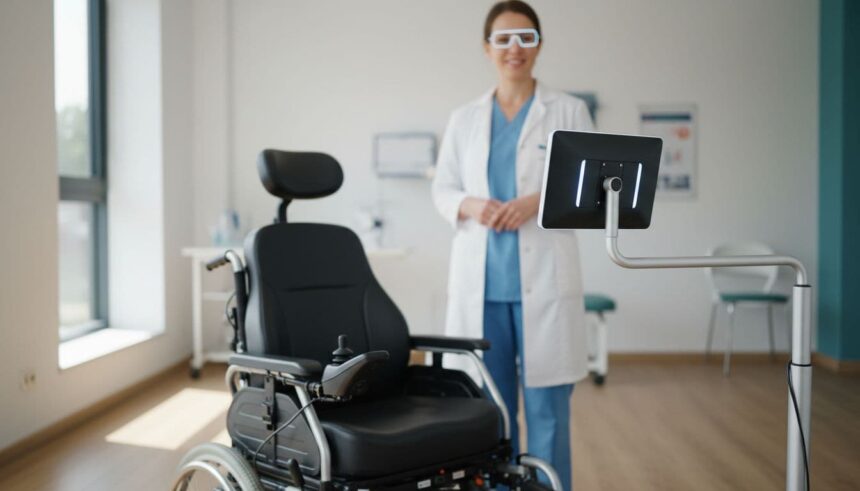
Imagine controlling a wheelchair with your eyes, without a heavy headset, a charging cable, or a dead battery at the worst time. That is the idea behind a self-powered eye-tracking system that turns blinking and eye motion into electrical signals.
Early reports link the work to assistive use cases for people living with ALS (amyotrophic lateral sclerosis) who can still move their eyes and may depend on eye-based tools to communicate or navigate daily life.
The promise is simple: hands-free control with fewer hardware hassles. Still, this remains early-stage research, not a product you can order today. The next steps are careful safety checks, comfort testing, and real-world trials that reflect daily conditions.
What the researchers built, and why it matters in daily life
News coverage describes a team led by Long Yunze at Qingdao University, whose findings were published in Cell Reports Physical Science (Cell Press). In plain terms, the design aims to make eye tracking feel closer to everyday wear.
Instead of a single bulky unit, the reported prototype uses a dual-layer wearable:
- A soft, contact lens-like layer that sits on the eye surface
- Eyeglass frames that hold sensors and electronics close to the eye
The headline feature is power. Many assistive setups already require daily maintenance. Charging routines, cable management, and battery anxiety can pose barriers, particularly for individuals who rely on caregivers for setup. A design that can generate its own power for sensing could reduce those friction points.
It also helps to separate what different sources are doing. Media stories often focus on the most relatable use case, such as wheelchair control. A peer-reviewed paper focuses on how the device was built, how signals were captured, and how performance was measured in test conditions. For assistive technology decisions, that difference matters.
Common pain points in many current eye-tracking setups include:
- Power dependence: a low battery can stop communication or control mid-task
- Cables and connectors: extra parts can snag, break, or complicate mounting
- Bulk and weight: Head-mounted or screen-mounted gear can feel tiring over long sessions
How this differs from today’s camera-based eye trackers
Most eye trackers used in clinics and consumer tech rely on cameras (often infrared) that watch pupil and corneal reflections. These systems have been proven and can be highly accurate. They also typically require stable power and careful positioning for optimal results.
A key contrast in this reported approach is sensing. Instead of visually tracking the eye with a camera, the prototype aims to detect electrical signals created by eyelid and eye-surface motion. That is why coverage characterizes it as a battery-free, self-sustaining concept on the sensing side.
Both approaches have tradeoffs. Camera-based trackers can struggle with glare, lighting changes, or repositioning. A motion-and-charge approach may avoid some lighting issues, but it raises new questions about comfort, fit, long-wear safety, and signal stability across different users.
For a general summary of the same research, you can also review: Researchers Develop Self-Powered Eye-Tracking System.
How blinking can generate electricity (explained simply)
The core idea is familiar, even if the engineering is complex. Friction can build tiny electrical charges. It is the same basic reason static electricity can build up after shuffling on the carpet. Blinking is a constant motion, so a wearable can repeatedly harvest small charge changes.
In summaries of this prototype, the contact lens-like layer is described as made of a soft material (often abbreviated as PDMS in technical coverage). As the eyelid moves over it during blinking or eye movement, charge can accumulate and redistribute. The eyeglass frame then helps detect these changes and convert them into signals that electronic devices can interpret.
You may see the term triboelectric generator used here. In plain language, it means a surface that can create small electrical signals from rubbing and motion. The goal is not to generate large amounts of power. It is intended to generate sufficient signal and energy for tracking and communication to operate without a traditional battery.
Some reports refer to it as a “mini power plant.” That metaphor can be helpful, but it can also sound overstated. A more accurate mental model is a steady stream of tiny electrical changes that can be measured and translated into commands.
For related eye-tracking lens research (not the same device), see: Frequency-encoded eye tracking smart contact lens.
From tiny signals to real commands like left, right, and stop
To turn eye motion into control, a system typically follows steps like these:
- The user blinks or moves their eyes in a deliberate pattern.
- The wearable generates and detects charge changes linked to that motion.
- Electronics filter noise and identify patterns tied to direction or intent.
- Software maps the pattern to commands that a device can understand.
Real-time conversion matters. A control system must respond quickly enough to be usable, but it must also avoid accidental triggers. That is why calibration is critical. Most eye-control systems require a brief setup to learn a person’s baseline signals and distinguish intentional gaze shifts from normal blinking.
Technical summaries also mention transparent electrode materials such as indium tin oxide (ITO). The practical point is simple: a sensor can conduct electricity while remaining transparent, which is important when components are located near the field of view.
For wheelchair control, safety is not optional. “Stop” must be reliable and fast. Any real product would also require fail-safes to prevent the chair from moving if signals drop or the system loses confidence.
What this could mean for ALS assistive technology, and what is still unknown
For people living with ALS, the goal is often not flashy technology. It is a reliable tools that protect energy, time, and dignity. If a self-powered eye-tracking system can reduce charging routines and cable management, it could help in small but meaningful ways.
Potential benefits, if the concept holds up in real-world testing, include:
- More independence for basic tasks (moving, calling for help, navigating a room)
- Less caregiver time spent on charging and troubleshooting
- Fewer interruptions from low batteries or loose connectors
It is important to keep the line clear between “could” and “does.” A prototype may show promising accuracy in controlled tests. Daily life introduces complex variables such as dry eyes, skin oils, dust, vibration, head motion, and prolonged wear time.
Key unknowns that still need strong answers before real use:
- Comfort after hours of wear, including dryness and irritation
- Hygiene and infection-control routines for a lens-like component
- Durability, including scratches and material breakdown
- Accuracy across different users, eyelids, and blink patterns
- Cost, repairability, and replacement schedules
- Training time and user fatigue during calibration
Anyone choosing assistive devices should discuss available options with clinicians and rehab teams. Research prototypes do not replace today’s tools.
Example of an existing commercial eye-control product (with its own power and mounting needs): Ability Drive eye tracking control system.
Reality check: what must happen before this leaves the lab
Transitioning from a lab demonstration to a daily assistive device requires time. Reports mention engagement with companies. That usually means early work on manufacturing, supply chains, and practical design. It does not mean a finished device is close.
Before any wider rollout, researchers typically need broader user testing, clear safety protocols, and repeatable performance in settings that match real life, not just controlled experiments.
What needs to happen next (testing, safety, and support)
A research prototype can demonstrate a concept, but a real eye-movement control device requires reliability comparable to that of a seatbelt. It must function when the user is tired, when lighting changes, when the wheelchair encounters bumps, and when cleaning is not perfect.
Key steps usually include:
- Safety and comfort studies: long-wear tests for irritation, dryness, and fit problems, plus safe handling guidance.
- Reliability testing: performance over weeks and months, not only short demos, including vibration, dust, and daily handling.
- Wheelchair integration and fail-safes: auto-stop behavior, caregiver override, and safe “neutral” states when signals are uncertain.
- Regulatory pathway: requirements depend on how the device is marketed and used, but medical use needs strong quality controls.
- Service and training: fitting, repairs, and user training must be realistic for families and clinics.
Potential future uses beyond wheelchairs
Wheelchair control gets attention because it is easy to picture. The same approach could also support assistive communication technology, in which eye movements select letters, icons, or preset phrases. If the hardware becomes lighter and simpler to maintain, it could reduce daily setup time for communication.
Some reporting also mentions VR and hands-free interfaces. That use case has different demands, including low latency and comfort during head motion. It also must avoid eye strain during prolonged sessions.
A consumer-facing summary focused on VR possibilities is available here: This eye tracker for hands-free VR doesn’t need batteries. This is not clinical evidence, but it illustrates why designers pay attention when eye tracking becomes smaller and more power-efficient.
FAQ: common questions about blink-powered eye control
How does a self-powered eye-tracking system work?
At a high level, blinking and eye motion create small electrical changes through friction. Sensors in the glasses detect patterns, and software maps them to commands. This reflects research descriptions and summaries, not product specs.
Can blinking really power a wheelchair?
No. The wheelchair still uses its own battery for motors. The idea is that blinking helps power the tracker’s sensing and signal output, reducing dependence on a separate battery for the eye-tracking unit.
Could this help ALS patients control a wheelchair?
That is one use case highlighted in coverage. Eye movements could map to commands like forward, turn, and stop. Any real-world system would need strong safety layers and a caregiver override.
Is the technology available to buy yet?
As of early 2026, reports indicate that it remains in the research stage. No general consumer release has been announced in the sources linked here.
What testing is needed before medical use?
Longer comfort tests, eye health checks, cleaning and infection-control protocols, accuracy testing across many users, and trials in real settings. Regulatory steps depend on the location and mode of use of the device.
What are the risks of a contact lens-like component?
Potential issues include irritation, dryness, fit problems, hygiene concerns, and sensitivity. That is why careful testing and clear safe-use instructions would be required before use outside research settings.
Sources and further reading
- Global Times: Self-powered eye-tracking system for ALS wheelchair control
- SciMex: Driving a wheelchair through the power of blinking
- Peer-reviewed background: eye-controlled wheelchairs and ALS
- Eureka Magazine: Researchers develop self-powered eye-tracking system
Conclusion
This research prototype aims to capture eye movements using a light, wearable device that can operate without a battery. If it holds up in larger studies, battery-free sensing could reduce downtime and day-to-day hassle for people who rely on eye control. The next phase should focus on comfort, safety, and reliability rather than on marketing claims. The most important takeaway is to follow the evidence as it emerges and discuss current assistive options with a rehabilitation team.
SEE ALSO: Galaxy S26 Ultra Release Date Report: When Preorders Start and When It Ships