




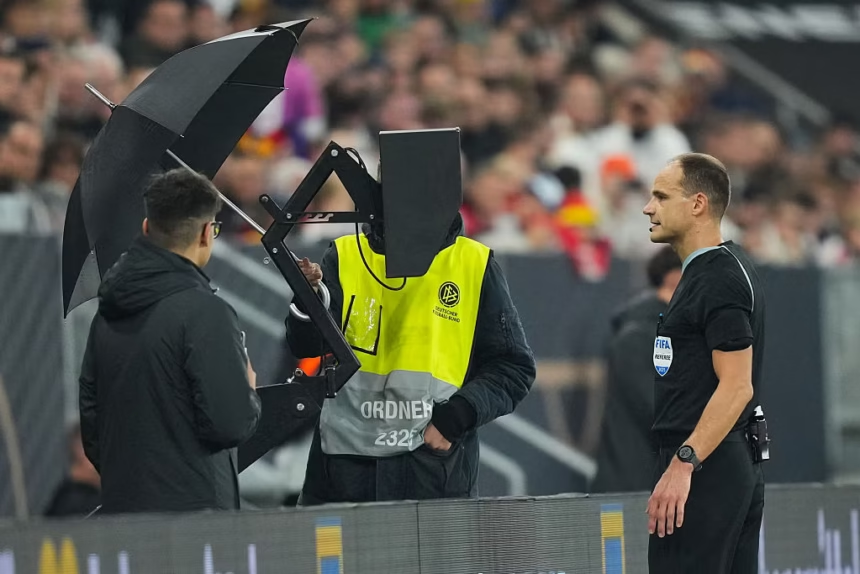
Video assistant referees are now part of modern football. Fans are used to seeing the screen, the wait, and the final decision. Now FIFA wants to go a step further and use VAR to check corner kicks at the 2026 World Cup in North America.
- What Is VAR and How Does FIFA Use It Today?
- Simple explainer: What VAR does and when it can step in
- Why FIFA Wants VAR Checks On Corners At The 2026 World Cup
- Corners change games: the problem FIFA is trying to fix
- Inside the new plan: how VAR reviews for corners would actually work
- Why IFAB and domestic leagues are worried about corner checks
- Pierluigi Collina and the push for fewer “easy to fix” mistakes
- Will VAR On Corners Make Football Fairer Or Slower?
- The big trade off: accuracy, time, and the fan experience
- What comes next before the 2026 World Cup and beyond
- Conclusion
The idea sounds simple. Corners create many chances and goals, so a wrong decision about who touched the ball last can shape a match. At the same time, many supporters, players, and leagues are tired of long delays and confusing checks.
The International Football Association Board (IFAB), which writes the Laws of the Game, is still weighing the proposal. FIFA is ready to ask for a special trial only for the World Cup, even though leading domestic leagues have rejected the same plan. The next few months will decide how far technology will go at football’s biggest event.
What Is VAR and How Does FIFA Use It Today?

Simple explainer: What VAR does and when it can step in

Simple explainer: What VAR does and when it can step in
VAR is a video assistant referee who sits in a booth and watches the match on many camera feeds. This team can talk to the referee on the field through a headset.
Right now, VAR can only step in for four types of decisions:
- Goals
- Penalties
- Direct red cards
- Mistaken identity
The basic idea is to fix a “clear and obvious error.” For example, if a player scores but replays show a handball in the build-up, VAR can tell the referee to review the goal. If a defender makes a high, dangerous tackle and the referee shows only a yellow card, VAR can advise a check for a possible red.
The referee still makes the final call. VAR is meant to correct big mistakes, not to re-referee every small decision.
How FIFA’s big tournaments already push VAR technology
FIFA has used its flagship tournaments to bring in new refereeing tools. At the 2022 World Cup in Qatar, semi-automated offside technology and a connected ball helped speed up offside calls. Referees also announced some VAR decisions to the crowd and TV audience.
World Cup matches had more cameras and a larger VAR crew than most domestic leagues. That heavier setup is part of why FIFA believes it can go further in 2026. Reports such as FIFA Plans to Expand VAR Powers for the 2026 World Cup explain that corner checks and second yellow cards sit at the heart of this next step.
Why FIFA Wants VAR Checks On Corners At The 2026 World Cup
Corners change games: the problem FIFA is trying to fix
Top leagues usually see around ten corners per match. Many of them lead to shots or scrambles in the box. A single set piece can decide who goes through at a World Cup.
Recent incidents have highlighted how a wrong corner can hurt a team. In the Premier League, Nottingham Forest complained after Everton scored from a corner that replays suggested should have been a goal kick. Domestic officials could not use VAR to change the decision, because corners sit outside the current protocol.
Cases like this have sharpened FIFA’s focus. Every World Cup game carries huge weight, from the opener to the final. The feeling in Zurich is that one obvious error on who touched the ball last, seen clearly on video, should not decide who advances. That belief feeds the push for a targeted, fact-based review of corner awards.
Inside the new plan: how VAR reviews for corners would actually work
Under FIFA’s plan, VAR would not look at every tussle in the box. The main checks would focus on factual points:
- Did the ball fully cross the goal line or touchline?
- Which player touched it last?
- Was there a clear, simple foul or handball just before the corner was given?
IFAB rules say referees cannot change a restart once play has resumed. That means any VAR check on a corner must happen before the kick is taken. FIFA argues that most reviews would happen in the background while players get into position.
At a World Cup, extra cameras on the goal line, ball sensors, and larger VAR crews would support this process. Coverage such as VAR could get extra powers at the 2026 World Cup notes that these tools are aimed at quick, fact-based decisions, not long delays.
Why IFAB and domestic leagues are worried about corner checks
IFAB has tried to keep VAR limited to the four original areas. Routine checks of all corners for the global game would be a major change. In October talks, many domestic leagues, including leading European competitions, argued against expanding the protocol.
Their main concerns are clear:
- More delays and more breaks in the rhythm of matches
- Added pressure on referees, who already manage several types of reviews
- A gap between elite tournaments and lower divisions, which lack full camera coverage and ball-tracking tech
If corners joined the official VAR protocol for everyone, many leagues, from the Premier League to second tiers in Europe and Asia, would struggle to match FIFA’s setup. For now, the idea is for a restricted trial at the World Cup only, similar to how new formats at major events featured in pieces like the Upcoming FIFA World Cup 2026 highlights often differ from regular league play.
Pierluigi Collina and the push for fewer “easy to fix” mistakes
Pierluigi Collina, FIFA’s referees chief and one of the most respected former officials, is a strong voice behind the plan. He has argued for years that technology should remove the simplest errors that look obvious on replay.
Collina has pointed to past examples, such as a wrongly given free kick in the Euro 2016 final, where TV viewers could see the mistake at once. His view is that some decisions, like a ball clearly touching a defender last, can be corrected fast without breaking the flow.
He also repeats that referees must remain in control. VAR should back them, not replace them. In public comments and in reports like Ifab rule change could allow VAR to adjudicate on corners at 2026 World Cup, Collina has supported corner checks only when the error is clear, factual, and quick to spot.
Will VAR On Corners Make Football Fairer Or Slower?
The big trade off: accuracy, time, and the fan experience
Supporters, coaches, and league bosses all face the same trade off. More technology can bring more accuracy, but often at the cost of time and rhythm.
Possible benefits are easy to list. Fewer wrongly awarded corners, fairer results in tight knockout matches, and better use of expensive tech at FIFA’s main event. A wrong call in a round-of-16 match in 2026 would feel harsh if replay showed the truth in seconds.
The risks are just as real. More stoppages might push fans further away from the flow that makes football unique. Confusion could grow if spectators inside the stadium do not know what is being checked. There is also concern that only rich competitions can afford full VAR on corners, while leagues in places like Asia focus on basic coverage of tournaments such as the China Football Super League overview.
Some experts warn that if only direct goals from a corner were reviewable, teams would change how they play. They might aim for quick short corners or second phases to avoid review. That is one reason FIFA prefers to look at the award of the corner itself rather than only what happens after the kick.
What comes next before the 2026 World Cup and beyond
Current reports such as 2026 World Cup set to trial bold VAR change to avoid corner controversy suggest that selected competitions will host small-scale tests before 2026. FIFA wants a controlled trial at the World Cup if IFAB does not give global approval.
At the same time, IFAB is closer to allowing VAR to help with wrongly given second yellow cards. These situations are rarer than corners, so they add less extra work and fewer delays.
Both bodies are trying to balance modern tools with the simple, flowing nature of the sport. Any change at the World Cup usually spreads, first to other international events, then to major domestic leagues. The debate over VAR on corners fits that pattern and will shape how refereeing develops over the next decade.
Conclusion
FIFA’s push to extend VAR to corner decisions at the 2026 World Cup shows how hard it is to balance accuracy and speed. The goal is to remove clear, simple mistakes about who touched the ball last, in matches that define careers and national histories. IFAB and many leagues worry about longer delays, higher costs, and a growing gap between rich and poor competitions.
Fans now have to decide what they want most from top-level football: cleaner results or smoother matches. The first live trials will matter, not just for North America in 2026 but for every league that watches from afar. Choices made for the sport’s biggest stage could decide how every supporter experiences football in the years to come.


