



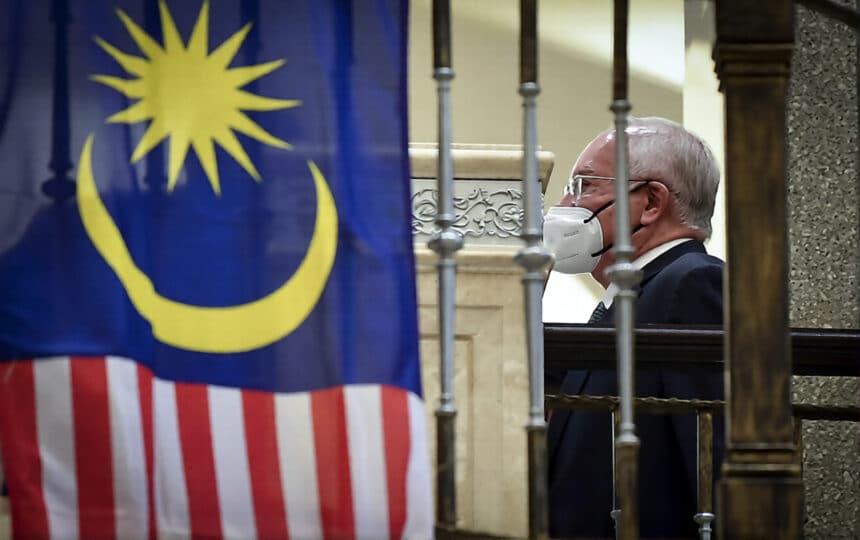
KUALA LUMPUR– Former Malaysian Prime Minister Datuk Seri Najib Razak hit a fresh legal roadblock on Monday after the Kuala Lumpur High Court rejected his request to serve the rest of his jail term under house arrest.
The 72-year-old has been behind bars since August 2022 and will stay at Kajang Prison to complete his reduced six-year sentence. The ruling weakens his latest attempt to secure more comfortable conditions while other 1MDB-linked cases continue.
Najib Razak’s imprisonment traces back to his 2020 conviction for abuse of power, criminal breach of trust, and money laundering tied to RM42 million (around US$9.9 million) taken from SRC International Sdn Bhd. SRC International was once a unit linked to 1Malaysia Development Berhad (1MDB), Malaysia’s state fund at the centre of a huge scandal.
He was first given a 12-year prison sentence and a RM210 million fine. After he lost his appeals, including at the Federal Court, he began serving the sentence in 2022. That made him the first former Malaysian prime minister to be jailed.
In February 2024, the Federal Territories Pardons Board, led by the then Yang di-Pertuan Agong Sultan Abdullah Sultan Ahmad Shah, cut Najib’s prison term in half to six years and reduced the fine to RM50 million.
The decision angered many people, who said it was far too soft given the corruption claims. Najib Razak has kept saying he did nothing wrong. He often points to fugitive financier Low Taek Jho (Jho Low), saying he was misled.
The House Arrest Request and the “Addendum” Claim
This latest push relied on what Najib Razak called an “addendum order”, described as a separate royal directive linked to the 2024 pardon. His lawyers said the document stated he should finish his sentence under house arrest at his Kuala Lumpur home.
In April 2024, Najib filed for a judicial review, seeking to force the authorities to accept and carry out the claimed order.
The case gathered pace earlier this year after the Court of Appeal and the Federal Court allowed access to related records, reversing an earlier rejection. Najib’s supporters saw it as a sign of royal mercy. Critics questioned whether the alleged order was real and lawful.
In a 41-page decision delivered on 22 December, High Court Judge Alice Loke Yee Ching said the claimed addendum could not stand. She found that house arrest was not raised or agreed at the Pardons Board meeting on 29 January 2024. She also ruled that a separate instruction made outside the board’s process did not meet the requirements set out under Article 42 of the Federal Constitution.
The judge also said there is no clear legal pathway for house arrest in Malaysia as a substitute for prison. She said a house arrest order could not be carried out because Malaysia has no law that sets out how it would work.
With that, Najib remains in Kajang Prison, with a projected release in 2028 if he meets standard conditions such as good behaviour.
Najib stayed calm in court as prison staff escorted him. His wife, Rosmah Mansor, and their son were present. Outside the court, hundreds of supporters from his United Malays National Organisation (UMNO) party gathered and chanted “Free Bossku”, using Najib’s well-known nickname that means “my boss”.
Wider Impact as the 1MDB Story Continues
The ruling lands just days before another major outcome in Najib’s main 1MDB trial, with a decision due on 26 December. In that case, he faces four charges of abuse of power and 21 money laundering charges linked to RM2.2 billion (about US$539 million).
US investigators have said at least US$4.5 billion was taken from 1MDB, and more than US$1 billion is alleged to have gone into accounts tied to Najib. The scandal was also linked to extravagant spending on luxury items and investments connected to Hollywood. It played a key role in Najib’s coalition losing the 2018 general election.
Najib continues to deny wrongdoing. He apologised in 2024 for how the issue was handled, but said others, including Jho Low, tricked him. Jho Low remains a fugitive.
Prime Minister Anwar Ibrahim, whose unity government includes UMNO, urged people to respect the courts and stay calm as feelings run high. Some UMNO figures voiced frustration, while opposition leaders welcomed the outcome as a sign that accountability still matters.
Najib Razak’s Appeal, and What Comes Next
Najib Razak’s lead lawyer, Tan Sri Muhammad Shafee Abdullah, called the ruling “shocking” and said an appeal would be filed at the Court of Appeal. He argued the judgment places too many limits on royal pardon powers. The Attorney General’s Chambers replied that the decision backs the proper constitutional process for pardons.
As Malaysia continues to deal with the long shadow of 1MDB, one of the biggest financial scandals in the world, the rejection of Najib’s house arrest bid highlights how closely the courts are watching high-profile corruption cases. For Najib, once one of the country’s most powerful figures, the route out of prison still looks difficult, especially with the risk of more punishment if he is convicted in the upcoming trial.
The dispute also keeps the spotlight on bigger issues, royal powers, court oversight, and how far Malaysia has come on anti-corruption since the 1MDB fallout.