



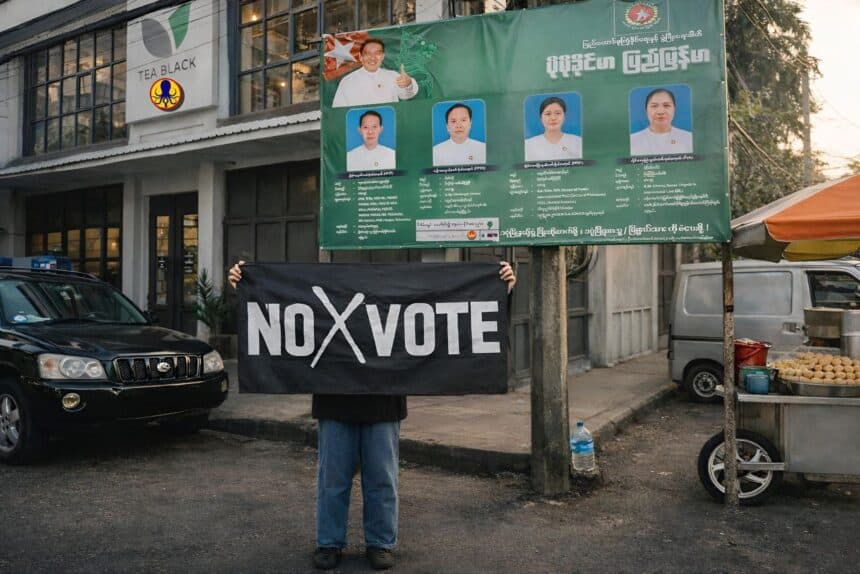
CHIANG RAI – The military-ruled Myanmar (earlier known as Burma and Brahmadesh) staged the first phase of the general election on 28 December 2025 amid a civil war-like situation across the Southeast Asian nation with visibly low voter turnout.
It covered 102 out of 330 townships (loosely termed for constituencies), even though many localities evaded the voting as those were not under the control of the military regime led by Min Aung Hlaing.
Currently, the anti-military people’s defence forces, ethnic groups, and other armed resistance outfits rule nearly one-third of the trouble-torn Myanmar territories. The second and third phases are scheduled for 11 January, covering 100 townships, and 25 January (63 townships), 2026. The results are expected by the end of January.
The Buddhist majority country of over 55 million people witnessed a military coup on 1 February 2021, overthrowing the democratically elected NLD government in Naypyitaw. Since then, former State Counsellor Suu Kyi (facing 33 years of imprisonment), President U Win Myint (sentenced to 12 years), and thousands of NLD leader-workers, along with civilians, including media professionals, remain inside the jails.
The NDL Absent from Elections
The absence of the NLD, which won landslide victories in the 2015 and 2020 national polls, has already dwindled the credibility of polls. The pro-democracy activists around the world termed the Myanmar electoral process as a reflection of a sham election.
The poverty-stricken country has lost 7,500 people in the violent political turmoil, where 3.6 million people were displaced since 2021 as the government forces exercised indiscriminate crackdowns, including air strikes on crowded places, hospitals, and even schools.
Over 22,000 political prisoners are still under detention. A large number of pro-democracy leaders had left for neighbouring countries like Thailand, China, Bangladesh, and India to escape the military atrocities. Nevertheless, military dictator Hlaing and his associates will try to showcase the exercise as a successful venture to get legitimacy for their unlawful power grab.
The military junta-appointed Union Election Commission (UEC) used electronic voting machines instead of ballots for the first time in Myanmar in the polling exercises planned for 274 townships, while the rest have been declared as disturbed and unstable (precisely under Rakhine, Sagaing, and Shan provinces).
The voting began at 6 am under heavy security arrangements in major cities like Naypyitaw, Yangon, Mandalay, along with the townships under the Bago and Ayeyarwady regions, and continued till 4 pm.
Young Voters Boycotting Election
The peaceful polling witnessed mostly elderly voters, who came out to vote only to get rid of threatening actions by the armed forces (popularly known as Tatmadaw), but the young voters largely boycotted the electoral exercise. In contrast, the last national election recorded around 70 percent voter turnout.
The UEC had earlier canceled the registration of a number of mainstream political parties, citing various reasons. Over 40 political parties, including the National League for Democracy (NLD) led by Nobel laureate Aung San Suu Kyi, did not re-register with the electoral authority.
Only six political parties, including the junta-aligned Union Solidarity and Development Party, along with the National Unity Party, People’s Pioneer Party, Myanmar Farmers Development Party, Shan & Nationalities Democratic Party, and People’s Party, are allowed to field candidates nationwide, where 51 smaller parties are entitled to take part in regional assemblies. Over 4,850 candidates representing various political parties remain in the fray.
Joining the chorus of pro-democracy workers, the ASEAN Parliamentarians for Human Rights (APHR) recently urged the ASEAN 2026 leaders to reject the junta’s fraudulent elections.
Talking about the last meeting between an APHR delegation and Philippine foreign affairs secretary Ma Theresa P Lazaro, who serves as ASEAN 2026 special envoy on Myanmar situation, the network of ASEAN lawmakers expressed concerns over the junta’s escalating violence and worsening humanitarian conditions in the country emphasizing on a principled, united, and justice-driven approach to end the suffering and also restoring the democratic aspirations of Myanmar people.
Appreciating Lazaro for her commitment to the cause of Myanmar and its people, the APHR stressed that ASEAN’s credibility and regional stability are at stake. The forum also offered possible support to help bridge the humanitarian, political, and technical gaps.
Exile Authority in Myanmar
The election was rejected by the National Unity Government (an exile authority in Myanmar) as well as several global actors, including the United Nations, many Western nations, and human rights groups, citing the electoral process as ‘not free, fair and inclusive’.
NUG representatives claimed that the junta conducted the farce election only to legitimize their rule in the Land of Golden Pagodas. Political observers believe that the election will hardly help install an independent civilian regime, as the military dictators want to install a government only to avoid international sanctions.
However, military dictator Hlaing, who, after exercising his franchise in a polling station, argued that the election would be thriving and reading for the people.
All neighboring countries, including India, which has a major investment in the under-construction Kaladan Riverine project, have expressed concern over the continued instability in border localities and the influx of Myanmar migrants.
The current military chief, Hlaing, may emerge as the new Myanmar President, and he would appoint someone from his trusted followers as the top military commander.
At the same time, the lawmakers (under the military-drafted 2008 Constitution, reserving space for 25% members in the Parliament and key ministries to the defence personnel) will probably function as mute spectators while dealing with any military-interested developments.