



Last Updated on June 15, 2026 by Jeff Tomas
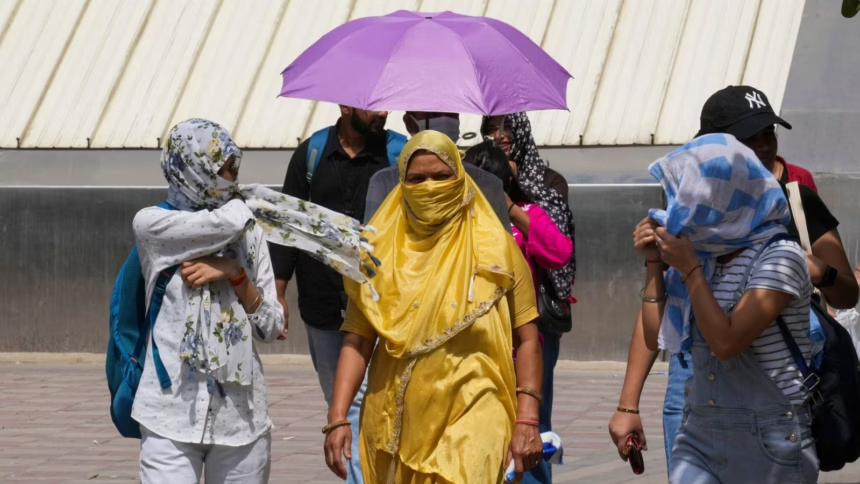
NEW DELHI — If you walk down a street in the national capital during the peak of summer, you know the feeling. The local news channel reports an official temperature of 41 degrees Celsius. Yet, when you step outside, the air hits your face like an open furnace. Your clothes stick to your skin instantly. Your chest feels heavy, and catching your breath feels difficult. The official weather report does not match what your body is experiencing. You are not imagining things. Delhi genuinely feels much hotter than what the standard thermometers show.
This growing gap between official statistics and physical reality is creating a massive public health crisis across the National Capital Region (NCR). To address this problem, the India Meteorological Department recently introduced an experimental heat index system. This system measures the “feels like” temperature rather than just tracking dry air temperature. Understanding why the city has become an unbearable pressure cooker requires looking closely at climate science, city architecture, and changing humidity patterns.

What Is the Heat Index and Why Does It Matter More Than Air Temperature?
For decades, weather reports focused solely on land surface and dry air temperatures. However, simple temperature readings only tell half the story. The heat index combines actual air temperature with relative humidity to calculate how hot the air truly feels to human skin.
When the air contains a high amount of water vapor, the human body cannot cool itself efficiently. Humans rely on sweating to regulate internal body temperature. As sweat evaporates from your skin, it pulls heat away from your body. But if the surrounding air is already saturated with moisture, your sweat cannot evaporate. Instead, it just sits on your skin. As a result, your internal body temperature continues to rise.
According to data tracked by regional meteorologists, a dry day at 40 degrees Celsius feels hot but manageable in the shade. However, if you add a relative humidity level of 60 percent to that exact same 40-degree day, the heat index spikes dramatically. The air suddenly feels like a punishing 49 degrees Celsius. This swampy heat puts immense strain on the heart and lungs as the body fights a losing battle to stay cool.
The Dangerous Math of Wet Bulb Temperature
To measure extreme heat risk accurately, climate scientists look at a metric called the wet bulb temperature. You can think of this as the lowest temperature your skin can reach through evaporative cooling. To find this number, meteorologists wrap a wet cloth around a thermometer bulb and let air pass over it.
For healthy humans, the absolute limit of physical survival sits at a wet bulb temperature of 35 degrees Celsius. If the wet bulb temperature stays at that level for more than six hours, a human being cannot survive outdoors. It does not matter if you sit perfectly still in the deep shade, wear lightweight clothing, and have an endless supply of drinking water. Without mechanical air conditioning, your body will overheat from the inside out, leading to organ failure and heatstroke.
In Delhi, the wet bulb temperature has routinely crawled up to dangerous thresholds between 28 and 30 degrees Celsius during recent heatwaves. Experts warn that if these numbers cross the 32-degree mark, even fit and healthy people will face severe medical emergencies within hours of working outside. This is why local weather experts emphasize that looking at the standard thermometer is no longer enough to keep people safe.
How Concrete and Built Environments Trap Intense Heat
Delhi has experienced an unprecedented construction boom over the past twenty-five years. A spatial analysis by the World Resources Institute shows that built-up areas in the region increased by over 60 percent in a fifteen-year period. This massive shift from green landscapes to concrete infrastructure has triggered a powerful meteorological phenomenon known as the Urban Heat Island effect.
Natural landscapes like forests, open fields, and wetlands act as natural air conditioners. Plants absorb rainwater and release it slowly into the air through a process called evapotranspiration, which cools the local environment. When you replace trees with concrete houses, multi-story apartments, and wide asphalt highways, you destroy this natural cooling cycle.
Materials like concrete, brick, and asphalt have a very high heat capacity. They act like giant thermal batteries. During the daytime, these hard surfaces absorb massive amounts of solar radiation from the blazing sun. Instead of reflecting the sunlight back into the atmosphere, the buildings and roads store the energy. Additionally, the close arrangement of narrow streets blocks natural wind patterns, preventing cooler air from circulating through residential neighborhoods.
Why Delhi Nights Are No Longer Providing Relief
Historically, Delhi summers were characterized by blazing days followed by cool, breezy nights. The dry desert air allowed heat to escape rapidly into space once the sun went down. This nighttime cooling period gave the human body a vital chance to rest, lower its core temperature, and recover from the daytime stress.
Today, that nightly relief has largely disappeared. A report by the Council on Energy, Environment and Water highlights a worrying trend: Delhi now experiences at least six more “very warm” nights each summer compared to just a decade ago.
Because the city’s concrete infrastructure stores so much energy during the day, it begins releasing that trapped heat slowly after dusk. At the same time, millions of air conditioning units run constantly across the city. These AC units cool the inside of homes, but they pump massive amounts of hot waste air directly out into the streets. This cycle creates a permanent dome of hot air over the city. When night-time temperatures remain near 35 degrees Celsius, the human body stays in a state of constant physical stress, which increases the long-term risk of cardiovascular failure.

The Invisible Strain on the Human Cardiovascular System
When environmental temperatures match or exceed the temperature of human skin, the body faces severe physiological strain. To shed internal heat, your heart must pump significantly faster, redirecting blood flow away from internal organs toward the skin’s surface.
Medical data tracks this phenomenon closely. According to research on extreme weather trends, prolonged exposure to high heat index environments causes blood pressure to drop as blood vessels dilate. This forces the heart to work twice as hard to maintain stable circulation. If you add heavy physical labor—such as pulling a cycle rickshaw or carrying bricks at a construction site—the cardiovascular system can experience sudden failure.
Because many low-income workers cannot afford to take a day off, they continue to push their bodies through dangerous wet bulb conditions. This lack of rest leads to chronic dehydration, kidney damage, and progressive heat exhaustion. Public health officials emphasize that heat acts as a silent magnifier of pre-existing health conditions, quietly increasing mortality rates from heart attacks and respiratory failures long before an official heatstroke diagnosis is ever recorded.
Changing Weather Patterns and the Arabian Sea Connection
Many people wonder why Delhi has become so humid in recent years. May used to be the driest month of the year, bringing a blinding, dry heat known locally as the ‘Loo’ wind. However, climate shifts are altering the region’s traditional weather calendar.
Meteorologists point to a series of climate disruptions called western disturbances. These are weather systems that originate over the Mediterranean region and travel across Asia. Recently, these disturbances have drawn immense amounts of moisture up from the warming waters of the Arabian Sea and pushed it directly into northern India.
According to environmental data, the average humidity levels in Delhi have climbed by roughly nine percent since 2011. This influx of tropical moisture colliding with extreme continental heat creates an incredibly unstable and oppressive atmosphere. Instead of experiencing a clean, dry summer, residents now face extended periods of tropical, swampy conditions before the official monsoon rains even arrive.
The Unequal Burden of the Capital’s Heat Crisis
The physical reality of Delhi’s heat crisis is not distributed evenly across the population. Your experience of the summer depends heavily on your income level, your neighborhood layout, and your line of work.
A satellite study tracking surface temperatures reveals that Delhi contains dozens of distinct micro-heat islands. Affluent areas like central Delhi or Sainik Farm feature wide roads, mature tree canopies, and extensive park systems. These green spaces can keep local temperatures up to nine degrees cooler than surrounding areas.
In sharp contrast, low-income residential zones and unauthorized colonies like Sangam Vihar are highly vulnerable. These areas feature high population densities, narrow alleys, metal roofing sheets, and almost zero green spaces. Over two million citizens live in informal settlements across the capital. Most of these residents work as outdoor laborers, street vendors, or auto-rickshaw drivers. They face constant exposure to the sun without access to air conditioning or clean drinking water stations, making them the primary victims of heat-related illnesses.
Delhi Microclimate Inequality
┌──────────────────────────────────────────────┐
│ AFFLUENT NEIGHBORHOODS │
│ ∙ Abundant tree canopy and public parks │
│ ∙ Up to 9°C cooler surface temperatures │
│ ∙ Widespread access to indoor cooling │
├──────────────────────────────────────────────┤
│ INFORMAL SETTLEMENTS │
│ ∙ High-density concrete and metal roofs │
│ ∙ Trapped heat pockets with no wind flow │
│ ∙ High risk for outdoor manual laborers │
└──────────────────────────────────────────────┘
Restoring Balance: Practical Solutions for a Cooling City
Fixing Delhi’s climate crisis requires moving past temporary emergency declarations. Urban planners must implement long-term, nature-based design interventions to lower the city’s baseline heat stress.
Data published by NASA models show that increasing a city’s urban forest cover can reduce felt temperatures by up to 14 percent. Delhi actually possesses a massive network of over 18,000 neighborhood parks. However, many of these spaces lack dense tree canopies or suffer from poor irrigation. Reforesting these urban parks with native, drought-resistant tree species like Neem and Amaltas can create effective cooling pockets throughout dense residential zones.
In addition to expanding urban forestry, rewriting building codes is essential. Encouraging the use of cool roofs—which use reflective white paint or specialized tiles—can prevent buildings from absorbing solar radiation in the first place. Installing green walls and community planting strips along major highways can also help break up the asphalt heat traps.
Conclusion
The numbers on the traditional thermometer no longer accurately describe what it feels like to live through a Delhi summer. Rising regional humidity, rapid concrete development, and a lack of nighttime cooling have transformed the capital into a severe heat trap. Surviving this changing climate requires looking beyond basic temperature data and focusing on the true heat index. By redesigning urban spaces, planting native forests, and protecting vulnerable outdoor workers, the city can begin to cool its streets and protect its citizens from an invisible, silent killer.
SEE ALSO: Cockroach Janta Party in India: Meaning, Story, and Social Media Reaction

![Guild Chief Fired Over Racist World Cup Incident [Full Story]](https://i0.wp.com/www.chiangraitimes.com/wp-content/uploads/2026/06/22f15430-6866-11f1-9e64-f1871e4c539b.jpg.webp?resize=150%2C150&ssl=1)


