


SYDNEY – The famous golden sand of Bondi Beach is stained with blood and grief this morning after a terrorist attack shattered the first night of Hanukkah, killing at least 16 people, including a child.
Two gunmen opened fire on a joyful community celebration, plunging Australia into shock and forcing a hard look at how the country has failed to deal with a growing wave of anti-Jewish hatred.
The attack, now confirmed as the deadliest mass shooting in Australia in nearly 30 years, has been formally classified as an act of antisemitic terrorism.
The shooting began shortly after sunset on Sunday at the annual “Chanukah by the Sea” gathering in Archer Park, a grassy space near the Bondi Surf Bathers’ Life Saving Club. Hundreds of people had come together for the event.
Witnesses described a sudden burst of gunfire as two attackers, identified by police as a 50-year-old father and his 24-year-old son, started firing “long arms” into the crowd.
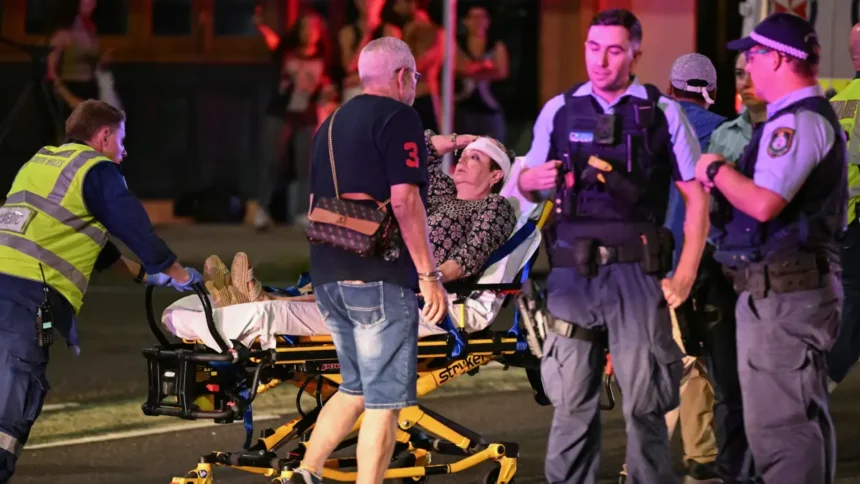
The number of dead, first reported as lower, climbed overnight as the full scale of the horror became clear. New South Wales Health Minister Ryan Park confirmed this morning that 16 people have died, including a 12-year-old child. At least 40 others are in hospital, some in a critical condition, among them two police officers.
Several well-known members of Sydney’s Jewish community are among the dead, including Rabbi Eli Schlanger, a key organiser of the Hanukkah event, and 87-year-old Holocaust survivor Alex Kleytman, who was reportedly killed while trying to protect his wife.
The attackers’ intent left little doubt. Prime Minister Anthony Albanese convened a meeting of the national security committee and condemned the atrocity as “a targeted attack on Jewish Australians on the first day of Hanukkah… an act of evil antisemitism, terrorism, that has struck the heart of our nation.”
Police shot and killed one gunman at the scene. The second suspect was arrested and is in a critical condition under police guard. Authorities later revealed that the dead attacker was already on the radar of security services. They also found improvised explosive devices in a vehicle linked to him, pointing to what appears to have been a carefully prepared plan for mass murder.
The Victims: Rabbis, a Survivor, and a Child
The identities of a number of victims have now been released, showing how deeply this attack has hit Sydney’s tight-knit Jewish community, especially in the Eastern Suburbs.
- Rabbi Eli Schlanger (41): Born in London and a father of five, Rabbi Schlanger served as an assistant rabbi at Chabad of Bondi and was one of the main organisers of “Chanukah by the Sea”. He had worked as a rabbi and chaplain in the Bondi community for 18 years. Family members recalled his recent warnings about growing antisemitism, and his plea to congregants to “be more Jewish, act more Jewish”. His death leaves a painful gap at the spiritual centre of the community.
- Alex Kleytman (87): A Ukrainian-born Holocaust survivor, Mr Kleytman was confirmed dead by his wife, Larissa, who is also a survivor. Witnesses said he was shot while trying to shield her during the first burst of gunfire. “He came to Bondi Beach to celebrate Hanukkah. For us, it was always a very, very good celebration,” his grieving wife told a newspaper.
- Rabbi Yaakov Levitan and Reuven Morrison: Chabad confirmed that Rabbi Levitan and community member Reuven Morrison were also killed, along with a 12-year-old child who has not yet been named publicly. The Israeli Foreign Ministry has stated that one of the victims was an Israeli citizen.
Alongside those killed, at least 40 people remain in hospital. Five are in a critical condition, including two police officers and a human rights lawyer.
Jewish Community Under Pressure: Antisemitism on the Rise
The horror at Bondi did not appear from nowhere. Many Jewish groups see it as the most extreme expression of a trend they have been warning about for years: a steep rise in antisemitic incidents across Australia, especially after the Israel-Gaza war that began in October 2023.
Australia’s Jewish population is around 120,000. For many families, the past year has been marked by anxiety and fear. The Executive Council of Australian Jewry (ECAJ) recently reported more than 1,600 antisemitic incidents in the 12 months to September 2025, around five times the yearly average of the previous decade. These incidents have included firebomb attacks on synagogues, physical assaults, and a surge in graffiti openly calling to “Kill the Jews”.
Jewish organisations have warned that a country long seen as a safe place for Holocaust survivors and their children has allowed open hatred of Jews to creep into mainstream debate and street protest.
Political Fallout: Pressure on the Albanese Government
After the Bondi massacre, criticism of the Australian Labor Party government, led by Anthony Albanese since May 2022, has intensified.
Opposition parties, Jewish leaders, and major media commentators have accused the government of failing to deal with the rise in antisemitism. They argue that this failure allowed hatred to grow and created the climate in which the Bondi attack took place.
A major point of anger is the government’s approach to pro-Palestine protests. While many rallies have focused on political demands, they have also featured disturbing elements, including:
- Antisemitic chants: Chants such as “Gas the Jews” and “Where’s the Jews” near the Sydney Opera House shortly after the 7 October 2023 Hamas attacks became a national flashpoint. Critics condemned what they saw as an initial reluctance by authorities to investigate and prosecute those involved.
- Holocaust denial and open incitement: Protest signs and slogans at some rallies have been widely read as supporting violence against Jews and denying the scale or reality of the Holocaust.
- Limited police response: Detractors say police, under state and federal direction, have often been slow to act or hesitant to apply existing laws on hate speech, incitement, and intimidation at large demonstrations.
In a recent televised statement, Israeli Prime Minister Benjamin Netanyahu directly blamed the Albanese government’s foreign policy, particularly its plan to recognise Palestinian statehood, accusing it of “pouring oil on the fire of antisemitism” in Australia.
The ECAJ, in a statement issued after the attack, expressed its frustration in stark terms: “The time for talking is over. We need decisive leadership and action now to eradicate the scourge of antisemitism from Australia’s public life, for which the Jewish community has long been advocating. Government’s first duty is to keep its citizens safe.”
The Albanese government has taken some steps, including the creation of a federal antisemitism taskforce and, in August, the expulsion of the Iranian Ambassador after intelligence linked Tehran to past antisemitic arson attacks on Jewish sites in Australia. Critics say these actions came too slowly and failed to match the speed or scale of the problem.
They argue that the government has tried to balance the right to protest against the basic safety of a minority community under direct threat, and that this balance has tipped the wrong way.
Now, the government faces the stark reality that one of Australia’s most popular public places, often seen as a symbol of its relaxed, multicultural identity, is the scene of a mass-casualty terror attack that openly targeted Jews.
Grief, Courage, and Demands for Change
Amid the horror, stories of bravery have emerged. One bystander, identified as Ahmed al Ahmed, a local fruit shop owner, was captured on video tackling one of the gunmen and helping to disarm him. Premier Chris Minns praised him as a “genuine hero” whose actions saved “countless other people.”
Acts like his offer a brief moment of light in an otherwise dark story. They show the best of ordinary people in the worst of situations.
Yet individual courage cannot erase the scale of what happened. Flags fly at half-mast, candles are lit at vigils across the country, and the focus has turned to what political leaders will do next.
The long-running argument about free speech, protest rights, and the safety of minority communities has now turned into something far more urgent. Australia’s pride in its multicultural values and its strict gun control laws, which had made mass shootings rare, now faces a serious test from religiously and ideologically motivated violence.
For many, the Bondi massacre is a point of no return. It has forced a reckoning that can no longer be delayed.
For the families of the 16 people killed, and for a Jewish community now living with deep fear, words of sympathy are not enough. They want concrete action to uproot organised hate, both online and on the streets, so that gatherings like “Chanukah by the Sea” can once again be celebrations of joy, not scenes of terror.