

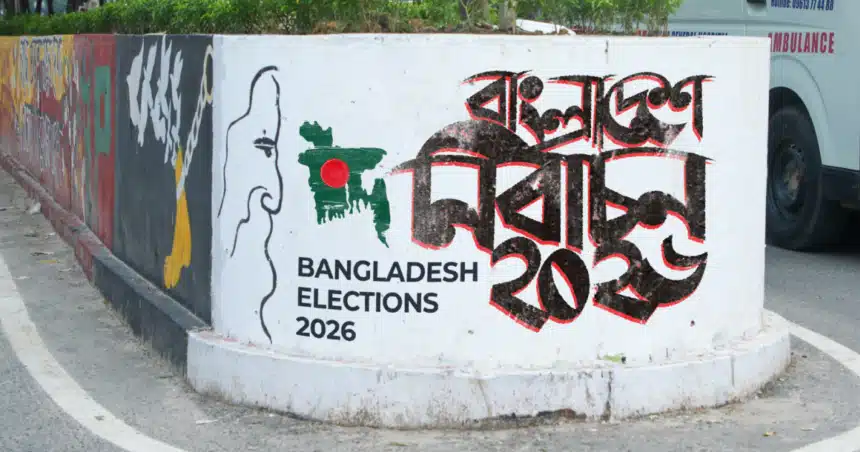

DHAKA – Bangladesh, a Muslim-majority country with more than 170 million people, will hold a general election on February 12, 2026, to choose its 13th Jatiya Sansad in Dhaka. The Bangladesh Election Commission says 127,711,895 people are eligible to vote, including more than 4.5 million newly registered young voters who recently turned 18.
Voting is set to take place at 42,766 polling stations nationwide. Authorities plan to deploy 785,225 presiding and polling officers. More than 900,000 security personnel are also expected to be on duty to protect candidates and voters.
A total of 2,034 candidates from 51 political parties, plus 275 independents, are contesting 299 parliamentary seats. Polling has been postponed in one constituency after the death of a candidate from Jamaat-e-Islami Bangladesh. Only 78 women, including 17 independent candidates, are running in the direct contests. Another 50 seats in Parliament are reserved for women and will be filled through indirect voting.
Campaign timeline and voting hours
Campaigning began on January 22 and ended at 7:30 pm on February 10. Election authorities have banned public rallies and processions for 96 hours before and after election day. Polling on Thursday will run from 7:30 am to 4:30 pm.
Nearly 500 foreign election observers are in Bangladesh, along with more than 150 journalists from 45 international media outlets.
Awami League, the party of ousted Prime Minister Sheikh Hasina, has been barred from taking part in the election. That opens up room for its long-time rival, the Bangladesh Nationalist Party (BNP). Bangladesh last held a general election in January 2024, but fresh polls were called after Hasina’s government fell following a student-led mass uprising about six months later.
Hasina’s exit, conviction, and the Yunus interim government
Hasina, who had been in power since 2009 after winning repeated elections, fled during the unrest on August 5, 2024. She took temporary shelter in neighboring India and is believed to be living somewhere in the Delhi area. The 70-plus leader, widely viewed in Bangladesh as pro-India, was recently convicted by a local court and sentenced to death in absentia for crimes against humanity.
The July to August 2024 unrest reportedly left more than 1,400 people dead, including minors, and led to an interim government headed by Nobel laureate Dr Muhammad Yunus. In recent months, the Yunus administration has pushed for Hasina’s extradition, a move that has strained ties with India ahead of the election.
Political violence and rising anti-India anger in Bangladesh
From the start, the road to the election has stayed rough for the Yunus-led administration. Tensions grew after the shooting of Sharif Osman Bin Hadi, a young figure who rose during the July 2024 protests against the Hasina government. Hadi later died in Singapore on December 18 while receiving treatment.
Rumors spread that Hadi’s killers fled to India, fueling renewed anti-India sentiment, often tied to anti-Hindu hostility. Reports followed of thousands of incidents in which extremist Islamist groups targeted non-Muslims across Bangladesh, prompting sharp reactions from Hindu-majority India. Protests also broke out outside Indian missions, with counter-protests later held outside Bangladeshi missions.
With Dhaka and New Delhi trading diplomatic protests and summoning each other’s high commissioners, both sides have tightened tourist visa rules.
Claims of attacks on minorities
India’s foreign ministry has said more than 2,900 incidents involving attacks on religious minorities were reported in Bangladesh under the Yunus-led interim government. New Delhi has also raised concerns about continued hostility toward Hindus, Christians, and Buddhists by extremist groups.
Independent sources have recorded nearly 200 deaths linked to mob violence over the past year. Bangladesh Hindu, Buddhist, and Christian Unity Council has also said attacks on minorities rose sharply during the political instability that followed Hasina’s removal.
International media reported widely on December 18 after Deepu Chandra Das, 29, was lynched in Mymensingh over an alleged blasphemy claim (accused of insulting Islam). Reports said his body was hanged and set on fire. Days later, Amrit Mondal, 30, was lynched in Rajbari on December 24.
On December 29, Bajendra Biswas, 42, a garment factory worker, was shot dead in Mymensingh by a colleague. Businessman Khokon Chandra Das, 50, was attacked in Shariatpur, hacked, and set on fire, and later died in the hospital on January 3. On January 11, Samir Kumar Das, 28, an auto-rickshaw driver, was stabbed to death in Chittagong.
Reports of other deaths, including Akash Sarkar, a student at Jagannath University in Dhaka, along with Mithun Sarkar, Proloy Chaki, and Sarat Chakraborty Mani, added to concerns among minority communities.
RRAG report and allegations of organized targeting
New Delhi-based Rights & Risks Analysis Group (RRAG) reported a rise in targeted attacks on Bangladesh’s Hindu minority, linking the trend to Islamist forces operating under the cover of election-related unrest. RRAG director Suhas Chakma said temples were being set on fire, homes were being vandalized, and minorities were facing physical assaults.
Bangladesh recorded more than 520 communal attacks in 2025, according to the same account. It also reported over 60 non-Muslims killed, along with 28 cases of rape and other violence against women. Several incidents included attacks on religious sites and the desecration of Hindu deities.
Chakma said official denials of a religious motive have encouraged hardline groups. He added that many victims, fearing retaliation, described arson attacks as “accidents or foul play,” even when they believed the goal was to burn them alive or to leave them destitute by destroying homes and property.
Bangladesh’s government press wing has acknowledged at least 274 violent incidents after Hadi, the convener of Inqilab Mancha, was killed in Dhaka during the second half of December.
Hasina’s audio message from New Delhi sparks a new dispute
Tensions rose again after Hasina gave a public address on January 23, accusing Yunus of “presiding over an illegal and violent regime” and pushing Bangladesh into lawlessness. She sent the audio message to the Foreign Correspondents’ Club in New Delhi, her first public remarks since leaving Dhaka.
In the message, Hasina attacked Yunus personally, calling the 80-plus caretaker leader “a murderous fascist, money launderer and traitor.” She also rejected allegations against her, saying she had no personal role in crimes against humanity. Dhaka reacted strongly, accusing New Delhi of giving Hasina space that deepened friction between the two neighbors.
A trader in Dhaka said Bangladesh’s elections have been controversial for decades, pointing out that the BNP stayed away from recent national polls. He said that if the Awami League’s absence in the coming election becomes a major issue, low turnout also happened when the BNP was not in the race, including in the 2024, 2018, and 2014 elections.
He also said Hasina’s presence in Delhi continues to complicate Bangladesh-India relations. In his view, India’s problem is that both its ruling and opposition parties have tended to see Bangladesh mainly through Hasina’s lens. He also questioned why, if Hasina is granted refuge, thousands of Awami League leaders are also reportedly allowed to remain in India, mainly in New Delhi and Kolkata.