


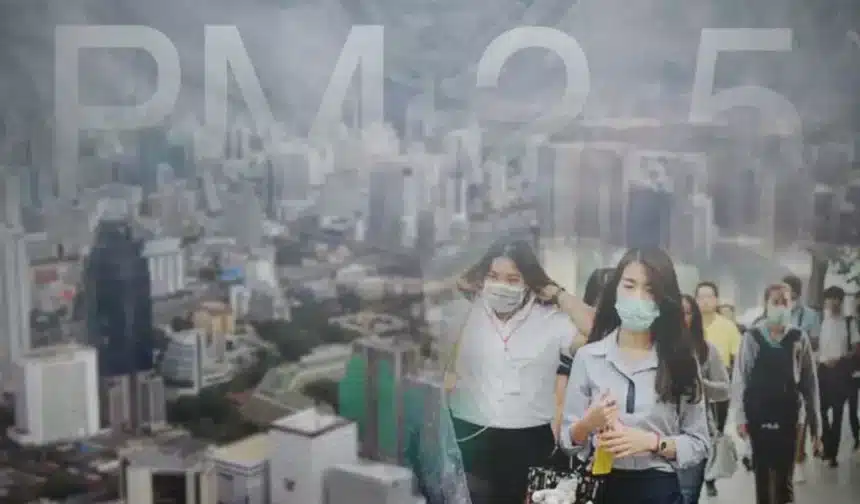
BANGKOK – With New Year events bringing large crowds into the capital, health officials are warning about a rise in fine dust pollution (PM2.5). The Bangkok Air Quality Information Centre says weaker air movement could push pollution higher from December 28, 2025, to January 1, 2026. That could turn countdown nights into smoky, uncomfortable evenings for many people.
The Centre’s newest outlook, covering December 26, 2025, to January 3, 2026, flags the holiday period as a concern. Air circulation is expected to be fair to good on December 26 to 27, which should help keep PM2.5 at lower levels.
From December 28 to 30, conditions are forecast to deteriorate. With weaker ventilation, PM2.5 is more likely to build up, especially from evening through to early morning.
The worst stretch is expected on December 31 and January 1. Poor airflow can trap pollution at street level, at the same time as traffic increases and fireworks and outdoor celebrations add to smoke and fumes in busy areas.
Some improvement is expected from January 2 to 3, when better mixing in the air should help clear the haze bit by bit.
Poor Ventilation Makes Bangkok’s PM2.5 Pollution Worse
Bangkok often struggles with air quality during the cooler months, and this forecast highlights how much the weather can affect pollution levels. Light winds and low ventilation can act like a lid over the city, keeping dirty air from spreading out.
Temperature inversions can make things worse. This happens when cooler air sits near the ground, with warmer air above it, which stops pollution from rising and dispersing.
In Bangkok, the main source of PM2.5 is traffic exhaust. Other contributors include construction dust, factory emissions, and, at times, haze drifting in from outside the city. Over the holidays, extra travel and fireworks can push levels higher, especially in central districts and areas downwind.
Past December and January periods have often seen higher readings, sometimes above Thailand’s 37.5 µg/m³ standard. By late December 2025, readings are already sitting in the moderate to unhealthy range, which is a clear signal to take care in the days ahead.
PM2.5 Health Risks Can Build Quickly
PM2.5 refers to particles that are 2.5 microns or smaller, around 30 times thinner than a human hair. Because they are so small, they can pass deep into the lungs and enter the bloodstream.
In the short term, exposure can cause irritated eyes, nose, and throat, coughing, breathlessness, and worse asthma or allergy symptoms. Children, older adults, pregnant women, and people with heart or lung conditions are more likely to be affected, and spikes can lead to more hospital visits.
Longer exposure carries more serious risks. Research links ongoing PM2.5 exposure to heart disease, stroke, COPD, lung cancer, type 2 diabetes, and respiratory infections. The World Health Organization classifies PM2.5 as a Group 1 carcinogen and says there is no safe level, since harm rises as concentrations increase.
Thailand records thousands of early deaths linked to air pollution each year, and Bangkok’s dense population means the impact can be widespread. Some people may notice chest tightness or wheezing straight away, while others might only feel the effects after spending hours outdoors.
What Does This Mean for Tourists and New Year crowds?
Bangkok’s New Year draw is huge, with visitors heading to rooftop venues and popular countdown spots along the Chao Phraya. Haze could take the shine off outdoor plans, especially in busy areas such as Khao San Road, Asiatique, and CentralWorld, where crowd levels are high, and pollution can gather late at night.
Visitors with breathing problems may want to limit outdoor time, particularly on December 31. Families with young children may find indoor venues a safer choice while keeping an eye on air quality updates.
Where to check Bangkok’s Air Quality
Both residents and tourists can follow real-time air quality updates through:
- The AirBKK app and website (air.bangkok.go.th), with district-level readings and alerts from the Bangkok Metropolitan Administration
- The Pollution Control Department’s Air4Thai app and website (air4thai.pcd.go.th)
- International platforms such as aqicn.org or iqair.com for broader comparisons and forecasts
These services show PM2.5 in micrograms per cubic metre (µg/m³), along with colour-based AQI ratings, from green (good) through to red (unhealthy) and higher.
Steps the authorities recommend to reduce PM2.5 exposure:
Officials are advising people to take simple precautions during the high-risk period:
- Wear an N95 mask or similar when outdoors, especially from evening to morning
- Cut back on heavy outdoor exercise, choose indoor plans if the AQI turns orange or worse
- Use HEPA air purifiers indoors and keep windows closed during spikes
- People in higher-risk groups should avoid unnecessary travel and seek medical advice if symptoms start
- Drivers should reduce idling, and businesses should avoid open burning
The Bangkok Metropolitan Administration says it is stepping up vehicle checks and widening low-emission measures to help reduce pollution sources.
As 2026 approaches, the warning highlights Bangkok’s ongoing struggle with PM2.5. Weather drives the short-term spikes, but lasting improvement depends on tighter emissions control, cleaner transport, and stronger regional action on haze.
For now, staying alert to air quality updates, masking when needed, and choosing safer plans can help people enjoy the celebrations with fewer health risks. Conditions should ease in early January as airflow improves.
Related News:
Bangkok Expands Low Emission Zones (LEZ) to Cut PM2.5 Pollution
Bangkok’s Air Quality Plunges on Christmas Day Amid PM2.5 Surge