



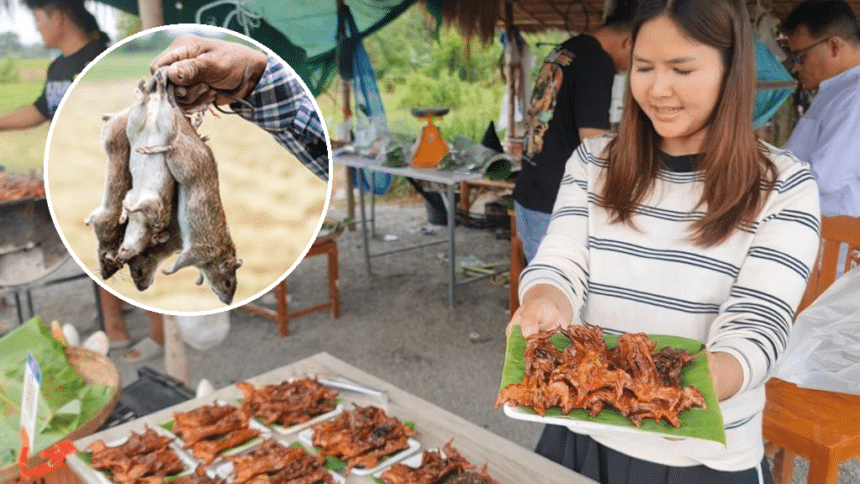
CHIANG RAI – Sukhothai has a new street-food favourite that appears only in the cool season, Rats!. In the Suankrok district, a former fish seller has turned to buying field rats from both local areas and other provinces, even as far as Chiang Rai.
She cleans and prepares them, then sells them fresh or grilled. Photos posted on social media have attracted so many customers that some drive from other provinces, buying up to 200 kilograms a day. Anyone who wants to try them has to call and book in advance, or they will miss out.
During the cold months, in Ban Nong Chum Saeng, Village 5, Tha Thong Subdistrict, Suankrok District, Sukhothai, a local woman known as “Aunt Tan” grills large amounts of field rats and sells them as a special seasonal dish at 100 baht per tray.
After Aunt Tan shared photos online, customers were drawn in by how tasty the grilled rats looked. Many called ahead to reserve and then drove across provincial borders to pick up their orders in person.

Parichat Saksit, or “Aunt Tan”, aged 52, told reporters that her family usually sells tilapia. They only switch to selling grilled field rats during the cool season, from November to January. They have been doing this for about 4 to 5 years.
She buys field rats from villagers who catch them in rice fields in Sukhothai, Kamphaeng Phet, Phrae, Lampang, and Chiang Rai. These are true wild field rats, which she says taste better than farmed rats.
The grilled rats are sold at 100 baht per tray, with 4 to 5 rats per tray, weighing around 250 to 300 grams. If bought by weight, grilled rats cost 350 baht per kilogram, while fresh, cleaned rats cost 250 baht per kilogram.
“Sales are very good at the moment. We sell about 200 kilograms a day. We can’t keep up with the orders, so we have to ask our family members to help out,” she said.

Eating Field Rats in Thailand
In Thailand, especially in rural areas such as Isaan in the north-east and in rice-growing villages, people often eat rice field rats (for example, the ricefield rat, Rattus argentiventer). These are not the same as city or sewer rats. T
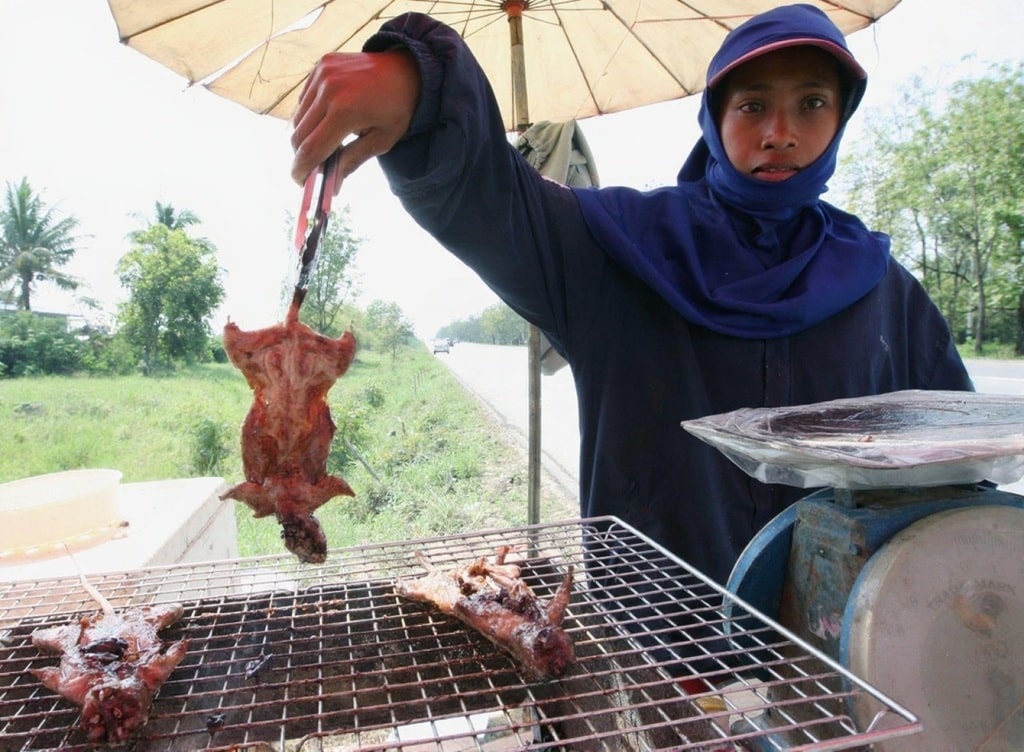
hey live in rice paddies and fields, and mainly eat rice, roots, and plants. Because of this diet, locals see them as cleaner and regard them as a seasonal delicacy and a useful source of protein. Vendors commonly grill them or sell them at roadside stalls, and they often cost more than chicken or pork because they are harder to catch.
Nutritional profile
Rice field rat meat is a lean, high-protein meat, similar to rabbit, squirrel, or dark chicken meat. The numbers below are rough values per 100 g of edible meat, based on studies of similar wild rodent meats, such as African giant rats and general field rats. Exact values vary with species and cooking method.
- Protein: about 20–25 g (similar to or slightly higher than beef at about 20 g, or chicken at about 20–25 g)
- Fat: roughly 3–10 g (usually quite low, often less than pork or beef, and with a good share of polyunsaturated fats)
- Calories: around 150–250 kcal (lean cuts are close to chicken breast)
- Other nutrients: A good source of iron (sometimes higher than chicken or pork), vitamin B12, potassium, phosphorus, zinc, and magnesium. Many wild rodent meats also have relatively low cholesterol.
For a whole rat of about 300 g of edible meat, estimates suggest around 60–63 g of protein, 15–33 g of fat, and roughly 400–650 calories, which makes it a dense source of energy and protein.
Benefits and comparisons
In areas where it is eaten, rice field rat is valued as a sustainable, low-fat source of protein. People often see it as a healthier choice than processed meats, since the animals feed on natural crops rather than rubbish. Some studies also mention omega-3 fats and a generally favourable fat profile.
Risks and considerations
- There is a risk of diseases that pass from animals to humans, such as leptospirosis or hantavirus, if the animals are not caught, handled, or stored safely.
- Careful, thorough cooking reduces most of these risks, and field rats are usually considered safer to eat than urban rats.
- It is not a common food in Thai cities; it is mostly eaten in rural areas and certain regions.
When caught from clean areas and cooked properly, rice field rat can be a nutritious type of wild game meat. Cultural views and safety concerns, however, mean that it remains a regional food rather than a widely accepted one.
Taste and Perception
People who grow up eating them often say the meat tastes like dark chicken or slightly gamey pork. When cooked fresh, it is usually tender, rich, and flavourful. Vendors are open about what they are selling, so you see them clearly labelled and displayed as rat, not disguised as some other meat.
For many outsiders, the idea of eating field rats feels adventurous, but in these communities, it is a normal rural food, and also a way to control pests that damage rice crops. If you are travelling in rice-farming parts of Sukhothai or central Thailand and feel curious, your best chance is at roadside grills or morning markets outside the main tourist areas, especially during the cooler season.