




Last Updated on July 18, 2026 by Jeff Tomas
CHIANG RAI – A severe environmental and public health crisis is unfolding across Northern Thailand as cross-border pollution ravages local communities. Toxic chemicals from foreign mining projects and thick smoke from agricultural fires are choking towns and rivers in Chiang Rai and Chiang Mai provinces. Residents state that they feel abandoned by state authorities while their health and local economies collapse from the ongoing damage.
The contamination of major northern waterways has sparked widespread outrage, leading to historic public demonstrations in the region. Recently, more than 600 residents, civil society groups, and Buddhist monks participated in a 68-kilometer “peace walk” to demand urgent state intervention. The marchers walked for six days from Chiang Mai province to the Chiang Rai Provincial Hall to deliver a list of urgent demands.
Key Takeaways
- Heavy metal contamination is affecting the Kok, Sai, Ruak, and Mekong rivers in Chiang Rai.
- The government has assigned the Pollution Control Department to work with UNIDO and JICA on a water quality monitoring system.
- Chiang Mai University researchers found higher heavy metal readings in some water samples and raised concerns about more than 60,000 rai of farmland.
- Civil society groups will hold a public forum to discuss the effects of pollution and the possible relocation of Chiang Rai’s raw water source.
- The People’s Party submitted scientific data to the Chinese Embassy and asked China to help investigate mining operations linked to the pollution’s suspected source.

Chiang Rai faces a cross-border water crisis.
The pollution crisis in the Kok River has become a major test of Thailand’s ability to protect water security. Government agencies, researchers, civil society groups, and international organizations are now working to respond to heavy metal contamination reported in the Kok, Sai, Ruak, and Mekong rivers.
The situation affects more than water quality. It has raised concerns about the health, livelihoods, food safety, agriculture, and economic security of people living throughout the Chiang Rai river basin.
Reports of heavy metal contamination have drawn attention from public agencies, universities, local communities, political parties, and international organizations at the same time. The problem also highlights the difficulty of managing natural resources when the suspected source of pollution is located outside Thailand.
Within a few days, the government announced cooperation with international agencies, Japanese specialists prepared to visit the affected area, civil groups scheduled a public forum, university researchers released preliminary water test results, and political representatives submitted information to the Chinese Embassy. These developments point to a central challenge: Thailand must find a practical way to manage pollution that crosses national borders.
The current response differs from earlier efforts because several groups are acting at the same time. The issue has expanded beyond environmental management. It now involves water security, public health, food safety, agriculture, border trade, and relations between neighboring countries.

Government expands international cooperation on water monitoring
On July 14, 2026, Lalida Periswiwatana, deputy government spokesperson, said Prime Minister Anutin Charnvirakul had instructed the Ministry of Natural Resources and Environment to speed up measures addressing heavy metal contamination in cross-border water sources.
The Pollution Control Department is leading coordination with the United Nations Industrial Development Organization, or UNIDO, the Japan International Cooperation Agency, or JICA, and the Embassy of Japan in Thailand. The goal is to build a more systematic water quality monitoring network.
The first stage of the cooperation includes:
- Developing an integrated arsenic management plan
- Providing water quality testing kits
- Training government officials and local communities to use the equipment
- Installing arsenic removal systems for village water supplies
These measures are intended to give residents better access to clean and safe water.
Experts from UNIDO and JICA are scheduled to visit Chiang Mai and Chiang Rai on July 16 and 17, 2026. They will meet with provincial governors and relevant agencies before beginning work on projects in the affected areas.
The government also plans to organize a joint training program for Thailand, Myanmar, and Laos under the Third Country Training Program. The program will strengthen staff skills in testing water and sediment quality. It will also create a regional monitoring network for the Mekong subregion.
The program would move pollution management beyond a single-country response. Water contamination in the region often affects several countries, so officials need shared data, compatible testing methods, and regular communication between agencies.
Researchers call for action at the source of the pollution
Researcher Suebsakul Kitchanukorn published observations about the involvement of UNIDO and JICA. He welcomed Japan’s support for water quality monitoring, but also raised questions about Thailand’s ability to manage cross-border pollution through existing government systems.
He also questioned Japan’s position in the global supply chain for critical minerals and called for broader measures that address the source of the contamination.
The observations reflect a concern shared by many researchers: testing water and treating pollution downstream will not solve the problem on its own. Authorities also need to examine mining operations in upstream areas, regulatory systems, and international mechanisms that can lead to policy changes.
A long-term response requires reliable scientific data, diplomatic cooperation, and participation from communities living along the rivers. Residents often see changes in water quality before government monitoring teams arrive, so their observations can help identify locations that need urgent testing.

Civil groups prepare a public forum in Chiang Rai.
The Network of People Protecting the Kok, Sai, Ruak, and Mekong Rivers will hold a forum titled “The Contamination and Effects of Problems in the Kok, Sai, Ruak, and Mekong Rivers” on July 19, 2026.
The event will take place at the meeting room of the Phra Rattanapanyayan Building at Chiang Rai Buddhist College, Mahachulalongkornrajavidyalaya University.
The forum will give affected groups a chance to share information and propose solutions. Participants are expected to include researchers, tourism operators, fishers, farmers from the Kok and Sai river basins, and residents of Chiang Khong district.
The discussion will also cover the possible relocation of Chiang Rai’s raw water source for municipal water production. The organizers have invited the governor of the Provincial Waterworks Authority, members of the House of Representatives, and senators to hear local concerns.
The organizers plan to send the forum’s recommendations to the Extraordinary Committee considering the 2027 annual budget bill.
The network has also invited the Consul General of China in Chiang Mai, as well as the Chinese and Myanmar embassies in Thailand. The invitations ask representatives to hear concerns from residents who have been directly affected.
The organizers estimate that contamination has affected more than 70,000 households, or about 210,000 people, in Chiang Rai. This estimate suggests that the effects may extend well beyond the communities located immediately beside the rivers.

Preliminary test results raise concerns about farmland
While government agencies and civil groups work on possible responses, preliminary findings from Chiang Mai University have drawn attention to the risks facing agricultural areas and public water sources.
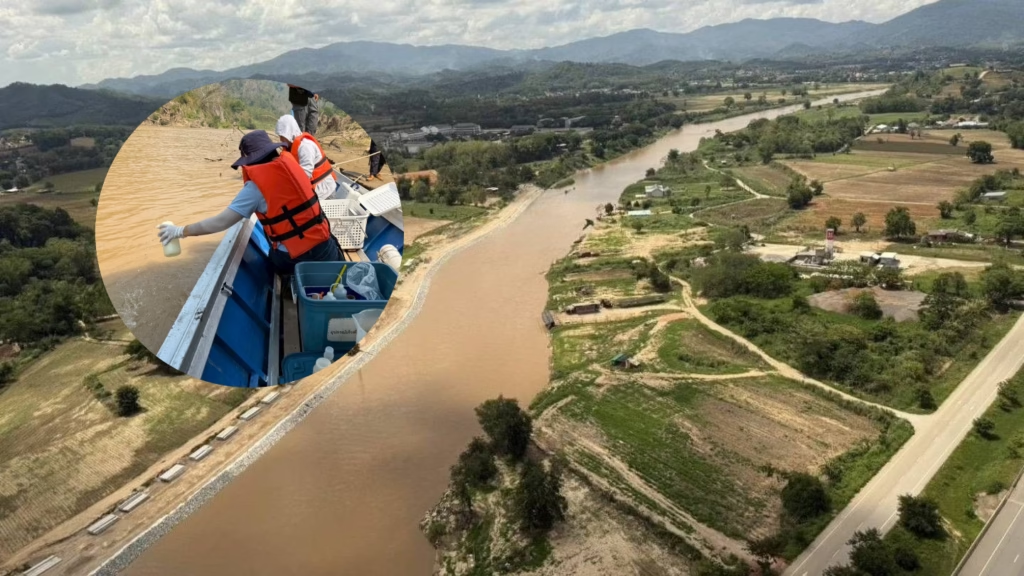
On July 15, 2026, Assistant Professor Dr. Wan Wiriya, a lecturer in the Department of Chemistry at Chiang Mai University’s Faculty of Science and assistant director of the Environmental Science Research Center, said her team had used water testing kits to monitor the Mae Sai irrigation system.
The researchers visited the area after receiving information that it might be at risk of heavy metal contamination. Preliminary tests found heavy metal readings of about 0.10 milligrams per liter at some locations in Mae Sai Mittraphap subdistrict.
That figure is higher than the maximum reading previously recorded in the Sai River, which was about 0.055 milligrams per liter.
Dr. Wan stressed that the result is only an initial screening result. The research team sent samples to a laboratory for detailed analysis and expected confirmation within one week.
The higher preliminary reading has raised concerns about irrigation management in the Sai River basin, particularly during the planting season. Many farmers rely on irrigation water for crop production, so any confirmed change in water quality could affect farming decisions and crop safety.
Researchers call for monitoring before a larger crisis develops
Dr. Wan said her team’s approach differs from routine testing carried out at fixed intervals. The researchers focus on locations and periods that may carry a higher risk of contamination. This approach can help identify abnormal water quality more quickly.
Heavy metal pollution is difficult to predict because contamination can move through a river in different ways and at different times. Rainfall, water flow, and local geology can all affect how pollutants spread.
For that reason, residents need a monitoring system that allows them to take part. When people notice an unusual color, smell, or change in the water, they should be able to collect samples and send them for testing quickly.
Rapid testing would give officials more time to assess the situation and introduce protective measures. Waiting until pollution has affected a large area could limit the available options.
This approach is consistent with the use of early warning systems in environmental management. Several countries use such systems to reduce the effects of cross-border pollution, especially in areas affected by upstream mining and industrial activity.

Irrigation officials await laboratory confirmation.
After the preliminary findings were released, Thaweechai Khowtrakul, director of the Chiang Rai Irrigation Project, said the agency had not yet received an official test report.
The irrigation project does not currently have a laboratory that can directly analyze heavy metals. However, its water management process includes holding water from the Sai River so that sediment can settle before the water moves into canals and reaches farmland.
If laboratory tests confirm contamination at a level that threatens public safety, the irrigation agency is prepared to take action under the law. Officials would then determine how to protect residents and agricultural land.
The statement shows that government agencies are waiting for laboratory analysis before deciding whether to restrict water use or introduce additional management measures. The confirmed results will be important because screening kits can identify possible contamination, but laboratory analysis is needed to verify the level and type of pollutants.
More than 60,000 rai of farmland may be exposed.d
The potential risk extends beyond the rivers themselves. If contamination is confirmed, authorities will need to assess the irrigation areas that depend on water from the Sai and Ruak river systems.
Aweera Phakmat, director of the Office of Environment and Pollution Control Region 1 in Chiang Mai, said the irrigation project could collect water samples and send them to a central laboratory as soon as researchers or outside agencies found evidence of contamination.
If tests identify toxic substances at levels that could cause harm, authorities must begin water treatment and quality control procedures under existing law. The purpose is to prevent pollutants from reaching agricultural areas.
Aweera also said cooperation between Thailand, UNIDO, and the Japanese government would begin with risk mapping. The map would identify areas that may face contamination and help officials plan long-term recovery efforts.
Later stages could include:
- Developing water filtration systems
- Establishing a local laboratory for heavy metal analysis
- Studying how to manage contaminated sediment
Data from the irrigation project shows that the main RC1, RC2, and RC3 canal systems cover more than 60,500 rai of farmland in five subdistricts of Mae Sai district:
- Mae Sai
- Si Mueang Chum
- Pong Pha
- Wiang Phang Kham
- Ko Chang
Farmers in these areas depend on irrigation water for cultivation. A change in water quality could affect crop yields, production costs, and consumer confidence.
Risk mapping would help authorities identify the areas that need the most frequent monitoring. It could also guide decisions about cleanup work, water treatment, and the allocation of public funds.

Civil society urges the government to make the issue a national priority
Government agencies have started technical work and international cooperation, but civil groups say the response is still too slow for the scale of the problem.
The Coordinating Committee of Thai NGOs, or NGO-COD, issued an open letter to Prime Minister Anutin Charnvirakul before his official visit to China from July 16 to 20, 2026. The group asked the government to raise cross-border pollution during high-level talks with the Chinese government.
The letter says heavy metal contamination is affecting the quality of life of people in the Kok, Sai, Ruak, and Mekong river basins. It also questions the progress of cooperation between Thailand and Myanmar.
The two countries established a cooperation mechanism in late 2025, but the group says there is still no clear action plan. Meetings between agencies from both countries have not yet produced a response that can resolve the problem.
NGO-COD called on the Thai government to treat pollution linked to mining in Myanmar’s Shan State as a national policy issue. The group also proposed a working committee with direct decision-making authority.
The organization says the issue involves water security, food safety, local economies, and international relations. It therefore requires coordination at the national level rather than action by local environmental agencies alone.
Household costs show the effect on river communities
The information cited by NGO-COD describes effects that go beyond the detection of pollutants in water.
According to the group, recent surveys found arsenic, lead, and manganese above standard limits in several areas of the Kok, Sai, Ruak, and Mekong rivers. The group also said arsenic levels in sediment at some locations along the Mekong were several times higher than safe limits.
NGO-COD reported that about 70 percent of residents in affected areas can no longer use water from the Kok River as they normally would. It also said households face additional costs of about 2,600 baht per month to obtain clean water.
The group reported that 63 percent of residents had lost income from river-related activities, including fishing, tourism, and farming.
These figures come from NGO-COD’s open letter and policy proposals. They differ from government data, which remains under review as agencies continue to test water and track the situation. The figures therefore require confirmation from the relevant authorities.
Even so, the information from government agencies, researchers, and civil society groups shares one point: cross-border pollution cannot be addressed by a single agency or country. Effective action requires reliable scientific data and cooperation between the countries connected to the river systems.

People’s Party submits mining data to the Chinese Embassy
The People’s Party also took action during the same period. Chiang Mai member of the House of Representatives Phattharaphong Leelaphat, party leader Natthaphong Ruengpanyawut, and other party lawmakers went to the Embassy of the People’s Republic of China in Thailand.
They submitted a letter and information about the cross-border water pollution problem. The party asked the Chinese government to review the information and investigate companies or organizations that may be connected to mining activities in the suspected source areas.
The People’s Party said the response should begin at the source of the contamination. The documents included scientific information, water and sediment test results, and the locations of 2,676 mines. The mine data came from the Stimson Center database.
The party said the information could help Chinese authorities determine whether Chinese companies or agencies are involved in activities at any of the sites. China could then use its domestic laws to oversee companies connected to those operations.
Phattharaphong said the purpose of the submission was not to blame one country. Instead, he said every country involved in the mineral supply chain should share responsibility for environmental damage linked to the industry.
The party also provided technical information stating that treating wastewater at its source costs far less than restoring an ecosystem after contamination has spread. The information cited a difference of several hundred times. This supports the argument that preventing pollution upstream is more effective than trying to repair extensive damage later.
After the meeting, the People’s Party said the Chinese ambassador to Thailand accepted the documents and promised to forward them to the central government in Beijing for review.

The pollution crisis tests regional cooperation.
The developments in July 2026 differ from earlier responses because several groups are now acting at the same time. Government agencies, universities, civil society networks, international organizations, and political parties are all pushing the issue forward.
The government is working with UNIDO and JICA to improve water monitoring. Researchers are continuing to test samples and track changes in water quality. Civil groups are creating a space for residents to report the effects on their lives and livelihoods. Political representatives are using diplomatic channels to ask China to investigate possible pollution sources.
These groups have different responsibilities and methods, but they share a basic position. Cross-border pollution requires more than environmental measures within Thailand. It needs verifiable scientific data, regular cooperation between countries, and direct participation from affected communities.
The visits by UNIDO and JICA specialists, meetings with the governors of Chiang Mai and Chiang Rai, and the public forum on July 19 will provide important opportunities to review the available evidence.
The next steps should include confirming the preliminary laboratory results, publishing monitoring data in a form residents can understand, identifying the pollution source, and protecting farmland and drinking water while investigations continue. Without those steps, communities along the Kok, Sai, Ruak, and Mekong rivers will continue to carry the cost of a problem that crosses borders.


