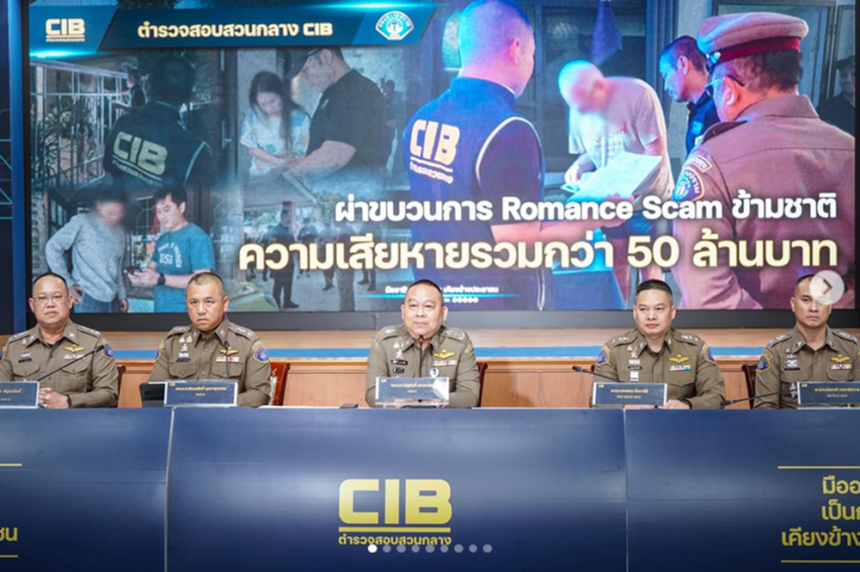
BANGKOK – The Royal Thai police say they are still looking for a Canadian and a Cambodian after breaking up a cross-border romance scam that allegedly took almost $705,000 from a Thai single mother over more than two years.
The Central Investigation Bureau (CIB) said 13 people have been arrested. Police are pursuing charges that include fraud by impersonation, forging documents, entering false information into computer systems, and money laundering. A Canadian man and a Cambodian man are still on the run, officers said.
Investigators said the case began when the woman reported it through the Thai police online system, using the Anti-Online Scam Center. She was reportedly drawn into an online relationship in 2023 after meeting a man on the ThaiCupid dating website. The conversations later moved to the LINE app.

Police said the scammer presented himself as a Jordanian single father. He claimed his business overseas had collapsed and later encouraged the woman to invest with him abroad. He promised that if the plan worked, he would move to Thailand to live with her.
Between January 2024 and July 2025, the woman made 42 transfers, losing 21.9 million baht, police said (about $704,900). She contacted authorities after the man’s messages slowed and she began to suspect she had been tricked.
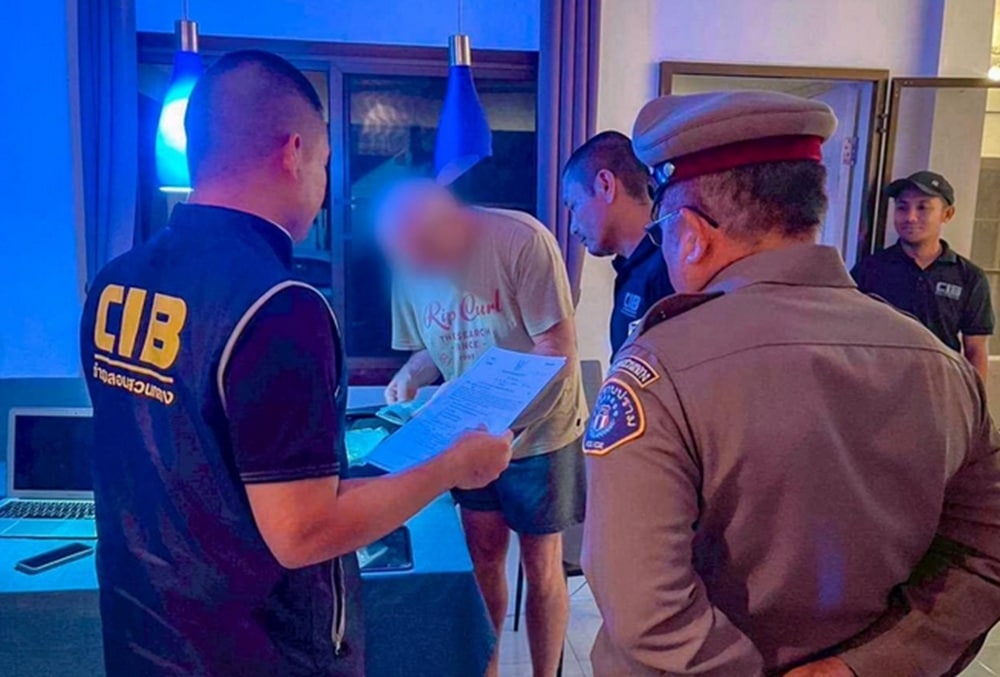
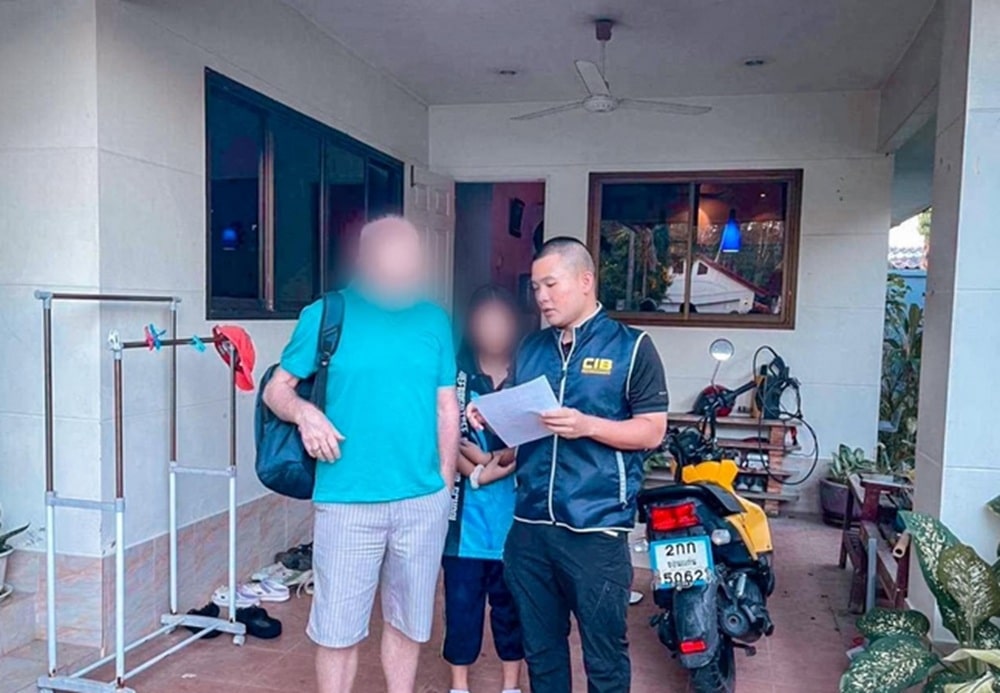
Police said warrants were approved for 17 suspects, including 14 Thais and three foreigners. The foreign names listed were one Canadian, one Cambodian, and one Swiss national. Officers arrested 13 suspects across nine provinces, while two others were already in prison for unrelated cases.
The two remaining fugitives were named by police as Mr Yat, a Canadian national, and Mr Kim, a Cambodian national.
All arrested suspects denied the allegations, police said. Some claimed they were only involved in buying and selling digital currency. Others said they were paid by unknown people to open bank accounts and set up mobile banking apps.
Investigators said the accounts linked to the group also appeared in at least 19 other call-centre scam cases, with losses topping 36 million baht (around $1.16 million). Combined with this case, police said the total damage was more than 50 million baht, roughly $1.6 million.
Police urged people not to send money to someone met online, or to accept investment pitches without checking who they are dealing with. They also warned that trading bank accounts or registered SIM cards is a criminal offence, punishable by up to five years in prison and a fine of up to 500,000 baht (about $16,100).
A senior officer said long online contact doesn’t prove trust, adding that even relationships lasting more than a year without meeting face-to-face can still hide serious risks.

Romance Scams in Thailand?
Romance scams involve fraudsters building fake romantic relationships to exploit victims financially. In Thailand, these scams are widespread, targeting both locals and foreigners (tourists, expats). Scammers operate via dating apps (e.g., Tinder, ThaiCupid), social media (Facebook, Instagram, LINE), or in-person encounters at bars or tourist spots. They exploit emotional vulnerability, often using stolen photos, AI-generated images, or elaborate backstories to appear attractive and trustworthy.
Thailand has a dual role: it’s a hub for scam operations (often transnational gangs from Nigeria, China, Korea, etc., using Thai accomplices for money laundering), and a location where foreigners are prime targets due to isolation, language barriers, and the country’s “Land of Smiles” reputation.
Common Types and Tactics
- Online Dating/Classic Romance Scams:
- Scammers pose as attractive partners (often Thai women targeting foreign men, or vice versa).
- They quickly profess love, then invent crises: medical emergencies, family illness, travel fees, or “stuck” valuables needing customs taxes.
- Requests escalate for money via wire transfers or crypto.
- Investment/Hybrid Scams:
- After building trust, they lure victims into fake investments (stocks, crypto, business ventures).
- Common in 2024-2025 reports from Thai police.
- Sextortion:
- Victims are persuaded into intimate video calls, recorded, then blackmailed.
- In-Person or Bar Girl/Guy Scams:
- Short-term relationships where the scammer extracts ongoing support (e.g., for “family” or debts), sometimes involving loan sharks.
- Marriage/Fake Matchmaking:
- Promises of marriage or introduction to partners, requiring upfront fees.
- Large-Scale Organized Operations:
- Gangs (e.g., Nigerian networks) use Thai “mules” to open bank accounts for laundering.
- Notable case: 2022-2025 scam defrauding over ฿6.2 billion (~$186 million USD) from executives, involving Nigerians and Thai women.
Transnational groups (Nigerian, Chinese, Korean) often base in Thailand or nearby, targeting global victims, including Americans.
Statistics and Impact (2023-2025)
- In 2023, 1,435 reported romance scam cases in Thailand, with losses of over ฿476 million.
- Broader cyber fraud (including romance): $2 billion lost (March 2022-August 2024).
- Overall scams in Thailand: Record ฿110 billion lost in recent years, with 6 in 10 Thais affected.
- Romance scams rank among the top fraud types in 2024-2025, spiking around Valentine’s Day.
- Impacts tourism: Warnings of a potential 5-6% drop in visitors due to scam reputation.
How to Protect Yourself
- Red Flags:
- Too-quick declarations of love.
- Refusal to video call or meet in person.
- Consistent money requests.
- Profiles with stolen/model photos (reverse image search them).
- Pressure to move off dating apps to private chats.
- Prevention Tips:
- Never send money to someone you’ve only met online.
- Verify identities independently.
- Use reputable dating sites with verification.
- Be cautious on social media; avoid sharing personal/financial info.
- Discuss suspicions with friends/family.
If You’re a Victim
- Stop contact and all payments immediately.
- Report in Thailand:
- Tourist Police: 1155 (English-speaking).
- Anti-Online Scam Operation Center: 1441 (24/7 hotline).
- Online: www.thaipoliceonline.go.th.
- Contact your bank for possible reversals.
- Seek legal help (e.g., firms specializing in fraud recovery).
- Report internationally if the scammer targeted you from abroad (e.g., FTC in the US).
Thai authorities actively warn about these (especially pre-Valentine’s) and conduct arrests, but scams persist due to organized networks. Stay vigilant—genuine relationships rarely start with financial asks.
Related News:
Related