


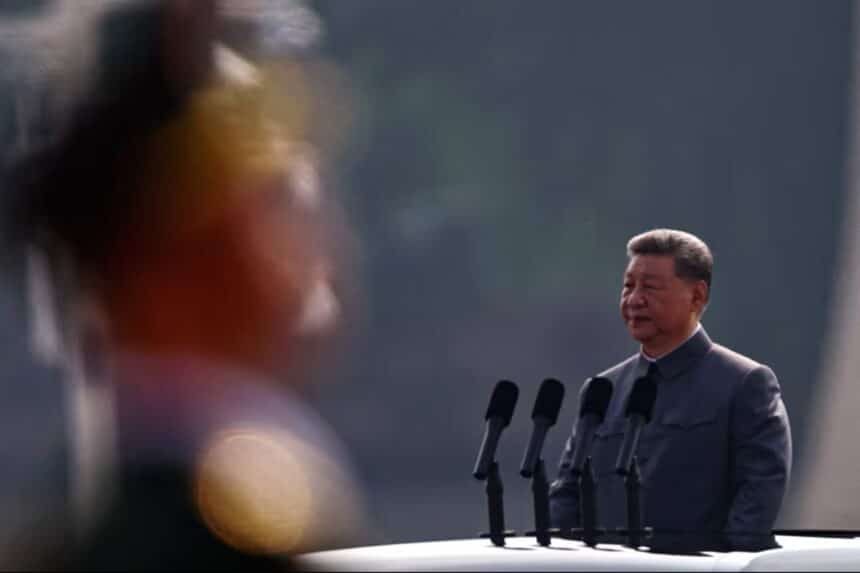
BEIJING – Chinese President Xi Jinping has put one of his most important military partners, General Zhang Youxia, under investigation for “serious violations of discipline and law.” The Ministry of National Defense announced the case on January 24, 2026.
It marks the latest step in a purge that has torn through the People’s Liberation Army (PLA) leadership.
Zhang, 75, served as vice chairman of the Central Military Commission (CMC), the top military body chaired by Xi. He stayed in place past the usual retirement age, widely tied to his long relationship with Xi Jinping.
Both men are “princelings” with roots in Shaanxi province, and their families share revolutionary-era connections from the 1940s. Even though history has not protected Zhang, Xi’s distrust widens.
The CMC was set at seven members after the 20th Party Congress in 2022. It now sits at just two, Xi and Zhang Shengmin. Zhang Shengmin, known for enforcing discipline and anti-graft rules, took over after
He Weidong was removed in October 2025. He, the other CMC vice chairman, was expelled along with eight other senior generals on corruption charges.
Earlier targets included former Defense Ministers Li Shangfu (2023) and Wei Fenghe (2024), senior Rocket Force leaders, and Miao Hua, who led the CMC Political Work Department until his suspension in November 2024. Joint Staff chief Liu Zhenli has also faced scrutiny.
Outside reporting has added sharper claims. The Wall Street Journal has alleged that Zhang passed nuclear-related secrets to the United States and took bribes. Beijing has not released details, which many observers treat as a sign that the real issue is political loyalty, not paperwork.
This does not look like a routine anti-corruption campaign. Many analysts see a broader shift, where loyalty checks outweigh readiness and performance. K. Tristan Tang of the Pacific Forum has described the effort as putting political loyalty ahead of combat strength.
Even officers promoted under Xi Jinping have been pushed out. Bloomberg reported that by October 2025, 15 of 79 generals promoted under Xi had been removed.
A Climate of Fear Under Xi Jinping: No One Gets a Pass
Xi’s system runs on a simple rule: anyone can fall. Reuters used that theme in its coverage of the Zhang investigation. Accounts from people watching Zhongnanhai describe a leadership circle where access is tight and direct contact is rare.
Senior officials often communicate through General Office channels, which reduces open discussion and raises the cost of saying the wrong thing.
Online commentators have framed the pattern as a hunt for betrayal. Posts on X from observers such as @wuchengwu0, a Chinese exile, describe Communist Party power struggles as fear-based, where investigations often signal shifting trust, not just financial misconduct.
Some analysts link the purge cycle to Xi’s personal insecurity. Su Hao, quoted by the New York Times, points to Xi’s sensitivity to threats.
Dr James Char of Singapore’s S. Rajaratnam School of International Studies has said the removals can also answer complaints that discipline drives are selective. The trade-off is steep. Each round chips away at trust inside the officer corps. Leaders learn to praise upward and stay quiet, even when honest feedback matters.
Neil Thomas of the Asia Society Policy Institute has called it one of the largest purges in PRC history. PLA Daily has also run commentaries pushing “absolute obedience” to Xi after the Zhang case became public.
History gives a warning. Stalin’s 1937 purge badly weakened the Red Army, which hurt Soviet performance early in World War II. Xi does not have a combat record, aside from a short period as a defense aide in the 1980s, so he often leans on ideology and control to close that gap.
The Pentagon’s 2025 China Military Power Report noted that constant turnover can lower confidence in leadership reliability, including reports of commissar removals across multiple services.
X users like @DavidAltonHL have compared the mood to rumor-driven paranoia, with coup fears in the background. Others, including @BodpaW, warn that unstable command structures raise the odds of mistakes, from Tibet to the Taiwan Strait.
From Commanders to Loyalists: Politics First, Skill Second
A common concern is that the purge pattern rewards loyalty more than skill. Critics say replacements often come from Xi Jinping’s trusted networks, including Zhejiang-era allies sometimes called the “Zhijiang Army,” as well as connections tied to Shaanxi. Zhang Shengmin is often placed in that loyalty-focused frame.
The Jamestown Foundation has argued that Xi prefers loyalists over highly capable officers, a dynamic that can make procurement corruption harder to fix, not easier, in a system with limited transparency.
Changes inside the Rocket Force show the risk. The re-shuffle moved in officers from other services, including Air Force and Navy backgrounds. The Pentagon has described this as a push that can favor party trust over deep technical experience.
That shift also sidelines some of the few senior leaders with real combat exposure, including veterans of the 1979 Sino-Vietnam War, such as Zhang.
Commentators in US media, including Fox News’ Craig Singleton, have argued the purge is meant to lock in political control before any high-risk operation, including Taiwan-related moves. The message to the force is clear: personal loyalty is the safest career plan.
Readiness can suffer under that model. Procurement slows when investigations spread into defense firms and contracting chains. Projects can stall, and officers can hesitate to sign off on decisions. The 2025 China Military Power Report also warned of morale and trust problems when junior officers cannot rely on stable leadership.
On X, @MarioNawfal framed the removals as Xi Jinping clearing out anyone he cannot fully trust ahead of future Taiwan pressure.
The loyalty-first approach extends beyond the PLA. Xi’s 2022 Politburo lineup elevated close allies such as Cai Qi and Ding Xuexiang, while sidelining other factions, as reported by the Guardian. China’s system also offers no clear successor path.
The vice presidency holds little real power. Analysts at the Lowy Institute have described this phase as “Maximum Xi,” with norms pushed aside in favor of strict personal loyalty.
A Leader at the Top, and Fewer People Around Him
When power stacks upward, isolation often follows. Xi’s travel has stayed limited compared with earlier periods. He has not attended events such as the UN General Assembly, the G20, or COP in recent years, with much of his schedule centered in Beijing.
Some reports say Xi Jinping increasingly works through small “central deliberative bodies,” rather than relying on broader Politburo discussion. That structure can speed decisions, but it can also narrow the input Xi hears. It also makes it harder for insiders to know where they stand.
Even close allies can look vulnerable. Cai Qi, a senior figure and head of the General Office, reportedly disappeared from public view briefly in November 2025 during a period of intensified political discipline talk. There is still no designated heir ahead of the 2027 Party Congress, while top leadership ages upward.
The Economist has described Xi Jinping’s paranoia as a force that pushes China toward a more closed and inward-facing posture. Abroad, China’s lending has reportedly cooled in parts of Africa as debt concerns rise. At home, Xi’s “self-revolution” messaging, often described as “turning the blade inward,” demands constant purification. That can also build quiet resentment if people fear they could be next.
Pressure Abroad While the Economy Cools at Home
While Xi Jinping tightens control inside the PLA, China has continued to fund military expansion. The defense budget reached about $246 billion in 2025 and has roughly doubled under Xi’s tenure. China’s nuclear build-up has also drawn attention. Public estimates referenced by US sources have pointed to 600 or more warheads, with projections that could rise toward 1,000 later in the decade.
The 15th Five-Year Plan (2026 to 2030) is expected to keep pushing “intelligentized” warfare and Military-Civil Fusion, with self-reliance framed as protection against US pressure and technology restrictions.
Taiwan remains central. Xi has repeatedly called for readiness by 2027. PLA drills around the island have grown in scale, including live-fire activity and encirclement-style operations. At the same time, purges can slow command rebuilding. Su Hao has suggested it could take years to stabilize leadership after so much turnover. NBC has reported that the purges may lower near-term invasion odds, while still raising the risk of miscalculation.
Meanwhile, the economy shows strain. Growth hit about 5 percent in 2025, meeting the target, but with less momentum than in earlier years. Forecasts cited by DBS and ThinkChina put 2026 growth around 4.5 to 4.8 percent.
China still faces a long property slump, weak consumer demand, deflationary pressure, youth unemployment issues, and heavy local government debt. Exports helped in 2025 but have shown signs of softening, with added worries in areas such as housing and parts of the EV market.
Xi Jinping has promised stronger macro support, including comments delivered on December 31, 2025. Still, the balance often tilts toward security and control, not broad stimulus.
Some strategists argue economic stress can increase nationalism, but others believe Xi cares most about regime stability and avoiding chaos, not rushing into war. A major conflict would be costly and could damage the Communist Party’s core claim that it delivers rising living standards.
The 15th Five-Year Plan appears to accept slower growth if it supports national security, echoing the official view that security comes before development. The tension remains: fear and rigid control can choke the same energy China needs for innovation and recovery.
Purge Power and the Risk of a Hollowed Force
China’s armed forces have modern hardware, including hypersonic weapons and new naval platforms. The problem is not only equipment. It is leadership stability. The Pentagon has pointed to “uncertainty” created by repeated removals and reshuffles.
A Taiwan invasion in 2026 still looks unlikely in many assessments, including an analysis cited by ASPI. Yet gray-zone pressure continues, including air and maritime coercion tactics.
At home, the purge wave signals vulnerability as much as strength. Some online observers compare it to past dynasties where rulers feared their own generals. The same pattern can raise risks outside China’s borders, especially in the Taiwan Strait and the South China Sea, where a shaky chain of command can turn a tense moment into a crisis.
Xi Jinping’s China can look strong from a distance. Up close, the system shows stress fractures. The PLA may keep growing in size and firepower, but fear is a poor substitute for trust, and it can dull the edge of any military.