



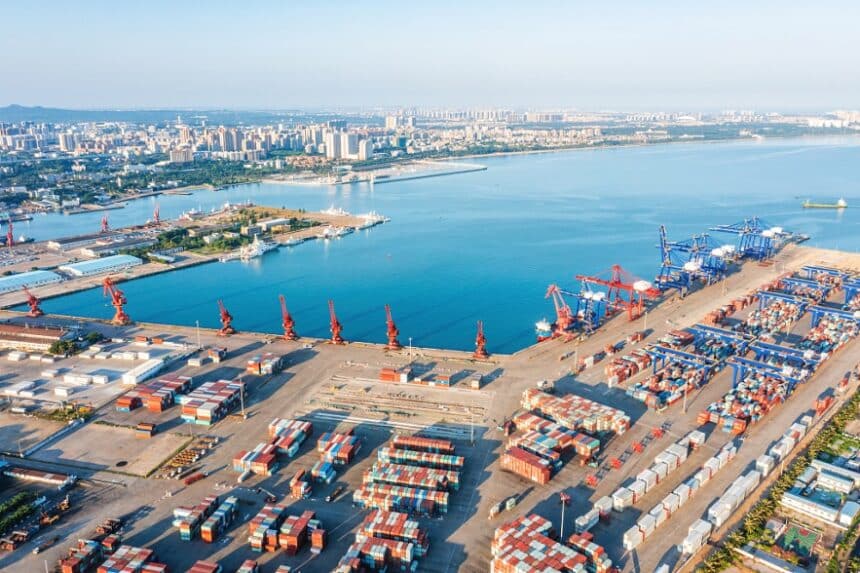
HAINAN – An iPhone that costs about $100 less might not sound like a trade policy story, but in China’s Hainan Island, it is. As global trade faces rising tariffs and growing protectionism, China is moving in the opposite direction by opening one of its doors wider. That door is Hainan, a tropical island now being positioned as China’s most ambitious experiment in free trade and economic openness.
On December 18, the country launched island-wide special customs operations in Hainan, transforming the entire island into a high-standard free trade zone, not a single port or industrial park, but the whole island. Expanded zero-tariff policies and new value-added rules are reshaping costs for international companies and delivering real savings to consumers.
What makes Hainan Free Trade Port unique?
China already has 22 free trade zones (FTZs), but Hainan represents a fundamentally different level of openness. Most FTZs are limited to specific urban areas and focus on upgrading local industries. Hainan has transformed an entire island into a unified free trade port, with its own customs, tax, and regulatory system.
Under the new policy, Hainan functions as a special customs area, enabling deeper institutional reforms: broad zero-tariff policies, freer cross-border capital flows, and a value-added processing policy that allows qualifying products to enter the Chinese mainland duty-free.
This scale matters. Hainan’s land area is more than 35,000 square kilometers, which is over 70 times the combined area of China’s 156 bonded zones. What elsewhere happens in tightly fenced industrial parks can, in Hainan, happen almost anywhere on the island.
For international companies, this provides unprecedented access and flexibility compared to other regions in China.
Island-wide Special Customs Operations: How it works
The rules sound technical, but the logic is straightforward.
-
Massive Zero-Tariff Expansion:
The share of goods eligible for zero tariffs rises from 21% to roughly 74% of all tariff lines, covering nearly all production equipment and key raw materials. Companies importing machinery and materials could reduce tax costs by around 20%.
-
30% Value-Added Rule:
Products processed in Hainan with at least 30% of their value added locally can enter the Chinese mainland duty-free. In simple terms, Hainan is saying: don’t just pass goods through – do real work here. Assembly, manufacturing, processing, and supply-chain development all count.
-
The “Double 15%” Tax Advantage:
For companies registered and genuinely operating in Hainan, and belonging to encouraged industries, corporate income tax is capped at 15 percent, compared with 25 percent on the mainland and 16.5 percent in Hong Kong.
The list of encouraged industries is broad, ranging from desalination equipment and commercial space launches to imported food processing, modern agriculture, and even rural homestays.
For individuals, the incentive is just as striking. For professionals listed in Hainan’s talent catalog, personal income tax is also capped at 15 percent, compared with a top rate of 45 percent on the mainland.
-
Simplified Regulations:
Customs and import procedures have been streamlined, including removing licensing requirements for many used mechanical and electrical products. This reduces administrative barriers and makes cross-border trade faster and easier.
Real impact: Businesses and consumers benefit
The effects of these reforms are already visible. Jingrun Pearl became the first company to benefit from these preferential policies. Founded in 1994, the company sells pearl accessories across Hainan, including at airports, ports, and resorts.
With the new policies, products with more than 30% value added locally now qualify for zero-tariff duty when sold on the Chinese mainland.
CEO Zhou Shuo recently purchased 40,000 pearls valued at $1.67 million, saving roughly $248,000 in taxes. By passing on some of these savings, Jingrun Pearl can offer customers lower prices, with some products now up to 20% cheaper.
This case demonstrates how Hainan’s policies can directly benefit both businesses and consumers, turning economic reform into tangible public gain.
People, capital, goods, and data: Making the four elements move
Successful global hubs usually excel at mobilizing one or more core economic elements. Hong Kong has long been a master at activating capital as an international financial hub. Singapore has optimized goods, handling roughly one-fifth of global merchandise trade through its ports. Dubai, meanwhile, has turned the free movement of people into an engine of growth.
Hainan is attempting something broader: activating goods, capital, people, and data at the same time.
86 countries now enjoy visa-free entry to Hainan. Capital flows are easier to manage across borders. Goods move with fewer tariffs and fewer barriers. And administrative systems are being redesigned to reduce friction wherever possible. The goal is to make the island feel less like a traditional special zone — and more like an international economic crossroads.
Early indicators suggest rising international interest. In the first three quarters of this year, Hainan’s actual use of foreign investment grew by over 40%, attracting companies from 176 countries and regions.
A clear signal to the world
Beyond immediate economic gains, many experts see Hainan’s deeper role as strategic.
Hainan is an island, both physically and institutionally. That separation matters. Unlike land-connected zones, abnormal flows of goods, capital, data, or people can be monitored and, if needed, contained.
Under the framework of “first-line liberalization” and “island-wide freedom,” the island allows China to test reforms in sensitive areas: offshore finance, cross-border data flows, and internationalized medical services.
Zero-tariff policies and simplified market access also act as stress tests, revealing which domestic industries struggle under global competition and which are capable of upgrading. Crucially, any side effects — speculative capital, smuggling risks, or financial volatility — can largely be confined to the island itself.
For this reason, experts often emphasize that Hainan’s goal is not to become China’s next economic engine overnight. Its primary function is to be a testing ground for internationalized rules within a controlled and manageable space.
The launch of an island-wide special customs operation sends a strong international signal: China is committed to opening up, even amid global uncertainty. Hainan serves as a testing ground for reforms that could be applied nationwide, while providing foreign companies with easier access to China’s domestic market.
By Chen Ziqi, reporter and editor at Round Table China, an English-language podcast exploring trends online and on the streets of China and around the world.
Related News:
Will China’s Shared Future Save the World From Fragmentation