



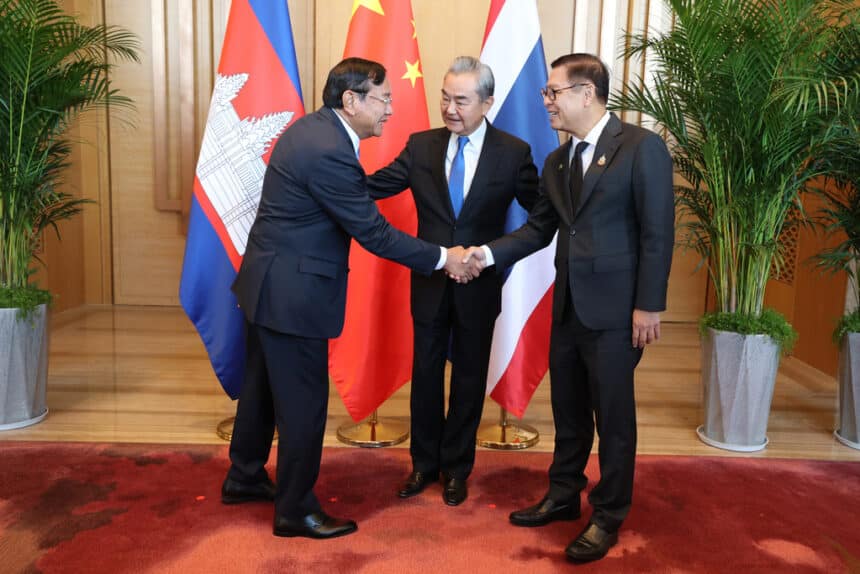
YUXI, China, – Cambodia and Thailand sent their foreign ministers to Yunnan on Monday for talks with China, as Beijing steps up its efforts to mediate the violent border dispute between the two neighbours.
The meeting in Yuxi, a city in south-west China, formed part of a fresh diplomatic push to steady a ceasefire agreed only days earlier. The truce remains shaky after months of clashes that have killed more than 100 people and forced hundreds of thousands from their homes.
The talks on 29 December were held at the invitation of China’s Foreign Minister Wang Yi. Cambodia was represented by Deputy Prime Minister and Foreign Minister Prak Sokhonn, while Thailand sent Foreign Minister Sihasak Phuangketkeow.
Senior military officials from all three countries also joined the discussions, highlighting how tense the situation remains along the 817-kilometre border.
The session followed a ceasefire signed on 27 December by the Thai and Cambodian defence ministers. That deal was reached during a special General Border Committee meeting at a checkpoint in Thailand’s Chanthaburi province. It took effect at once and set a halt to fighting, no further troop movements, and the safe return of displaced civilians.
It was also the second ceasefire attempt of 2025. A previous agreement in July, supported by Malaysia in its role as ASEAN chair and backed by pressure from the United States, later fell apart amid claims of breaches.
Fighting flared again in early December and quickly escalated. Border areas saw heavy artillery exchanges, Thai F-16 airstrikes, and rocket fire that damaged towns and villages on both sides.
The dispute stems from long-running territorial claims linked to colonial-era border lines. The worst violence has focused on contested zones near ancient temple sites, including Preah Vihear and Ta Muen Thom. The latest round began in July after a Thai patrol hit a landmine, and then the situation worsened fast. By December, more than 500,000 people had been displaced across the border region, with reports of civilian deaths caused by shelling.
China’s Wang Yi Urges Shared Work for Stability
During the trilateral meeting, Wang Yi called on both sides to work together to protect peace, stability, and development in the region.
China has been “actively mediating and providing good offices” since the conflict began, Wang said, according to a statement from the Ministry of Foreign Affairs. He described Cambodia and Thailand as “eternal neighbours” and said the meeting in Yunnan should help ease tensions and serve the interests of both peoples.
Wang also said China was ready to provide humanitarian support, including supplies for displaced families. He also backed ASEAN observer teams monitoring the ceasefire and offered help to keep that work going.
Officials said the meeting ended with a three-part understanding. The sides welcomed the recent ceasefire statement, supported a return to exchanges and co-operation, and agreed to rebuild political trust through diplomatic channels.
Thailand’s foreign minister said the talks helped move things forward. “We haven’t resolved everything, but I think we are making progress, and we have to keep up the momentum,” Sihasak told reporters afterwards. He added that Thailand saw China not only as a mediator but also as a constructive force in keeping the ceasefire in place.
Cambodian officials also reaffirmed their commitment to follow the truce and use dialogue channels to manage disputes.
China’s Expanding Role as a Regional Mediator
The meeting in Yuxi is China’s latest effort to play a bigger part in conflict mediation, including across Asia. Holding talks in Yunnan, closer to South-east Asia than Beijing, also carried a message. The province borders Myanmar, Laos, and Vietnam, and China often uses it as a base for engagement with mainland South-east Asia.
Some analysts view China’s involvement as part of a wider diplomatic drive, following earlier efforts such as helping Saudi Arabia and Iran restore ties. In Southeast Asia, where China has deep trade links and major Belt and Road projects, calm along key borders also supports Beijing’s interest in stable transport routes and cross-border commerce.
China’s push comes after earlier attempts led by ASEAN and the United States failed to stop the July truce from collapsing. Officials say China’s quieter work, including leader-to-leader calls and informal contacts, helped create space for the December ceasefire.
Wang voiced support for ASEAN’s role and offered help to observer missions, along with humanitarian de-mining. China also pledged emergency aid, including food, tents, and blankets, for affected communities.
Hard Work is Still Needed for a Lasting Peace
Even with the new agreement, a lasting peace is far from certain. Both sides have accused each other of provocation, while hostile messaging has made trust harder to rebuild. The ceasefire includes a 72-hour observation period. After that, Thailand plans to release 18 captured Cambodian soldiers, while also seeking the return of Thai nationals stranded across the border.
Large parts of the frontier remain undemarcated, and tensions around historic sites still run high. Observers say joint bodies, including the Joint Boundary Commission, can help, but progress depends on steady political will in both capitals. The Yunnan schedule also included separate bilateral meetings between Wang and each minister on Sunday, giving each side time for more direct talks.
As the delegations left Yuxi, attention turned to what happens next on the ground. With China’s support, Thailand and Cambodia have again committed to de-escalation and dialogue. Sihasak said Thailand was ready to look ahead, strengthen communication, and protect calm along the border, echoing messages shared during the meeting.
For families still living in temporary shelters, the hope is simple: that diplomacy holds, the guns stay quiet, and daily life can start to recover. The road back to trust will be long, but the Yunnan talks offered a sign of progress in a region that has seen too much violence in recent months.