


SHANGHAI — A morning hop from Hangzhou to Seoul became a frightening ordeal on Saturday when a lithium battery in an overhead bag caught fire, filling the cabin with smoke and forcing an urgent diversion.
The Air China flight landed safely, and while nerves were frayed, no injuries were reported. Quick action by the crew kept the situation under control and renewed focus on the risks of power banks and lithium‑ion batteries on board.
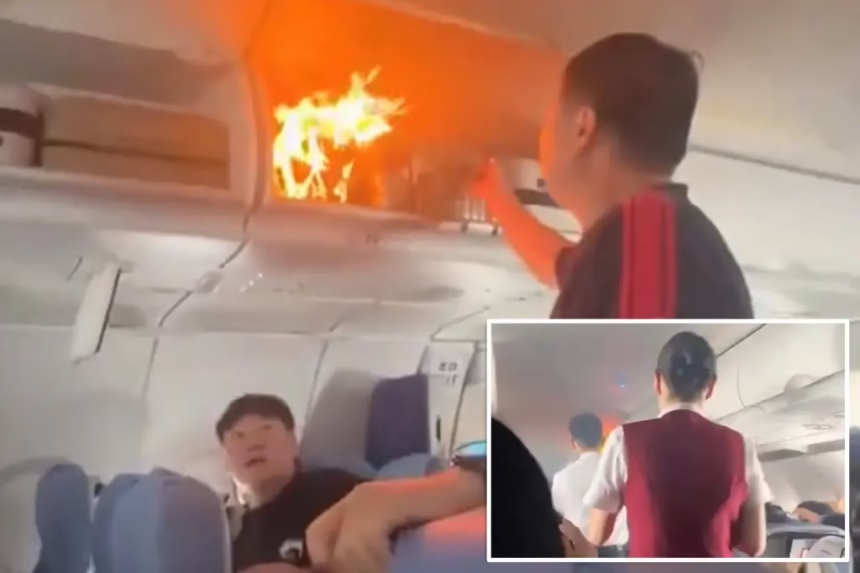
Air China flight CA139, an Airbus A321-200 registered B-8583, left Hangzhou Xiaoshan at 9:47 a.m., due into Incheon at 12:20 p.m. About 20 minutes after take-off at around 33,000 feet, a battery stored in a carry-on in the overhead bin reportedly ignited, according to an airline post on Weibo. Thick, acrid smoke spread through the cabin as the compartment smouldered.
Passengers described a chaotic scene. “There was a loud pop above my seat, like a small firework,” said Li Wei, 42, a software engineer from Hangzhou in row 12. “Smoke poured from the bin like a genie from a bottle. People screamed, some in Mandarin, others in Korean, shouting to hurry.
The flight attendants arrived with extinguishers, calm but focused. I thought, This is it.” Clips shared widely on social media, including X, show flames inside the bin, passengers shielding their faces, and crew members putting out the fire while giving firm instructions.
Captain Zhang Wei and the first officer declared a Mayday and turned toward Shanghai Pudong, about 100 miles away. The approach and landing were steady and controlled, with touchdown at 11:05 a.m. Fire and rescue vehicles met the aircraft on arrival.
Risk of Lithium Batteries
Passengers disembarked via mobile stairs while firefighters examined the scorched luggage area. “The crew’s training saved us,” Li said later, sitting in a Pudong lounge and waiting for a new flight. Air China offered compensation of 200 yuan for economy and 300 yuan for business class, plus meals and hotel vouchers for anyone delayed overnight.
The episode is a sharp reminder of how risky lithium‑ion batteries can be when things go wrong. These compact cells power phones, laptops, e‑cigarettes, and power banks. Their high energy density makes them useful, but it also raises the risk when damaged or poorly made.
Under stress from defects, impact, overcharging, extreme heat, or saltwater, they can enter thermal runaway. Heat builds, gases form, pressure rises, then flames erupt, with temperatures that can approach 1,000 degrees Celsius. Unlike many fires, battery fires can feed themselves, which makes them stubborn to put out and dangerous in tight spaces.
Regulators have warned about this for years. The U.S. Federal Aviation Administration reported 38 incidents involving lithium batteries on U.S. flights through 30 June this year, a serious number even as rules have tightened compared with 2024.
In a pressurized cabin, smoke can spread fast and reduce visibility and oxygen. Any fire near wiring or critical systems raises the stakes. “These batteries can act like grenades with faulty pins,” said Dr Sarah Kline, a materials scientist at MIT who researches battery failures. “On the ground you might scorch a rug. At 30,000 feet, you risk everyone on board.”

Air China Incident Follows Other Close Calls
China, a major centre for battery production, has tightened its rules. In June, after several scares, including a China Southern flight that turned back due to a smoking camera battery, the Civil Aviation Administration banned uncertified portable power banks on domestic flights.
Only units marked with national safety standards are allowed, and spares must go in carry-on bags, not the hold. IATA requires airline approval for batteries over 100 watt‑hours, and the FAA bans spare lithium batteries in checked luggage.
Yet many people still ignore the rules. An IATA survey in 2024 found that 15% of passengers packed unapproved spares, often without realizing the danger.
This Air China incident follows other close calls. In January, an Air Busan service saw a power bank fire that left seven people suffering from smoke inhalation. Another Chinese carrier diverted in May after a similar event. Experts, including Dr Kline, want safer designs, such as shutdown features or smarter monitoring of cargo.
Until those are standard, careful packing and compliance remain the first line of defence. The FAA advises one power bank under 100Wh, kept in the cabin, not charged in flight.
A replacement aircraft took passengers to Seoul later on Saturday. The original A321 remained in Shanghai for inspection. Investigators from China’s aviation regulator are examining the battery, believed to be a power bank, to determine the cause. For Li Wei and many others, the experience will linger. “I love my gadgets, but next time I will skip the spare,” he said, glancing at the bins before boarding again.
As people carry more devices than ever, the lesson is simple. Convenience can carry a hidden cost. Airlines and authorities must keep tightening standards, and passengers must play their part. Before packing that extra battery, ask if it is worth the risk.