





CHIANG RAI – Morning fog still hangs over the ridgelines, and the first Specialty Coffee blossoms add a soft scent to the cold air. Up on these highlands, coffee is no longer just another farm option. In Chiang Rai, specialty coffee has become a province-wide plan tied to farmer income, community jobs, and Thailand’s place in the global coffee market.
While many regions face tighter supply, climate risk, and stricter environmental rules, Chiang Rai stands out for one clear reason. The numbers back it up. This province is now the strongest base for Thai coffee.
Crop-year 2025 data from Thailand’s Office of Agricultural Economics (OAE), Ministry of Agriculture and Cooperatives, shows Chiang Rai as the country’s top coffee producer. Total output reached 4,850 tons from 55,415 rai of planted area, with 53,954 rai in production.
Put next to Thailand’s total coffee output of 16,020 tons, Chiang Rai accounts for about one-third of national production. The North produces 11,390 tons overall, more than 70% of the country’s coffee. Other top-producing provinces include Chiang Mai (3,203 tons), Nan (936), Mae Hong Son (921), Lampang (517), and Tak (396), all ranked in the national top 10.
What separates Chiang Rai from most provinces is how fully it focuses on Arabica. Of the province’s 4,850 tons, 4,822 tons are Arabica, about 99.25%. Robusta, which is more common in Southern Thailand, totals only 28 tons.
That mix makes Chiang Rai more than a big producer. It has become Thailand’s Arabica center, supplying many Thai specialty roasters and drawing coffee travelers who want to taste coffee at the source.
More coffee-growing households
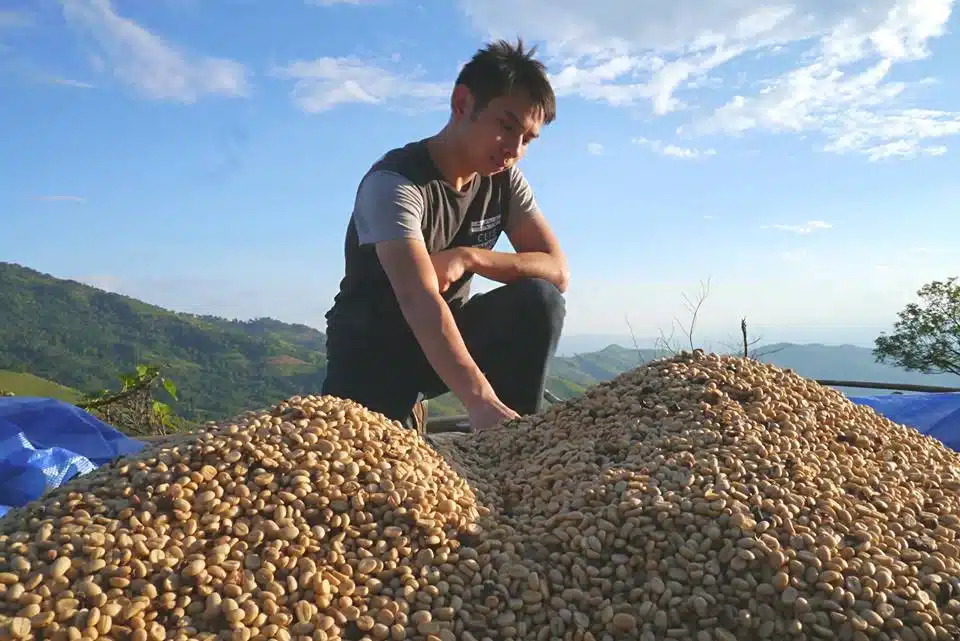
Across Thailand, the number of specialty coffee-growing households has dropped year after year, from 29,761 households in 2020 to 24,949 in 2025. Chiang Rai moved in the opposite direction. Local coffee households rose from 3,147 in 2020 to 3,921 in 2025.
The North as a whole also grew, from 13,067 households to 15,685 over the same period. That trend suggests highland communities still trust Arabica’s potential, while many Southern growers have switched to other crops or left coffee production.
In Chiang Rai, this growth isn’t only about headcount. It points to a changing community structure. Over the last 4 to 5 years, more young farmers have returned from big cities to invest in coffee farms, small stays, and local businesses.
Many long-time growers have also shifted away from single-crop farming toward mixed systems on the hills. Common pairings include coffee under shade trees with macadamia, avocado, or even herbs. This helps reduce risk when prices swing.
The province’s increase, while the national figure declines, signals how people now see specialty coffee in Chiang Rai. It’s a practical path for income, food security, and watershed forest care at the same time.
Northern Thailand is the backbone of specialty coffee.
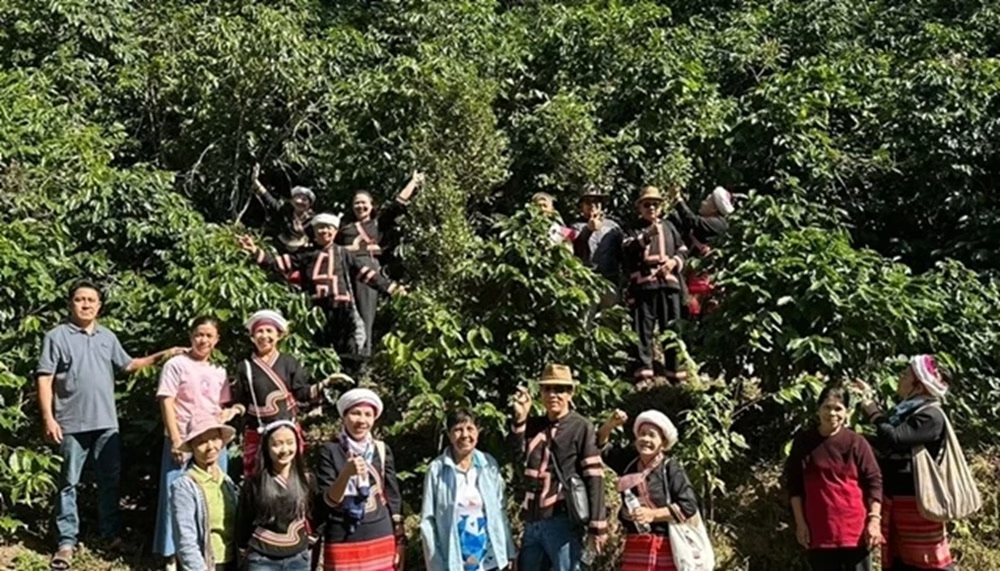
Zooming out, the data makes one thing clear. Northern Thailand is the heart of Thai coffee. The region has 138,574 rai of planted area and produces 11,390 tons. Arabica dominates, at 10,705 tons, more than 93% of Northern output.
Chiang Mai and Nan act as strong partners alongside Chiang Rai. Chiang Mai produces 3,203 tons across 35,615 rai, and Nan produces 936 tons from 12,677 rai. Mae Hong Son and Lampang produce less, but they are gaining attention in specialty coffee thanks to steep terrain, deep soils, and colder conditions that suit high-quality Arabica.
Seen as one connected chain, Chiang Rai plays a second role beyond farming. It’s also a trade and tourism gateway, moving coffee from mountain communities to city markets. With border logistics routes around Mae Sai and Chiang Khong, the province can also reach buyers abroad, especially in Southern China and Laos, both growing markets for Thai coffee.
Even with strong numbers in Chiang Rai and the North, Thailand’s overall coffee supply remains tight.
Thailand produces about 16,020 tons of coffee per year, while domestic demand is around 90,000 tons per year. That means local production covers only about 17% of what the country uses. More than 80% must be filled through imports of green beans and coffee products. In early 2025, Thailand’s coffee import value reached 8,387.30 million baht, based on international trade data.
Compared to the past, the drop is sharp. In 2001, Thailand produced as much as 86,000 tons. Over the last two decades, production has shrunk for key reasons: climate change has reduced suitability in some Arabica areas, and many farmers shifted to faster-return crops such as durian or certain field crops.
While many provinces have reduced coffee area, Chiang Rai has expanded both land and grower households. That trend suggests a large part of Thai coffee’s future depends on how well Chiang Rai and the wider North can protect and improve a sustainable coffee supply chain.

Global shifts, Tight supply, price swings, and stricter environmental rules
On the global stage, crop year 2025 to 2026 has been described as a year of tight balance. Forecasts from the International Coffee Organization (ICO) and the USDA put world production around 178 to 179 million 60-kilogram bags, while consumption rises to about 180 million bags. Ending stocks have fallen to around 20 million bags, down for the fifth year in a row.
When supply is tight, prices jump. Global coffee price indexes have climbed close to three times over the past two years. Climate shocks also keep hitting. Droughts in Brazil, off-season rains in parts of Asia, and other extremes push growers to adjust. In several places, producers have shifted more planting from Arabica to Robusta to manage risk.
Trade policy has also shaken the market. Under President Donald Trump, US tariff measures drove US retail prices for roasted and ground coffee up by over 30% at one point. Even after tariffs on coffee from Brazil were later lifted, the cost shock still rippled across supply chains. Many expect the market will need time, possibly until the third quarter of 2026, before it settles into a new normal.
At the same time, the European Union is moving toward full enforcement of the EUDR rules for deforestation-free products, including coffee. Full enforcement for large companies has been pushed to December 2026, but the message is already clear. Producing countries, Thailand included, need stronger traceability systems and mapped farm plots to keep access to premium EU markets.
For Chiang Rai, these rules can cut both ways. Without preparation, the province could lose access to higher-value markets. With early action on data, traceability, and greener production, Chiang Rai can lift long-term value and strengthen its position.
Chiang Rai 2026 Coffee Strategy
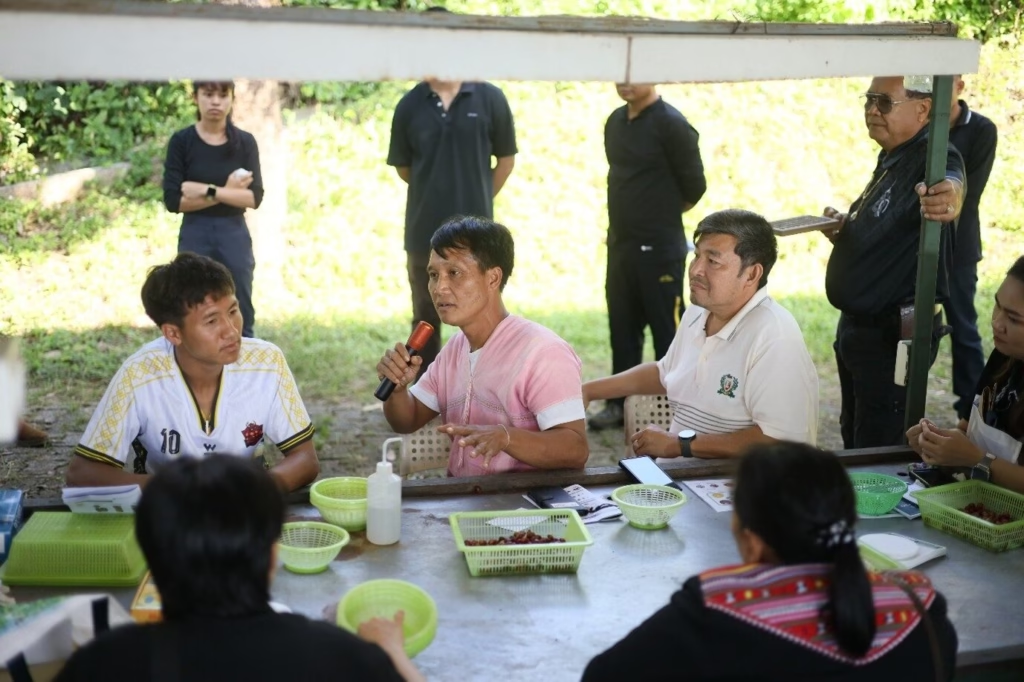
When you connect the provincial, national, and global numbers, Chiang Rai sits at a turning point for Thai coffee. Local discussions across sectors point to four main pillars that shape the Chiang Rai Coffee Strategy 2026.
Move from “selling volume” to “selling value” with specialty coffee and GI with high elevations and cool conditions, Chiang Rai is well-suited to Arabica with fruity and floral notes that specialty buyers look for. Pushing for stronger Geographic Indication (GI) coverage across areas like Doi Tung, Doi Chang, Doi Mae Salong, and other origins can build a clear regional brand.
The global specialty coffee market in 2025 was estimated at more than $10 billion, with forecasts of about 10% average annual growth through 2032. A key customer group is ages 18 to 24, who often care about ethical sourcing, community stories, and complex flavor, not just strong taste.
For Chiang Rai, telling the origin story matters. Shade-grown farming under forest canopies, jobs for young people on the hills, soil care, and clean water protection are not just marketing lines. They are part of how the product earns a higher price in city cafés and overseas.

Connect coffee with experiential tourism
Chiang Rai is being promoted as both a coffee destination and a wellness travel province. New routes built around “drink coffee from source to cup” are becoming a major draw. These trips often include walking through coffee plots, tasting ripe cherries, learning wet and dry processing, and finishing with roasting and brewing at hilltop cafés.
Linked with the Tourism Authority of Thailand’s Chiang Rai direction, which aims to shift the province from a pass-through stop to a place people stay and experience, coffee tourism can act as a core product. It brings income, extends the length of stay, and spreads spending into highland communities.
In Chiang Rai’s highlands, coffee is tied to watershed forests. Regenerative farming practices are gaining ground, including shade-grown coffee, mulching, more plant diversity in plots, and reduced chemical use.
National programs such as Coffee++ and Nescafé Plan 2030 have shown that when farmers switch toward regenerative systems, they can cut greenhouse gas emissions by about 40% and increase income through companion crops. In Chiang Rai, this approach supports forest protection, improves the environmental image of local coffee, and prepares producers for EUDR requirements ahead.

Data, technology, and cooperation
The Chiang Rai Coffee Strategy 2026 won’t work without shared data and real coordination. That means aligning efforts across public agencies, local governments, education partners such as Mae Fah Luang University, private firms, roasters, and tourism operators.
Key steps include building plot-level geolocation data, linking traceability with global standards, using sensors and precision farming tools to manage water and fertilizer, and developing finance and insurance products that match the needs of highland coffee growers. These pieces help Chiang Rai move toward being a national model for sustainable coffee.
Put all layers together, Chiang Rai’s 4,850 tons, about one-third of Thailand’s coffee, the rise in coffee households against the national decline, and the global pressure from tight supply and stricter green rules, and the picture changes. Chiang Rai coffee is no longer on the edge of the industry.
Every cup served in a Chiang Rai café, or in a premium shop in Bangkok or abroad, carries more than morning energy. It carries income for mountain communities, momentum for the Northern economy, and proof that Thailand can compete through quality, sustainability, and a better life for people at the source.
The next step is simple to say and hard to do. Turn the Chiang Rai Coffee Strategy 2026 from a written plan into real change on the ground, across farms from Doi Tung and Doi Chang to Doi Mae Salong and small Mekong-side villages. In a world where coffee faces supply risk and environmental pressure at once, the places that act early will be the ones that stay out front.