


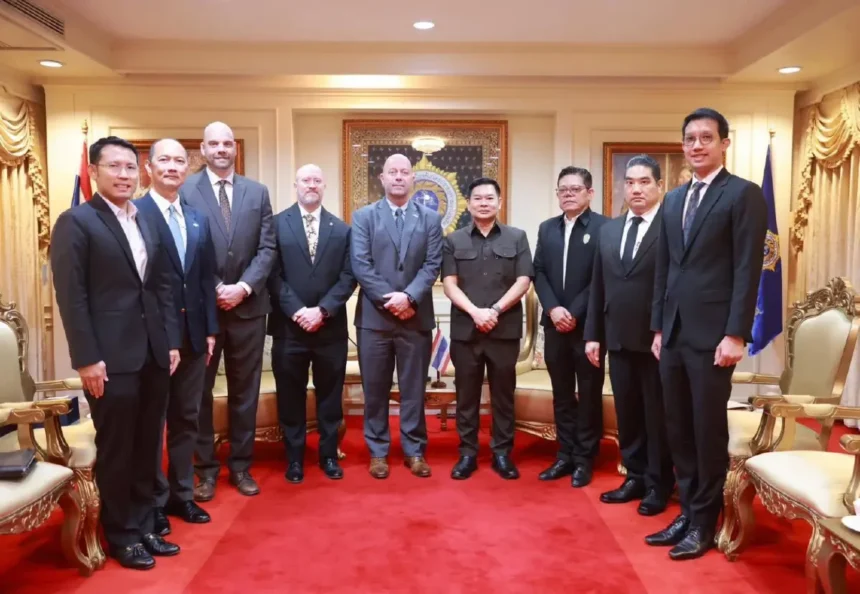
CHIANG RAI – The Secretary-General of Thailand’s Office of the Narcotics Control Board (ONCB) met with the US Drug Enforcement Administration (DEA) to strengthen joint work against narcotics and transnational crime.
The ONCB also agreed to co-host the Regional International Drug Enforcement Conference (Regional IDEC) 2026 in Chiang Rai. Talks highlighted progress on chemical interception operations and plans to expand the Sensitive Investigative Unit (SIU) training facilities, enabling Thai officers to investigate online drug networks and scam groups.
Police Lt Col Suriya Singhakamol, Secretary-General of the ONCB, welcomed and held official discussions with a DEA delegation. The team was led by Mr Matthew K. Gomm, Assistant Director for the Asia-Pacific Regional Office, along with Mr Jesse E. Odum, DEA Assistant Attaché, and other DEA officers.
They were received at the Phao Sarasin Reception Room at the ONCB, with Mr Kanisorn Phapirannon, Director of the Narcotics Suppression Bureau, and representatives from the International Affairs and Narcotics Suppression teams also in attendance.
Mr Gomm thanked the ONCB Secretary-General for meeting the delegation and recognised the long-standing, close cooperation between the two agencies. He also thanked the ONCB for its continued support for DEA operations in Thailand.
Drugs and wider transnational crime
He briefed the ONCB on upcoming personnel changes. At the end of December, Mr John P. Scott, Director of the Asia-Pacific Regional Office, will complete his assignment, and Mr David King, currently Assistant Director, will take over the role. In about six months, Mr Mark Laing, a Special Agent, will also complete his posting in Thailand.
During the meeting, the DEA invited the ONCB to co-host the Regional IDEC together with the DEA and Thailand’s Narcotics Suppression Bureau (NSB). The conference is scheduled for 30 March to 3 April 2026 in Chiang Rai.
The event is designed to support intelligence sharing, not only on drug trafficking but also on other forms of transnational crime, including online crime and scam networks. The DEA also asked for ONCB participation in the conference and support for study visits to the Golden Triangle area and the Opium Museum in Chiang Rai.
The ONCB Secretary-General welcomed the delegation and thanked the US Government and the DEA for more than 40 years of ongoing support. This includes operational cooperation, academic input, and training.
Trafficking and Social Media
He said the regular exchange of ideas and know-how has helped Thailand improve its approach to drug prevention and suppression in practical ways. One example is the creation of a committee focused on controlling and intercepting precursors and chemicals used in drug production.
He also pointed to operations guided by the “No Chemical, No Drugs” approach. Since October, two operations have been launched, with more than 40 tonnes of precursor chemicals and related substances intercepted and seized.
He added that the ONCB is setting up a working group to investigate and suppress drug trafficking through social media. Thailand is ready to keep working closely with the DEA on both chemical control and online drug cases.
For Regional IDEC, the ONCB confirmed it will support the DEA as a co-host, including organising the Golden Triangle and Opium Museum study visits and joining the conference as proposed.
On the same occasion, Mr Kanisorn handed the DEA delegation a list of suspicious precursor chemicals (a Red Flag list). This will support monitoring and ongoing intelligence sharing between the agencies.
DEA to Share Intelligence
Mr Gomm also spoke about results from ONCB and DEA cooperation, including drug interception efforts in Northern Thailand. He noted that part of the progress comes from DEA support for License Plate Recognition technology.
The DEA confirmed it is ready to keep sharing intelligence on drugs and emerging drug types, and to provide useful technology that supports prevention and enforcement work.
The DEA also reaffirmed training support through the International Law Enforcement Academy (ILEA) and the DEA Sensitive Investigative Unit (SIU) course. This year, the DEA plans to add 10 more training places for personnel from Thailand.
Mr Kanisorn praised the SIU course for raising Thai officers’ investigation skills and asked the DEA to consider inviting ONCB officers to join the programme. He said this would strengthen regional cooperation between Thailand and the United States on drug control.
To close, the ONCB Secretary-General stressed the value of policy-level discussions like this meeting. He described them as an important way to push forward drug prevention and suppression cooperation, so it delivers clear results and stays effective over the long term.