



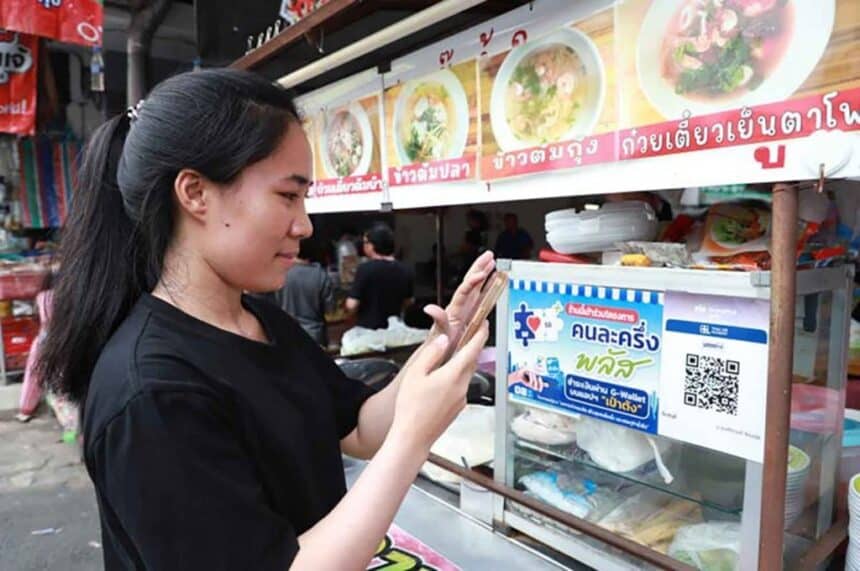
CHIANG RAI – Restaurant sales in Chiang Rai Province have exploded, growing 7 times under the “Khon La Khrueng Plus” scheme. This single figure has become a strong sign of how grassroots economies in the regions are bouncing back, even while the overall Thai restaurant sector remains fragile with rising costs, a 50% closure rate, and slow demand recovery in big cities.
This standout growth in Chiang Rai shows more than just “sales coming back”. It points to a new economic structure in secondary cities that are learning how to use state schemes, shifting consumer habits, and local identity as tools to build stronger food and beverage businesses.
Yod Chinsupakul, CEO of LINE MAN Wongnai, told Nakorn that the first half of 2025 was the “lowest point” for restaurants. Average sales per store fell by 14% in Q2, even as new restaurant openings still grew 3%. At the same time, about half of all restaurants nationwide shut down, showing how hard rising costs and fierce competition hit the sector.
Once the government launched “Khon La Khrueng Plus” in the second half of the year, the market started to shift in a clearer positive direction. In Q3, average sales per store managed to grow 1%. From October to November, growth improved to 5%. Restaurants chose LINE MAN as their main platform, with more than 65% of participating stores using it, and 63% of all programme sales passing through the platform.
Data from the first 3 weeks of the scheme shows how powerful the policy has been.
- More than 8 million orders nationwide
- Average restaurant sales grew 4.2 times across the country, with some provinces seeing more than 10 times growth
- Shops gained 22% more new customers, order frequency went up 30%, and average order value rose about 15%
Small restaurants earning under 10,000 baht per month saw the clearest upside. Their sales increased 5.9 times. Mid-size restaurants grew about 2 times. Riders’ income rose 15% to 25%. The money flowing from the scheme has not stopped at the storefront. It has spread along the entire food delivery chain.
Chiang Rai takes the secondary city crown
Among all provinces in “Khon La Khrueng Plus”, Chiang Rai is the star of secondary cities in both food and tourism. Data from LINE MAN Wongnai shows the provinces with the highest growth from the scheme as:
- Chanthaburi, up 9.4 times
- Nong Bua Lamphu, up 9.3 times
- Uttaradit, up 8.9 times
- Udon Thani, up 8 times
- Chiang Rai, up 7 times
This 7x figure for Chiang Rai does not happen in a vacuum. Looking at the wider picture, Chiang Rai’s GPP (gross provincial product) is expected to grow about 3.1% in 2025, higher than the national average of around 2.4%. The recovery is linked to its role as a tourism hub in the North, its push to position itself as a “Global Coffee Hub”, and its status as a key border trade gateway.
Compared with Bangkok, the contrast is sharp. Major business areas in the capital, such as Sukhumvit, Silom, and Sathorn, still show a small sales decline of 1%. Banthat Thong, once a famous night-time food street, shrank the most with a drop of 21%. Restaurants in shopping centres have started to recover from a 21% fall to 1% growth, yet the speed of recovery is still slower than in many upcountry areas.
In Chiang Rai and other provinces, average sales per restaurant in non-Bangkok regions rose 7%, after falling 11% in Q2. When this is combined with the impact of Khon La Khrueng Plus, which lifted sales 7 times at the provincial level, it underlines the strength of local economies that can rebound quickly when cash injections are well targeted.
Grassroots economy still fragile
Even though sales numbers look bright, the 2025 strategic report on Chiang Rai’s restaurant and beverage sector shows that F&B businesses still face serious pressure from costs and liquidity issues.
Nationwide, the food and beverage market is expected to be worth about 646 billion baht, with 2.8% growth. Behind this figure lies a hard truth. Around 50% of restaurants have closed, which means half the players in the market could not cope with rising costs and heavier competition, even with short-term support from stimulus schemes.
Typical restaurant cost structures look roughly like this:
- Ingredients about 35%
- Labour around 15%
- Rent and utilities are about 20%
When over 70% of income is under pressure at the same time, from volatile import prices, higher minimum wages, and stubbornly high rents in good locations, many operators in Chiang Rai and across Thailand have seen their profit margins squeezed again and again.
Chiang Rai also faces its own risks as a border province. Field reports from 2025 show that unrest along the Myanmar border has sometimes led to strict controls at the Mae Sai checkpoint. At certain times, only selected food and beverage products could cross. This pushed logistics costs up for businesses that rely on imported goods. Some shops near the border also reported clear drops in sales.
Local economic experts share the same view. The “7x growth from Khon La Khrueng Plus” should be read alongside these structural risks. It is not a sign that the market will keep growing smoothly on its own.
Value-for-money menus rule the day
From the consumer side, food delivery data shows that Thai people still spend carefully but want clear value and good quality they can afford.
“Tam Pu Pla Ra” has become the top-ordered dish of 2025, with more than 8 million servings across the country. Menu groups like som tam, yum, and mala have another 16 million searches combined. Strong flavours still sit at the heart of Thai food culture across regions.
For simple rice dishes, “khao kaeng” stands out as Thailand’s most stable fast food in this uncertain economy. It has more than 65 million orders, growing 8%. Key reasons are its affordable price, speed of service, and familiarity.
Looking at price behaviour, menus under 500 baht suffered the least. Their sales fell 12% in Q2, then turned around to 5% growth toward the end of the year. Menus above 500 baht did return to 4% growth during the same period, but their rebound has been slower.
In drinks, trends like iced green tea and matcha show what analysts call “affordable luxury”: something that feels special but still fits into normal spending. Matcha orders jumped 300%, with more than 6.5 million cups sold. However, iced green tea, which offers a similar feeling at a lower price, has become the more popular daily choice.
For Chiang Rai’s restaurant owners, these signs are clear. Long-term growth from state schemes will last only if menus match this “value-for-money but want quality” mindset of younger consumers.
Chiang Rai as a global coffee city
Another key piece of Chiang Rai’s F&B story is its role as a “city of tea and coffee” that aims to stand as a world-class coffee centre. The province produces several thousand tonnes of Arabica beans each year and has GI-certified coffee brands known both inside and outside Thailand, such as Doi Tung and Doi Chang.
The specialty coffee market helps turn local beans into products worth several times more than standard coffee. Chiang Rai also hosts regular tea and coffee festivals, like Tea & Coffee Central CEI and MFU Coffee Fest. These events bring tourists, coffee lovers, and business owners from across the country.
Success has also raised the level of competition. Reports note that Chiang Rai is one of the secondary cities with more than 1,000 coffee shops. Most are stand-alone cafés or small chains run directly by their owners. To survive in such a crowded market, shops must offer a “truly different experience”, not just good coffee.
Recent trends among Chiang Rai cafés point to garden-style spaces, modern Lanna décor, and menus built around chemical-free produce and health-focused options. Many owners now link their brands with coffee farms or organic vegetable sources. This builds trust and adds value to their cafés.
Chiang Rai’s F&B strategy report
The 2025 strategic analysis of Chiang Rai’s restaurant and beverage sector gives several key suggestions that match both Khon La Khrueng Plus data and current consumer trends.
- Focus on niche markets
Chiang Rai should use its strengths in specialty coffee and northern food to build restaurants with strong stories rooted in local identity and nature. Examples are cafés along mountain routes, or Lanna-style restaurants that highlight rare local ingredients. - Manage costs actively
With rising ingredient and wage costs, investing in POS systems and stock control is no longer a “nice to have”. It is a basic need. These tools help cut waste, reduce paperwork, and improve both kitchen and front-of-house efficiency. - Use more local sourcing to cut border risk
Uncertainty in Mae Sai border trade shows that heavy reliance on imported ingredients is risky. Chiang Rai businesses can protect themselves by using more local produce. This helps secure supply chains and gives brands richer stories to tell. - Adopt a full multi-channel model
Today’s customers expect dine-in, delivery, and pre-order options. Chiang Rai restaurants should connect to major delivery platforms and local ones at the same time. This widens the customer base and reduces the risk of relying on one location or one channel. - Build brands as new city landmarks
Successful restaurants in Chiang Rai often become check-in spots or tourist landmarks. Investment in atmosphere, storytelling, and distinctive online content can be just as important as food quality. People want places worth travelling to and sharing.
Khon La Khrueng Plus CoPayment Scheme Phase 2
Looking at 2026, Yod Chinsupakul believes that if the government continues with “Khon La Khrueng Plus Phase 2”, with 10 million entitlements at 2,000 baht each (5 million for new users and 5 million for affected groups), it will help support restaurant sales in the first quarter of next year.
He warns that if the programme rules are “too strict”, people may not receive the full number of entitlements planned. Restaurants that cannot join, or that rely too heavily on the scheme without adjusting their business model, may feel a hard impact once the policy ends.
Yod suggests raising the annual income cap for participating restaurants from 1.8 million baht to 3 million baht. This would let more mid-size restaurants, which are in the tax system but are not large chains, join the scheme. These mid-size players are important to the grassroots economy, yet many were left out under the old criteria.
For the restaurant sector in 2026, he estimates that even with Phase 2 of Khon La Khrueng Plus, full-year growth may stay around 1% if there are no extra support factors, especially from international tourism.
The 7x jump in Chiang Rai’s restaurant sales under Khon La Khrueng Plus highlights the strength of targeted state policies in pushing money into the grassroots economy. It also confirms Chiang Rai’s position as a northern economic hub, a coffee capital, and a growing tourist destination.
Behind this short-term success sit longer-term challenges. These include higher ingredient and labour costs, geopolitical risk at the Mae Sai border, intense competition in the café market, and heavy reliance on government schemes.
The future of Chiang Rai’s restaurant sector will depend on how owners can “build on state support” and turn it into a solid business base. That means using more local ingredients, investing in technology, creating unique customer experiences, and growing digital and offline channels side by side.
If Chiang Rai can do this well, it will not just be the province that grew sales 7 times for a short period. It can become a role model for how secondary cities turn an economic crisis into a long-term structural opportunity.