



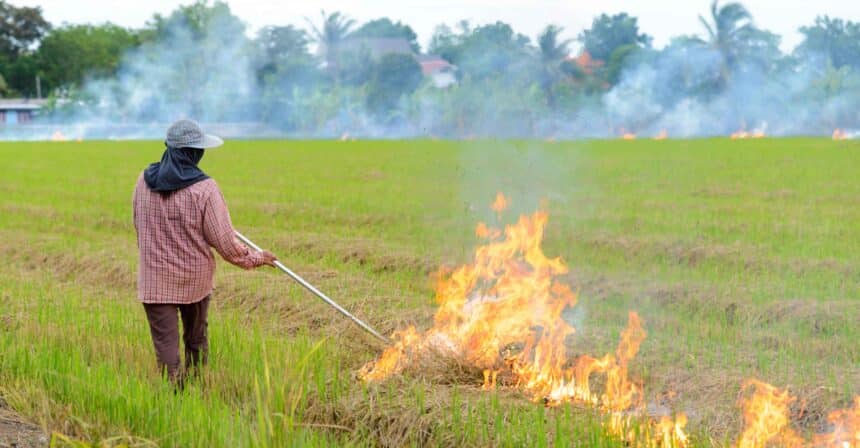
CHIANG RAI – Provincial leaders met at the governor’s office to set stricter steps against wildfire smoke and PM2.5. For Chiang Rai, this is not only about fire control. It is about everyday breathing in a tourism and border province that faces haze season year after year.
Governor Choochip Pongchai called in related agencies to agree on tighter limits for open burning in 2026. Deputy Governor Prasert Jittpleecheep and relevant department heads also joined the meeting.
This year’s plan shifts from requests to firm enforcement. The province divides operations into two phases:
- Phase 1 (Jan 1 to Feb 13): A cooperation period. Communities are asked to manage fuel and farm waste through plowing under, composting, and avoiding open burning.
- Phase 2 (Feb 14 to May 10): The peak-risk period, 86 days in total. All open burning is strictly prohibited across agricultural areas, crop-residue management, garbage, and weeds. Violators face legal penalties.
Provincial leaders stressed that stopping forest fires, haze, and PM2.5 takes teamwork across agencies, local groups, and residents. Clear communication matters, especially so that people understand what the rules are and why they matter. The message is simple: cleaner air protects children, older adults, and high-risk groups, and it also protects Chiang Rai’s tourism image and local income.
Targets: fewer hotspots and fewer unhealthy-air days
The ban is tied to measurable goals, not just administrative order. Chiang Rai set targets to:
- Cut hotspots by 30 to 40 percent
- Reduce days with pollution over the standard by 15 to 30 percent
For PM2.5, Thailand’s reference standard (shared by the Pollution Control Department) sets the 24-hour average at 37.5 µg/m³ and the annual average at 15 µg/m³. So the “days over the standard” goal is directly linked to lowering health risk, not making numbers look good.
Still, Chiang Rai’s challenge is bigger than stopping burns inside the province. The terrain, basin-like areas surrounded by mountains, and cross-border haze can limit how much local control can achieve on its own.
Supporting documents cited an analysis report on hotspot patterns and haze response in Chiang Rai (2025). The key lesson was the gap between hotspot counts and the real burned area.
According to Nakorn Chiang Rai, during the 2025 fire season (Feb 1 to May 8), Chiang Rai reduced accumulated hotspots from 3,885 in 2024 to 611 in 2025, a 84.3 percent drop. But the actual burned area decreased only 16.33 percent, from 62,521 rai to 52,311 rai. That suggests fewer ignitions, but more severe spread when fires did occur.
In plain terms, counting hotspots alone can miss the full picture. A small fire can grow fast before crews can reach it, especially in steep mountains, deep forest, and hard-to-access zones near farm edges.
Satellites help decision-making, but they do not stop fires by themselves
Thailand’s agencies rely on satellite hotspot data to monitor burning. GISTDA provides hotspot data from multiple sources, including VIIRS with roughly 375-meter resolution, widely used for surveillance and area analysis. Agriculture agencies also describe how hotspot detection supports farm management and burn monitoring.
But Chiang Rai’s 2025 numbers highlight a limit. Faster detection does not always mean faster control. If access is slow or fuel loads are high, a single incident can burn a large area. That is why the 2026 approach pairs the burn ban with fuel management options such as plowing under, composting, and stricter control of garbage and weeds that can become ignition sources.
Even when local burning improves, cross-border smoke remains a major risk, as noted in the provincial materials. When winds shift, border districts like Mae Sai and Chiang Khong can face higher exposure than other areas.
Geography also plays a role. In the dry season, temperature inversion can trap cooler air near the ground under warmer air above it. This acts like a lid that holds pollution close to where people breathe. When local smoke mixes with incoming haze, PM2.5 can spike even if hotspot counts are not high. For this reason, Chiang Rai’s messaging ties “no burning” to health and tourism, to help households see the real-world impact and follow the rules.
Health first: clean-air rooms and practical protection
Public health measures support residents on high-pollution days. The province reported 903 clean-air rooms across service units and public locations. Thailand’s health guidance for clean-air rooms focuses on basics that work, sealing doors and windows, reducing leaks, wet-cleaning surfaces, and avoiding activities that add dust indoors.
Taken together, Chiang Rai is not only issuing an order. It is also trying to help people get through the worst days while pushing harder on the causes that return each dry season.
For Chiang Rai, air quality is also about confidence in the province. It shapes travel decisions and affects income for shops, homestays, tour operators, and cultural tourism communities across many districts.
That is why the province frames the 86-day plan in everyday terms. Less smoke means easier breathing for locals and visitors. If the measures work, Chiang Rai gains on both health and the economy. If they fall short, the cost shows up first at home, especially for children, seniors, and people with respiratory illnesses.
What to watch: fair enforcement and real options for farmers
A strict, total ban only works when people have practical alternatives. In farming areas, burning is often seen as the quickest and lowest-cost way to clear residue. The 2026 plan promotes options like plowing under, composting, and better weed management.
Enforcement also needs to be consistent and fair, paired with communication that explains rules without escalating conflict. The province’s monitoring and response centers, referenced in the supporting materials, will be a major factor in whether Chiang Rai can keep control during the 86-day high-risk period.
Chiang Rai’s 2026 approach builds on a clear lesson from 2025. A big drop in hotspots does not always mean a big drop in damage. This year, the province is tightening rules with an 86-day no-burn order, setting goals to cut hotspots and reduce unhealthy-air days, and supporting communities with alternative fuel management and health protections such as clean-air rooms.
The outcome people care about is simple. More days with safe air, fewer gray skies, and a province that residents and visitors can enjoy without holding their breath.