


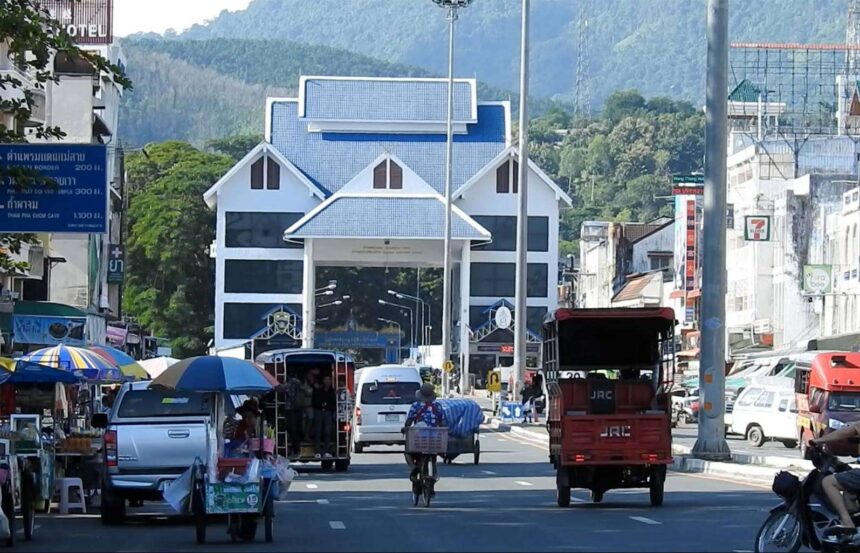
CHIANG RAI – At the Mae Sai checkpoint, trucks hauling fruit still race the clock. Every delay risks freshness and adds cost, especially when bottlenecks keep repeating. That’s why Chiang Rai is moving with a clearer plan in 2026 to make its role as a real Mekong trade gateway more practical and measurable.
This week, the province is advancing two tracks at the same time. First, it is pushing to have the Mae Sai border checkpoint considered under Thai to China protocols tied to importing and exporting fruit via a third country. If approved, land transport would have a more official status and smoother procedures.
Second, Chiang Rai is using place-based economic action by hosting a border trade fair from February 12 to 16, 2026, giving businesses space to negotiate and find new markets while some border routes remain uncertain.
This is not just another meeting or event. It is a response to national trade data, turned into concrete steps that can work on the ground.
Mae Sai moves from a local crossing to a Thailand to China fruit gateway
On February 5, 2026, Chiang Rai held a meeting at the provincial hall to review readiness to add Mae Sai as an import and export point for fruit trade between Thailand and the People’s Republic of China, under the framework covering transport through a third country.
The meeting was chaired by Chiang Rai’s deputy governor, together with a representative from the National Bureau of Agricultural Commodity and Food Standards (ACFS), and attended by related agencies.
The main point was simple: turn a route into a system. In the fruit trade, the advantage is not only at the destination. It starts at the orchard, then moves through inspection, quarantine controls, temperature management, customs procedures, and the total time on the road.
The province noted that Thai farm products still have strong demand in China. At the same time, limits in transport routes and some clearance steps can raise transit time and costs.
Bringing Mae Sai under the protocol framework is seen as a practical option for faster land shipping, fewer chokepoints, and lower logistics costs that exporters and farmers have faced for years.
Even small time savings can cut system-wide costs. Time lost at the border often means higher transport fees, more fuel, higher quality risk, and more uncertainty on delivery dates. All of that affects pricing and weakens Thailand’s bargaining power.
Border trade fair, February 12 to 16, creates space for real deals
On the second track, the Department of Foreign Trade announced the “Border Trade Fair in Chiang Rai Province,” scheduled for February 12 to 16, 2026. Key venues include Wing 416 and The Heritage Chiang Rai Hotel.
The stated goal is to strengthen Thai businesses, connect trade with Myanmar, Laos, and China, and reinforce Chiang Rai’s role as an upper Mekong subregion trade hub.
The format focuses on transactions, not just displays. The event includes more than 200 sales booths, business matching sessions, and a meeting to track the province’s border and transit trade situation. There is also a seminar titled Winning the New Chinese Wave, centered on preparing businesses for the next shift in China’s economy and competition on cross-border platforms.
Organizers also plan support for businesses affected by the Cambodia checkpoint situation, by bringing them into a new negotiating venue to find replacement markets and new partners through matching activities. It is a practical way to spread risk when one route becomes unstable.
National numbers show the pattern: transit trade surged in 2025 and held up growth
Chiang Rai’s push in 2026 is not based on hope alone. It follows clear national data.
The Department of Foreign Trade reported that in 2025, total border and transit trade reached 1,937,629 million baht, up 6.71 percent year over year. Exports totaled 1,063,104 million baht, up 1.39 percent, while imports were 874,525 million baht, up 13.98 percent. Thailand recorded a trade surplus of 188,579 million baht.
A closer look shows a major shift in where growth came from.
Border trade totaled 894,193 million baht, down 8.47 percent. Border exports were 522,007 million baht, down 13.31 percent, while border imports were 372,186 million baht, down 0.69 percent.
Transit trade moved in the opposite direction. Total transit trade reached 1,043,436 million baht, up 24.39 percent. Transit exports were 541,097 million baht, up 21.23 percent, and transit imports were 502,339 million baht, up 27.99 percent. Thailand posted a transit surplus of 38,757 million baht.
The message is clear. Direct border trade with neighbors slowed, but transit trade to third countries grew fast enough to keep the overall system expanding.
Transit trade to China alone totaled 608,165 million baht, up 26.71 percent, making China Thailand’s top transit market in that dataset, followed by Singapore and Vietnam.
On the ground, that explains the urgency in Chiang Rai. When national trends show transit shipments to China are doing the heavy lifting, border routes and checkpoints need to be ready, with clear rules and reliable processing.
December data confirms it, transit stayed strong even as border exports dipped
December 2025 numbers reinforce the same picture. Total border and transit trade for the month reached 162,064 million baht, up 7.76 percent. But the two engines moved in different directions.
Border trade in December was 66,031 million baht, down 15.16 percent. Border exports were 38,426 million baht, down 23.86 percent, while border imports were 27,605 million baht, up 0.87 percent.
Transit trade for the month reached 96,033 million baht, up 32.36 percent. Transit exports were 42,750 million baht, up 6.66 percent, and transit imports rose sharply to 53,283 million baht, up 64.07 percent.
For businesses, the takeaway is practical. Risk rises when trade depends too much on a few border channels that can change quickly due to closures or new rules. Opportunity grows in transit trade to third countries, where volumes are rising and where shippers need routes that are clear, transparent, and aligned with standards.
Chiang Rai can’t grow trade if logistics are still stuck
The same information set notes that Chiang Rai recorded more than 100,000 million baht in total border and transit trade in 2025. Key export items included durian, mangosteen, longan, and fuel.
That supports Chiang Rai’s long-standing position as a gateway to southern China and nearby countries. Still, being a gateway only matters if goods can pass quickly, safely, and under rules both sides recognize.
With transit trade to China expanding, pushing Mae Sai into the fruit-related protocol framework is like upgrading the gateway from a local passage to an internationally recognized channel.
If Mae Sai is upgraded as planned, the first group likely to benefit is fruit farmers and exporters, especially in northern Thailand, who want a land route with fewer bottlenecks and lower costs. Logistics firms, cold storage operators, and border service businesses would also see added demand.
Competition will also rise. Faster systems raise expectations for consistent quality and on-time delivery. Smaller operators may need to prepare more on standards, paperwork, and platform-based sales, which is also part of what the trade fair seminar is trying to address.
That is why the border trade fair should be seen as more than a selling event. It is also a place to build skills and secure new orders while the trade structure is changing.
What this means for 2026, Chiang Rai tries to ride the transit momentum
In 2025, national border trade contracted, yet total trade still grew because transit trade surged. Chiang Rai’s 2026 approach reflects that reality, putting effort behind the part of the system that is growing, while reducing weak points that slow shipments.
Three areas will matter next:
- Progress on bringing Mae Sai into the fruit-related protocol framework, including inspection standards and logistics readiness
- Deal outcomes from the Chiang Rai border trade fair, measured by real partners and real orders
- How well local businesses adapt to cross-border platform competition, where rules and pace can change quickly
With 2025 transit trade reaching 1,043,436 million baht, up 24.39 percent, Chiang Rai’s task is not only to follow the trend. It is to build capacity that can handle the volume, while keeping smaller players from being left behind.
Key figures
- 2025 total border and transit trade: 1,937,629 million baht (up 6.71 percent), exports 1,063,104 million baht (up 1.39 percent), imports 874,525 million baht (up 13.98 percent), surplus 188,579 million baht
- 2025 total border trade: 894,193 million baht (down 8.47 percent)
- 2025 total transit trade: 1,043,436 million baht (up 24.39 percent)
- 2025 transit trade to China: 608,165 million baht (up 26.71 percent)
- December 2025 total border and transit trade: 162,064 million baht (up 7.76 percent)
- December 2025 transit trade: 96,033 million baht (up 32.36 percent)
Source: Nakorn Chiang Rai