






CHIANG RAI – On February 25, at the Chiang Rai Provincial Hall meeting, Governor Choochip Pongchai chaired a water quality monitoring meeting focused on public concern about arsenic found in a sample group living near the Kok River.
Provincial administration officials met with Dr. Siriwan Kantisin and a research team from Mae Fah Luang University (MFU) to connect the latest findings and align next steps.
The goal is simple, clear up the facts quickly and ease worries for residents and tourists.
The governor said Chiang Rai isn’t ignoring the situation and thanked the MFU team for sharing useful data. At the same time, the province wants one clear set of facts to reduce confusion. As a result, the meeting agreed to strengthen joint work with researchers in four key areas.
- Re-test using international standards
The province will support MFU with budget and resources, and coordinate with the Pollution Control Department. Together, they will collect new samples using standard operating procedures (SOPs) for both environmental samples and biological samples. The province aims to confirm the source of arsenic within two weeks. - Create a central information hub (Single Command)
Chiang Rai’s provincial office will act as the main center for coordination and information management. This helps reduce pressure on researchers and keeps public updates accurate, consistent, and easy to understand. - Strengthen local lab capacity
The province will push to develop MFU and the Medical Sciences Center into a local reference laboratory (Reference Lab). This would allow Chiang Rai to test for heavy metals faster and handle more of the work locally, instead of waiting for results from central agencies. - Set safety steps for tourism ahead of Songkran
With Songkran approaching, Chiang Rai will follow expert guidance and emphasize safety standards for water activities. The province will also speed up public communication materials (Infographic) that show where water activities are considered safe and where people should be more cautious. The plan is to support the local economy while still protecting public health.
“We’re not blaming the researchers,” the governor told The Standard. “We’re supporting them with better tools and a bigger data set, so the truth is as clear as possible. Science should guide policy, not be blocked.”
Meanwhile, civil society representatives welcomed the direction. They said this meeting signals a positive shift, with local government and academics working together more seriously to solve problems at the source.
They also pointed to wider concerns, including possible mining impacts near border areas and toxic contamination moving through the food chain.
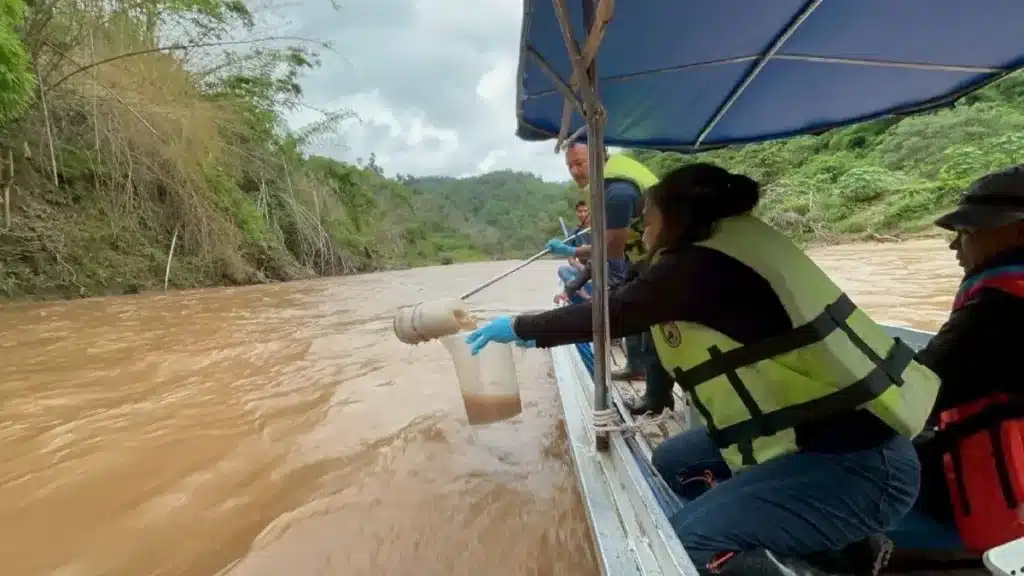
Arsenic Contamination in the Kok River
Arsenic contamination in Chiang Rai’s Kok River (Mae Kok River) has become a serious environmental and public health issue, and many reports tie it to mining upstream in Myanmar. The problem drew wide attention in early 2025, after tests found higher arsenic and other heavy metals in the river.
Researchers and government officials point to illegal gold and rare earth mining in Myanmar’s Shan State near the headwaters. Some reports also link the activity to Chinese-backed operations and local armed groups, including the Wa State Army.
After that, monitoring through mid-2025 and into 2026 found arsenic levels above Thailand’s safety standard of 0.01 mg/L in parts of the Kok River. Similar results also appeared in connected waterways, such as the Sai and Ruak rivers. As a result, people living along the river in Chiang Rai province worry about long-term exposure.
The main risks come from using river water, eating fish from the river, and possibly farming with contaminated irrigation water, including rice fields. Health experts also warn about poisoning symptoms, so they have pushed for bio-monitoring, including hair testing to check arsenic buildup.
More recently, stronger oversight from Thai agencies, including the Ministry of Public Health and the Pollution Control Department. Some checks of river water and village tap systems have come back within safe limits in early 2026.
However, certain hotspots still show levels above the standard, so officials continue testing, issue warnings against using river water, and work through diplomatic channels to address cross-border pollution with Myanmar. At the same time, academics warn that the damage may spread beyond health concerns, hurting ecosystems, tourism, and agriculture unless long-term cleanup and prevention efforts continue.


