



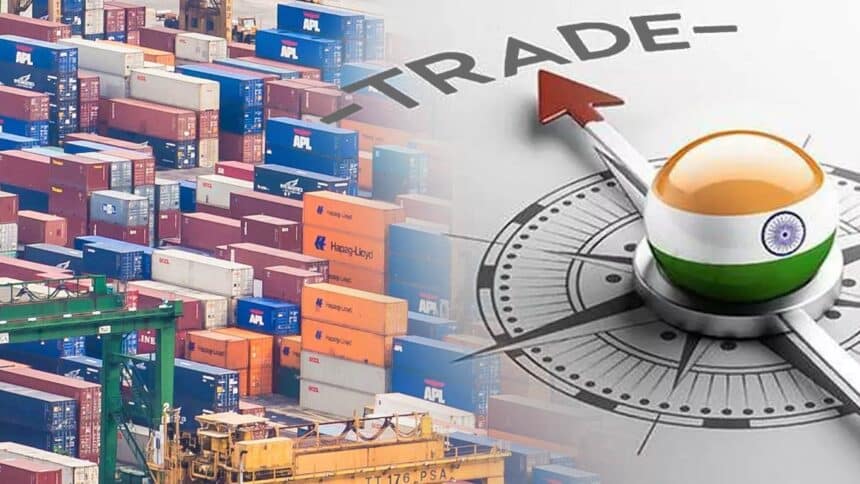
NEW DELHI – India is moving quickly to build stronger economic ties with Western markets in a strategic bid to overtake China. In early 2026, New Delhi signed two major deals, a wide-ranging Free Trade Agreement (FTA) with the European Union and a tariff reduction pact with the United States.
Together, they signal a serious push to make India a top choice for global manufacturing, investment, and supply chains. These steps come as China sticks to tight import controls and faces weaker growth at home. Many economists now think India could take a bigger role in the world economy over the next few decades.
The EU-India FTA was concluded on 27 January 2026, ending almost 20 years of stop-start talks. It is described as the biggest trade deal either side has ever signed. The combined market covers close to two billion people and about a quarter of global GDP.
The agreement cuts or removes tariffs across a large share of trade. India gains preferential access across 97% of EU tariff lines, covering 99.5% of the value of India’s exports to the bloc.
Many labour-heavy sectors benefit, including textiles, leather, footwear, gems and jewellery, tea, coffee, spices, sports goods, toys, and certain marine products. For more than 90% of these exports, duty-free entry starts right away.
The EU also gains. Tariffs fall on 96.6% of EU goods exports to India by value. European exports to India could double by 2032, with estimated duty savings of around €4 billion each year.
A Western anchor, with room for sensitive sectors
The timing matters. The deal lands during wider global trade tensions and gives India a steadier base in the West. It also protects policy space for areas such as agriculture and dairy, while creating more openings for services, investment, and sustainable industry ties.
The European Commission has also pledged €500 million over two years to support India’s green transition. That includes help to cut emissions in steel and aluminium, shaped by the EU’s Carbon Border Adjustment Mechanism.
A few days later, on 2 February 2026, US President Donald Trump announced a major trade understanding with Indian Prime Minister Narendra Modi. Under the agreement, US tariffs on Indian goods fall from levels as high as 50% (including penalties linked to Russian oil purchases) to 18%.
In return, India agrees to reduce purchases of Russian crude, open parts of its agriculture market, and raise imports of US goods. Purchases could reach $500 billion across areas such as energy, technology, and aircraft. It is not a full FTA like the EU deal, but it eases near-term tensions and fits with US efforts to spread supply chain risk.
These deals sit within a wider plan to bring in foreign capital and tie India more closely to Western-led value chains. Over the past year, India has signed or moved forward on trade talks with partners such as the UK, Oman, and New Zealand, while continuing talks with others.
This also speeds up the “China Plus One” approach. Many firms want a second production base, so they are less exposed to China-related tariffs, geopolitics, and supply disruptions. India’s market size and improving industrial capacity make it a strong option for that role.
China’s tighter model and a slower economy
India’s more open stance stands out against China’s current direction. Beijing keeps high barriers on many imports and relies on strong state control. At the same time, China’s economy is under strain.
China hit its official 5% growth target in 2025, but some independent estimates place growth lower. Forecasts for 2026 sit around 4.4% to 4.5%. Domestic demand remains soft, retail sales are weak, and deflationary pressure has grown as wages stall. Property, once a key growth engine, is still struggling. Some analysis puts local government debt burdens above 270% of GDP.
Youth joblessness is another pressure point. For ages 16 to 24, the rate stayed above 17% in late 2025. Some estimates suggest it is higher when discouraged workers and flexible work are counted.
A record 12 million graduates have entered the job market, while private firms have cut roles in tech, property, and tutoring. That comes after regulatory crackdowns and more automation.
Many young people have turned to stable but slow-growth public sector roles or have chosen to step back from career ambition, a sign of weaker belief in upward mobility.
Politics and demographics add to the drag
China’s internal strains do not stop at economics. Centralised decision-making under President Xi Jinping has prioritised loyalty, which can slow flexible responses to structural problems. Demographics are a big one, with fertility below 1.1 and a shrinking workforce.
Even with record export surpluses, cracks show. Overcapacity, weak consumption, and lower foreign investment point to an economy that looks strong on paper but faces real limits underneath.
Many economists now see India as better placed to become a major global hub. India’s growth story leans more on domestic demand, infrastructure building, and expanding manufacturing. IMF data for 2026 shows India contributing 17% of global real GDP growth, second to China at 26.6%, and ahead of the US at 9.9%.
Projections also suggest India could become the world’s third-largest economy by 2028, moving past Japan and Germany. Longer-term forecasts point to the potential for a $30 trillion economy by 2047 if high growth holds.
What gives India an edge with Western firms
India has a young and increasingly skilled workforce, often described as a demographic dividend. Policy changes across labour, land, and digital systems also support growth in ways China may find harder to match in the years ahead.
For many Western businesses, India can look like a steadier long-term partner. It is democratic, widely English-speaking in business, and seen as more aligned with Western trade and security goals.
For companies, the EU-India FTA and US tariff cuts can lower costs and reduce friction across sectors such as textiles, pharmaceuticals, IT services, and autos. They also support supply chain diversification, which has become a board-level priority.
For global politics, these agreements point towards a more multipolar system. Middle powers such as India can strengthen ties with the West while balancing relationships across regions.
The direction is clear, but execution will decide the results. The deals need ratification, legal alignment, and steady work on ports, roads, power, and logistics. Sensitive sectors will keep pushing for protection, and environmental rules will need careful alignment.
Even with those challenges, the momentum is moving towards India. As China faces slower growth and rising frustration at home, India’s push to open up to Western markets is changing the map of global trade. New Delhi is positioning itself as a practical alternative to Beijing’s more guarded approach.