



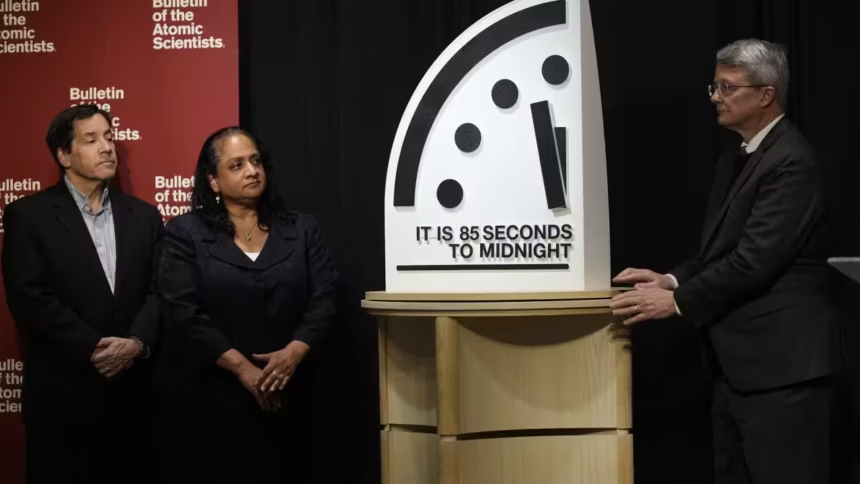
WASHINGTON, D.C. – On January 27, 2026, the Bulletin of the Atomic Scientists pushed the Doomsday Clock to 85 seconds to midnight, the closest it has come to disaster in almost 80 years. The shift is only four seconds from last year, but the message is loud and clear.
Global risks driven by people are growing, and the margin for error keeps shrinking.
The Doomsday Clock first appeared in 1947, not long after the bombings of Hiroshima and Nagasaki. The Bulletin of the Atomic Scientists, founded in 1945 by scientists such as Albert Einstein and J. Robert Oppenheimer who were tied to the Manhattan Project, set out to warn the public about nuclear danger.
Artist Martyl Langsdorf created the now-famous clock for the Bulletin’s magazine cover. It began at seven minutes to midnight, a signal of rising fear as the U.S. and the Soviet Union moved deeper into a nuclear arms race.
Midnight stands for global catastrophe, the end of civilization caused by our own tools. Since then, the Bulletin has reset the clock 26 times. It moves closer when threats grow, and it moves back when leaders choose restraint and diplomacy.
Doomsday Clock history, 1947 Doomsday Clock, Manhattan Project scientists, nuclear arms race
Doomsday Clock Key Moments of Alarm
The clock has swung widely over the years. In 1953, after the U.S. and the Soviet Union tested hydrogen bombs, it dropped to two minutes to midnight, one of its worst positions until recent times. During the Cuban Missile Crisis in 1962, the world came close to nuclear war, and the clock sat at seven minutes (a setting later reconsidered with hindsight).
The biggest break came at the end of the Cold War. In 1991, after the Strategic Arms Reduction Treaty (START), the clock moved back to 17 minutes to midnight, the safest point it has ever shown. That calm did not last. In 2007, the Bulletin added climate change to its decision-making, widening the focus beyond nuclear weapons.
By 2020, the clock hit 100 seconds to midnight for the first time, pointing to nuclear risk, the climate crisis, and fast-moving technologies. It stayed at 90 seconds in 2023, shifted to 89 seconds in 2025, and now sits at 85 seconds in 2026.
Doomsday Clock timeline, Cold War nuclear threats, 17 minutes to midnight, 100 seconds to midnight
Why the Clock Shows 85 Seconds in 2026
The Bulletin’s Science and Security Board, working with Nobel laureates and other experts, pointed to a “global failure of leadership” as the main reason for the change. The risks they flagged are familiar, but they are getting harder to manage:
- Nuclear weapons: Conflicts involving nuclear powers remain tense, including the Russia-Ukraine war with implied nuclear threats, India-Pakistan strain, and strikes on Iranian facilities. The U.S., Russia, and China keep upgrading their arsenals. The Bulletin also raised concern about the future of arms control as the New START treaty nears expiration, which could open the door to a less restrained arms race.
- Climate change: The Bulletin pointed to rising atmospheric CO2 (about 150% of preindustrial levels), extreme heat, sea-level rise, and policy backsliding. It also noted reduced U.S. renewable energy commitments as part of the broader problem.
- Disruptive technologies: Artificial intelligence spreads disinformation faster and is moving into military systems. Biological dangers are also growing, tied to synthetic biology (including “mirror life”), AI-supported pathogen design, and weaker public health capacity.
- A wider breakdown: More authoritarian rule, sharper nationalism, and weaker global cooperation make every major risk harder to control.
Bulletin President and CEO Alexandra Bell said, “Catastrophic risks are on the rise, cooperation is on the decline, and we are running out of time.” Board Chair Daniel Holz warned that major powers have become “more aggressive, adversarial, and nationalistic,” even after years of public caution.
2026 Doomsday Clock statement, 85 seconds to midnight, nuclear proliferation, AI risks, biological threats
A Warning That Still Leaves Room for Change
Even with a bleak reading, the Bulletin says the clock can move back. History shows it has happened before, through arms control, diplomacy, and shared limits that reduce the chance of disaster.
The Bulletin places heavy responsibility on leaders in the U.S., Russia, and China, urging them to reduce nuclear danger, set firm rules for AI, and build stronger global agreements on biological risks and climate action.
The Doomsday Clock is not a forecast. It’s a signal and a push to act. As the Bulletin put it, “Our current trajectory is unsustainable. National leaders must take the lead in finding a path away from the brink.”
Turning back the Doomsday Clock, global cooperation, existential threats, reducing nuclear risks, and climate action urgency
Now set at 85 seconds to midnight, the Doomsday Clock remains one of the clearest symbols of self-made danger. It started as a post-World War II warning about nuclear weapons, and it now reflects a wider set of threats that feed into each other.
It also carries a simple point: people can still change the outcome. The next steps depend on what the public demands and what leaders choose: accountability, diplomacy, and survival over division. Every second matters.