




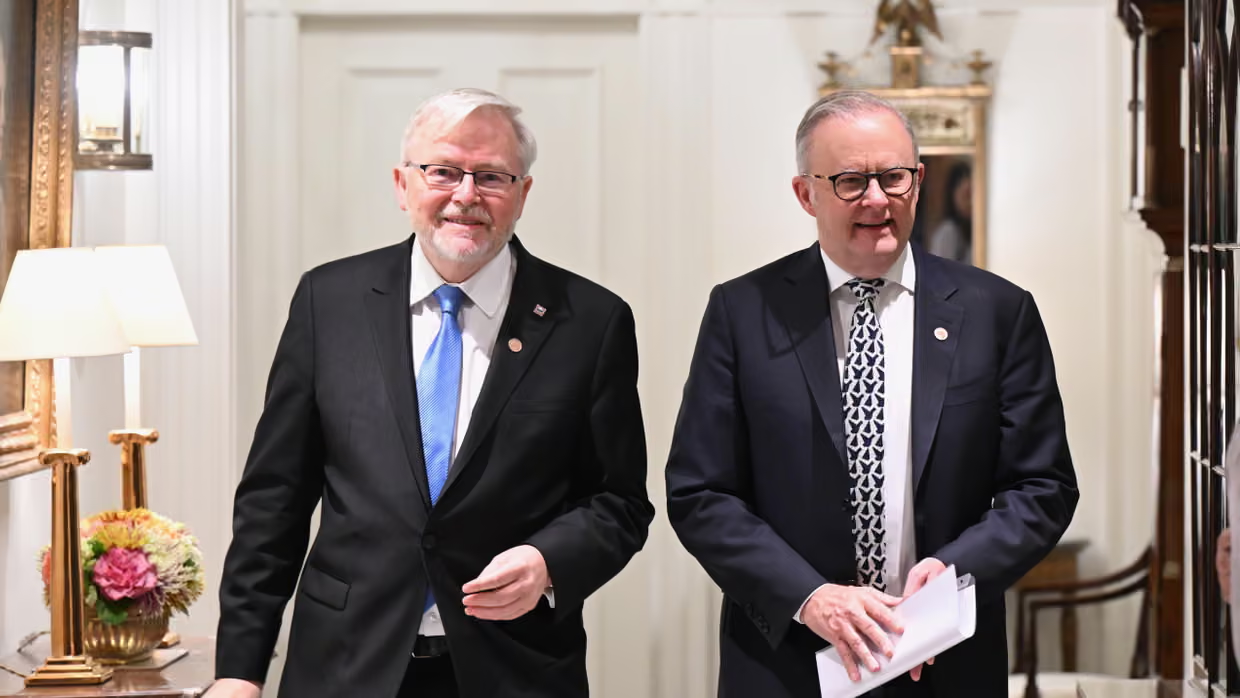
WASHINGTON, D.C. – Prime Minister Anthony Albanese announced on 13 January 2026 that Kevin Rudd will finish as Australia’s Ambassador to the United States at the end of March 2026, around a year earlier than planned.
Rudd, a former two-term prime minister, started in Washington in March 2023 during the Biden administration. He said he wants to return to leading the Asia Society think tank, and Albanese stressed the timing was “entirely” Rudd’s choice. The Prime Minister also praised Rudd’s energy, experience, and focus on advancing Australia’s interests in the US capital.
Rudd’s time in the role covered a major change in US politics, moving from the Biden years into Donald Trump’s second term after his 2024 re-election. Australian officials pointed to a list of results during his tenure, including steps forward on the AUKUS nuclear-powered submarine partnership, help that supported Julian Assange’s release in 2024, work on a critical minerals agreement, and billions of dollars tied to new investment discussions in areas such as AI data centres and quantum technology.
Strain with the Trump administration
Rudd’s dealings with the Trump administration carried clear personal tension, linked to comments he made before becoming ambassador. In public remarks and on social media, he had called Trump the “most destructive president in history”, a “traitor to the West”, and other harsh labels. After Trump’s election win, many of those posts were deleted, but the quotes continued to circulate and remained a point of irritation.
The most visible moment came in October 2025 during a White House bilateral meeting between Albanese and President Trump. A reporter brought up Rudd’s old remarks.
Trump gestured towards Kevin Rudd, who was seated across the table, and said, “You said bad?” Kevin Rudd replied evenly, “Before I took this position, Mr. President.” Trump then responded, “I don’t like you either. And I probably never will.” In earlier media comments, Trump had described Rudd as “a little bit nasty” and “not the brightest bulb”.
Those exchanges added to talk in Canberra and Washington that the personal bad blood could weaken the ambassador’s influence. For a short time, some opposition figures argued Rudd should be replaced. The Albanese government rejected that, pointing to his outreach across party lines and his ability to keep working ties in place.
In Washington, the reaction to Kevin Rudd’s exit has been restrained. A White House official offered a brief statement, saying, “Ambassador Rudd worked well with President Trump and the administration. We wish him well.” The wording suggested a practical approach. Even without warmth, the US-Australia alliance kept moving, supported by shared security priorities such as AUKUS and a broader Indo-Pacific strategy.
Commentators have said the change may remove a small, ongoing irritant, especially given Trump’s “America First” style and preference for personal loyalty from foreign envoys. At the same time, people close to the administration have indicated the main focus stayed on outcomes, and that Rudd was credited with keeping lines open on key files despite the tension.
Kevin Rudd’s Replacement
With Kevin Rudd due to finish on 31 March 2026, attention has shifted to who will take over what is often seen as Australia’s most high-profile diplomatic job. Albanese has said a decision will be announced in the coming weeks, and that the next ambassador will need the “right skills” to build support across the US political system.
Several names are being discussed, including former Labor ministers Joel Fitzgibbon (ex-Defence) and Stephen Conroy (ex-Communications). Both have strong party links and experience in sensitive areas.
Other options mentioned include career diplomats such as Justin Hayhurst (recently ambassador to Tokyo) and senior public servants like Defence Department Secretary Greg Moriarty. Former Liberal Prime Minister Scott Morrison has also been raised in passing because of his past rapport with Trump, although a cross-party appointment is still seen as unlikely.
Whoever takes the role will step into a demanding setting. Trump’s style can be unpredictable, and a fresh start may help. As one long-time observer has put it, the alliance is “bigger than any one president or ambassador”, but personal relationships can still shape how smoothly business gets done.
Rudd’s departure ends a period marked by heavy policy work, constant relationship-building, and regular controversy. It also gives the Albanese government a chance to reset the tone in Washington, at a time when the US-Australia partnership faces growing pressure from a less stable global outlook.


