



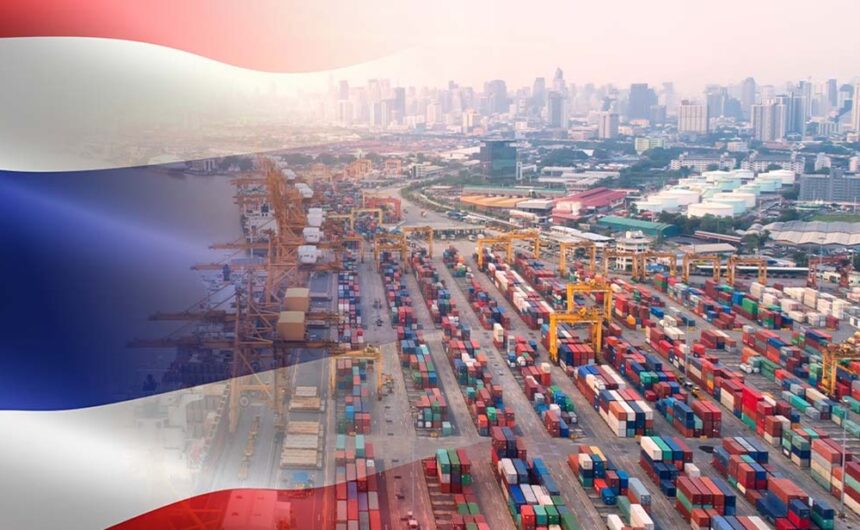
BANGKOK – In a standout achievement highlighted by the International Institute for Trade and Development (ITD), the latest UNCTAD Trade and Development Report 2025 reveals that Thailand has secured the top position among Global South economies for export product diversity, underscoring the nation’s resilient and multifaceted trade strategy amid global uncertainties.
The International Institute for Trade and Development (Public Organization), known as ITD, has shared key points from the United Nations Trade and Development Report 2025 (UNCTAD Trade and Development Report 2025).
The report says the world economy is slowing, and trade policy changes are adding uncertainty. Even so, Southeast Asia continues to show encouraging signs, helped by growth in developing countries. Thailand stands out in the region thanks to its strong performance and steady position.
It ranks first among Global South economies for export product diversity and sits among the top countries worldwide for the range of its trade partners. This broad mix helps soften the impact of tariffs and global financial swings, while supporting Thailand’s ambition to become an ASEAN centre for green innovation and digital services.
Mr Suphakit Chareonkul, Executive Director of ITD, said Southeast Asian developing countries, including Thailand, are dealing with unclear global trade rules and sharper geopolitical tensions. A key pressure point is rising trade protection through tariffs. Even with those headwinds, ASEAN continues to show strength and remains important to global supply chains.
UNCTAD expects global growth in 2025 and 2026 to cool to 2.6%. Its analysis still points to a brighter outlook for developing economies, including ASEAN. Growth for developing countries is forecast at 4.3% in 2025 and 4.2% in 2026, which keeps them as a main driver of global expansion.
Thailand Faces Extra Tariff
Thailand is highlighted as having one of the strongest strategic positions in the Global South. It holds the top spot in the Trade Product Diversity Index, with exports spread across agriculture, manufacturing, and higher-value processed goods. Thailand scored 1.02, the highest among developing economies.
This wide export base is expected to help protect trade flows if new US tariffs take effect. Thailand could face an extra tariff of around 10%, which is among the lowest rates applied to newly taxed partners.
Its broad range of products and markets should help it adjust quickly, including shifting sales towards other destinations when conditions change. That flexibility helps Thailand balance trade risks as global policies move.
The TDR 2025 also warns about financialisation, where finance has a growing influence over real production. The report points to food and agricultural markets, where Thailand is a major player.
It says more than 75% of revenue at large global food firms now comes from financial intermediation rather than selling physical goods. This can add to price swings, which then hit farmers and other upstream producers.
Another trend covered in the report is frontloading, where exporters ship earlier to avoid tariffs. This boosted trade in the first half of 2025, but that effect is fading and could slow global trade further.
Digitally Deliverable Services
For steady, long-term growth in Thailand and across the ASEAN Community, ITD points to regional cooperation and the build-out of value chains in future-facing sectors, such as electric vehicles (EVs) and the green economy.
The report also says services trade is growing faster than goods trade. Thailand and ASEAN are urged to upgrade their digital infrastructure so they can capture more growth in Digitally Deliverable Services, which UNCTAD views as a new source of income and jobs.
In 2026, Thailand will host the IMF-World Bank Annual Meetings. This is seen as a strong platform for Thailand and ASEAN to set out a shared vision, with a focus on the green economy and digital services for the Global South, aimed at long-term and sustainable growth.
ITD said it acts as a bridge between global knowledge and regional action on trade and development in Asia. The organisation plans to use insights from the report as a guide for its work. Its focus includes supporting Thai businesses, especially SMEs, with tools and access to deeper market information so they can better handle economic swings.
ITD also said it is ready to help build skills for trade professionals through training, academic work that matches regional needs, and support for research and development of staff across countries, with a strong focus on Asia. Mr Suphakit said these efforts should help strengthen the capacity of developing nations to grow and adapt as conditions change.
Institute for Trade and Development
The Trade and Development Report (TDR) is UNCTAD’s flagship annual publication. It is widely used for analysis of global economic trends, international trade, and development finance. The 2025 edition, titled On the Brink: Trade, Finance and the Reshaping of the Global Economy, looks at major turning points shaping the world economy.
The full report is available at On the brink: Trade, finance and the reshaping of the global economy
The Institute was officially inaugurated on 1 May 2002 during the Mid-Term Review Conference of UNCTAD X, hosted by the Thai Government. ITD is a government entity as a public organisation established under the Royal Decree on the Establishment of the International Institute for Trade and Development (Public Organization), B.E.2544 (2001).
It provides academic services for training and research in trade and development. ITD is overseen by a Board of Directors, with an Executive Director serving as the chief administrator.