




First-time visitors often worry about doing the wrong thing at a Thai temple, and Chiang Rai is no exception. This Chiang Rai Temple Etiquette Guide is built for travelers who want clear rules before stepping up to the gate and getting waved back. Dress checks can be strict at Wat Rong Khun (White Temple), and the busy photo spots at Wat Rong Suea Ten (Blue Temple) can make minor mistakes more noticeable.
Wat Huay Pla Kang adds viewpoints, stairs, and large statues where respectful behavior still matters. The sections below cover what happens if you’re underdressed, when photos are allowed, and how to act inside worship halls without guessing.
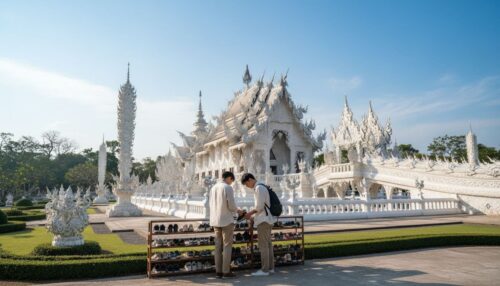
Quick checklist you can screenshot before entering any Chiang Rai temple
Outfit
- Shoulders covered (no tank tops)
- Knees covered (pants or skirt below the knee is safest)
- Skip see-through fabric, even with “cute” layers
- Avoid very tight outfits that read like gym wear
Shoes
- Easy slip-on sandals or flats
- Clean socks help if floors are hot
Pack
- Light scarf or sarong (for quick cover)
- Small cash for donation boxes and cover-ups (often around 100 THB)
- Water (drink outside, not in worship halls)
Camera
- Flash off before you enter
- Be ready to stop shooting inside halls
- Silence the camera shutter sound if possible
Behavior
- Quiet voice
- Feet rule: don’t point soles at Buddha images or monks
- No PDA (hugging and kissing draws attention fast)
- Follow signs and staff directions
If you are unsure
- Look for posted signs first
- Copy what locals are doing
- Ask staff with a short, polite gesture and a smile
Chiang Rai Temple Etiquette Guide to dress codes that actually get enforced
Many pages say “dress modestly.” Chiang Rai temples can go further, because some sites check clothing at the entrance and can deny entry, especially at Wat Rong Khun. A good rule that works across most temples is simple: cover shoulders and knees for everyone, no matter gender.
What enforcement looks like in real life:
- A staff member points to a sign and asks for more coverage.
- Visitors are redirected to buy or borrow a cover-up.
- Entry is delayed until clothing is fixed, and sometimes refused if it can’t be fixed.
Fast fixes are common near popular temples. Many entrances have scarf or sarong cover-ups for sale or rental, often around 100 THB, but prices and availability vary by day and season. When in doubt, bring your own. It’s cheaper and faster.
A small detail that matters inside: hats and sunglasses come off in worship halls. Outside courtyards are more relaxed, but inside is treated like a formal space.
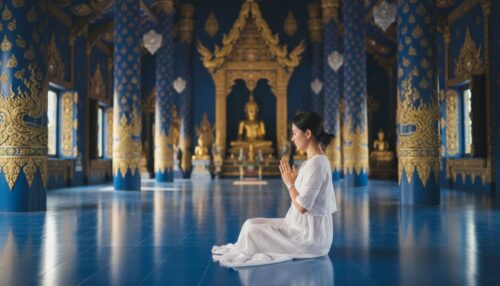
Do / Don’t at Chiang Rai Temples
| Area | Do | Don’t |
|---|---|---|
| Clothing | Cover shoulders and knees | Wear tank tops, mini skirts, or see-through outfits |
| Shoes | Use slip-ons, remove them before halls | Walk inside with shoes, even “just for a photo” |
| Photos | Follow signs, keep it quick and respectful | Use flash, ignore “no photo” signs, pose on structures |
| Behavior | Speak softly, keep feet tucked away | Point soles at Buddha images, block prayers, show PDA |
What’s usually OK for men and women (simple examples)
Heat is real in Chiang Rai, so the goal is breathable clothing that still follows rules.
Men (safest choices):
- Light long pants
- A shirt with sleeves (T-shirt or polo works)
- Long shorts that cover knees might pass at some temples, but pants are safer across sites
Women (safest choices):
- Long skirt or loose pants
- A top that covers shoulders and chest
- A thin overshirt or scarf for extra coverage when needed
The simplest plan is the same for everyone: shoulders and knees covered, even if it feels slightly warmer for a short visit.
What’s usually not allowed, plus what to do if you show up underdressed
Common items that get stopped:
- Very short shorts
- Mini skirts
- Tank tops and sleeveless tops
- Deep necklines
- See-through fabric
- Very tight outfits (leggings with a short top often cause problems)
Fast solutions at the gate:
- Wrap a sarong over shorts or a short skirt
- Use a scarf to cover shoulders and chest
- Put on a light overshirt
- Buy or rent a cover-up near the entrance
If staff says no, the best move is simple: accept it and change. Arguing rarely works and can slow down the line. Wat Rong Khun is well-known for strict checks, so planning ahead saves time and frustration.
For more Chiang Rai planning context, this overview of key sights can help set expectations for busy temple stops: Discovering Chiang Rai: 10 Gems in Northern Thailand.
Photography etiquette in Chiang Rai temples (where it’s OK, where it’s not)
Photos are part of the Chiang Rai temple experience, but the rules vary by location.
Outside courtyards and grounds
- Photos are usually fine.
- Keep walkways open.
- Don’t climb on statues, railings, or decorative pieces.
- Avoid silly poses near Buddha images or shrines.
Inside worship halls
- Rules are often stricter.
- Some halls allow photos without flash, others ban photos entirely.
- Wat Rong Khun is widely known for no images inside the main hall. Signs and staff enforce it.
Flash guidance
- Keep flash off everywhere, including outdoors at night events.
- Flash can distract people praying and can be harsh on murals and art.
Selfies and posing
- Don’t take selfies pressed close to Buddha images.
- Avoid turning your back to Buddha images too close to them just to frame a shot.
- Step to the side if others are waiting to pray or place offerings.
Many temples post clear signs near entrances and doorways. When rules aren’t posted, treat the hall like a quiet room in a museum, then go even quieter.
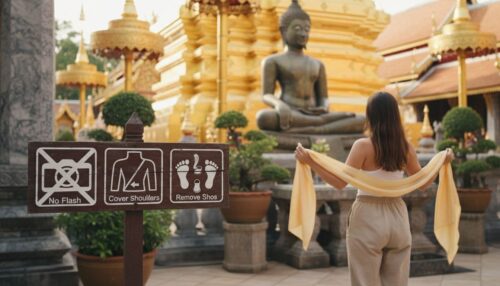
Can you take photos inside Thai temples, what to do with “no photo” and “no flash” signs
Common sign patterns:
- Camera icon with a slash: no photos, stop shooting.
- “No flash” text or a lightning bolt with a slash: flash must stay off, and photos should stay quick.
- Shoe icon: remove shoes before entering.
- Dress icons: shoulders and knees required.
Simple decision rule:
- If there’s a camera with a slash, phone stays down.
- If it says no flash, flash stays off and the shot stays fast.
- If staff waves you on, stop and move along.
Phones should be on silent. Calls inside worship spaces draw immediate attention and can interrupt prayer.
People photos: monks, worshippers, kids, and group tours
People shots need more care than building shots.
- Don’t photograph people praying up close.
- Ask before taking photos of monks, and don’t crowd them.
- Don’t treat monks like props for a posed travel shot.
- Step aside for group tours and let them pass, especially at hall entrances.
A practical rule works well: if a photo would interrupt someone’s worship, skip it.
For broader Thailand context on respectful behavior, TripSavvy’s overview is a useful baseline: Thailand Temple Etiquette: Dos and Don’ts.
How to behave inside worship halls (shoes, feet, sitting, and moving around people praying)
Inside halls, visitors often freeze for a moment because the rules feel unspoken. The good news is that the routine is consistent across Chiang Rai.
Shoes and entry:
- Remove shoes before stepping into the hall.
- Place shoes on racks or along the side where others do.
- Step carefully at thresholds and avoid stepping on raised edges.
Voices and movement:
- Keep voices low and short.
- Walk along the edges when possible.
- Don’t cut between a person praying and the Buddha image at the front.
The feet rule is the one most visitors miss. In Thai Buddhist temple etiquette, the soles of the feet are treated as the lowest part of the body, so pointing them toward sacred images or people is seen as disrespectful.
Quick do and don’t inside halls:
- Do: move slowly, pause if a ceremony is happening.
- Don’t: sit with feet aimed at the altar.
- Do: keep kids close and calm.
- Don’t: eat or drink inside.
Where to sit, what to do with your feet, and how to pass in front of others
Simple seating options that work:
- Kneel with feet behind you
- Sit with legs tucked to one side
- Sit cross-legged only if you can keep soles angled away from the front
Passing others:
- Move behind seated people when possible.
- If you must pass in front, keep a little distance and stay low.
- Don’t step over someone seated on the floor.
Monk etiquette with clear women specific rules (what to do instead of touching)
For everyone:
- Don’t sit too close to monks.
- Don’t take close selfies in their face.
- A small wai greeting is polite if you’re comfortable doing it.
For women in particular:
- Women should not touch monks.
- Women should not hand items directly to a monk.
What to do instead:
- Place the item on a table or cloth for the monk to pick up.
- If appropriate, ask a man to pass the item.
- Follow local guidance if staff or signage explains a specific method.
Temple by temple etiquette notes in Chiang Rai (White, Blue, and Huay Pla Kang)
Each major Chiang Rai temple has its own pressure points, usually tied to crowds and photo behavior.
Wat Rong Khun etiquette (White Temple): strict dress checks, no photos inside, and crowd patience
- Dress enforcement: active checks at entry points, cover-ups are often available nearby.
- Photos: outside photos are usually fine, no photos inside the main hall.
- Crowds: follow line routing and staff instructions, patience matters here.
- Hands off: don’t touch artwork, murals, or displays.
- Costs: the entry fee for foreigners is often around 100 THB, but posted rates can change.
Visitors planning their first visit often benefit from a site-specific primer: A Complete Chiang Rai White Temple Guide and a focused look at what gets enforced at the door: White Temple Chiang Rai Dress Code & What to Expect.
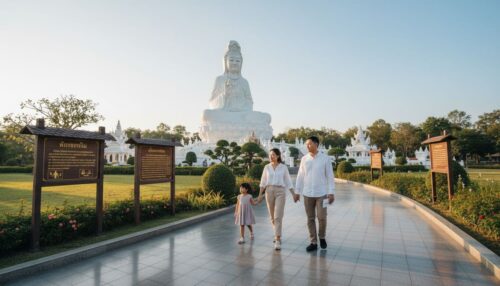
Wat Rong Suea Ten etiquette (Blue Temple): quiet voices, respectful seating, and inside photo caution
- Interior: bright murals invite photos, but rules still apply.
- Flash: keep it off.
- Space: don’t block the front area where people pray.
- Shoes: remove them before entering buildings.
- Sitting: tuck feet away from the altar and keep posture calm.
A practical visitor overview is here: Blue Temple Chiang Rai (Wat Rong Suea Ten).
Wat Huay Pla Kang etiquette: viewpoints, big statues, and donation manners
- Viewpoints: treat stairs and platforms like sacred space, move carefully.
- Statues and structures: don’t climb on statues, railings, or decorative features.
- Dress code: still matters, even for “just the viewpoint photo.”
- Donations: boxes are common; when donating, give with two hands if possible.
- Families: keep kids from running inside halls, quiet voices travel far in open spaces.
Common Chiang Rai temple mistakes tourists make (and what to do instead)
Mistakes happen most often when crowds are thick and people rush.
Common problems and quick fixes:
- Wearing shorts or a tank top and arguing with staff: bring a cover-up, fix it fast, move on.
- Forgetting to remove shoes: step back out and remove them, don’t keep walking.
- Pointing feet at Buddha images in photos: re-seat with legs tucked to the side.
- Loud talking or phone calls: step outside, finish the call, come back quietly.
- Hugging and kissing: save it for outside temple grounds.
- Selfies too close to Buddha images: take the shot from farther back, keep it respectful.
- Using flash: turn it off before entering, and leave it off.
- Blocking prayer areas for pictures: move to the side and wait for a clear moment.
- Touching monk robes: step back and give space.
If a mistake already happened, a simple script works: stop, smile, step back, and follow staff directions.
FAQ: Chiang Rai Temple Etiquette Guide (fast answers)
Q: Can I wear shorts at temples in Chiang Rai?
A: Shorts often cause problems if they don’t cover the knees. Long pants are the safest choice, especially at Wat Rong Khun.
Q: Do I need to cover my shoulders at the White Temple?
A: Yes. Wat Rong Khun is known for strict rules: shoulders must be covered.
Q: Do I remove shoes at Chiang Rai temples?
A: Yes, before entering worship halls and many temple buildings. Look for shoe racks near the entrance.
Q: Can you take photos in Thai temples, including inside halls?
A: Sometimes, but rules vary by hall. Outside is usually fine. Inside halls may restrict photos, and Wat Rong Khun’s main hall is widely posted as no-photo.
Q: What does a “no photo” sign look like in temples?
A: Often a camera icon with a slash through it, or clear text stating no photography.
Q: Is it rude to take selfies at Thai temples?
A: It can be if the selfie is too close to Buddha images, blocks walkways, or uses silly poses. Keep distance and keep it calm.
Q: Can women talk to monks in Thailand?
A: Yes, polite conversation is fine. The key rule is that women should not touch monks.
Q: How do women give items to monks without touching?
A: Place the item on a table or cloth, or follow local guidance for handoff procedures.
Q: What happens if I’m underdressed at a Chiang Rai temple?
A: Staff may deny entry until clothing is fixed. Cover-ups are often available near entrances, sometimes around 100 THB.
Conclusion
A smooth temple visit in Chiang Rai comes down to a few consistent habits: cover shoulders and knees, remove shoes, watch where you point your feet, and stay quiet in the halls. Photo rules should be treated as strict, especially at Wat Rong Khun where the main hall is typically no-photo. Monk etiquette is simple when remembered: keep space, and women shouldn’t touch monks. Save or screenshot the checklist, then share any Chiang Rai temple tip that helped avoid an awkward moment.