



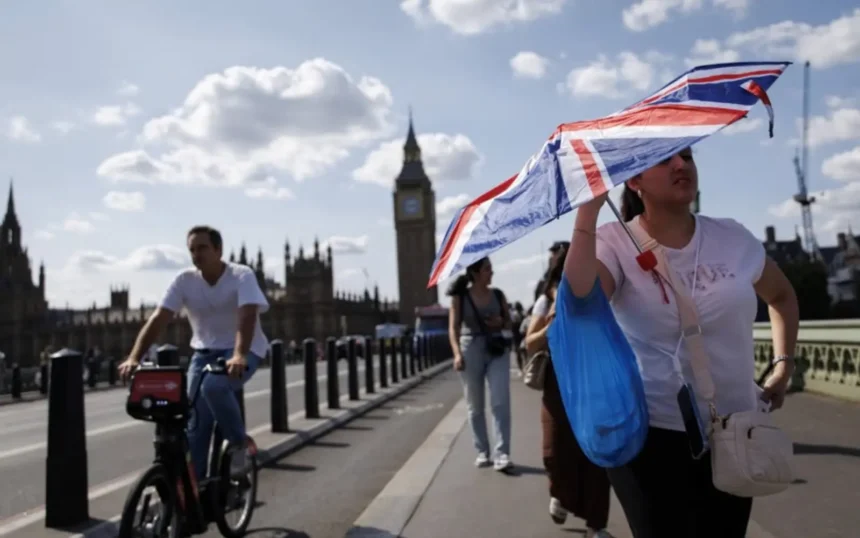
The Met Office says 2025 is likely to finish as the UK’s hottest year, but it’s not a done deal yet. Late-December weather can still pull the final average up or down by a fraction, and that’s enough to change the ranking.
This matters beyond bragging rights. A warmer year raises the risk of heat stress, strains water supplies, increases the chance of wildfires, and can also set up wetter winter spells that push up flood risk.
This explainer covers the key numbers behind the “warmest year on record” claim, what “UK average temperature” actually means, how the Met Office calculates it, what drove 2025’s extremes, and quick FAQs people keep searching for.
Met Office: What we know so far about the UK’s 2025 temperature record
The headline is simple: based on observed temperatures so far and a standard way of estimating the remaining days, 2025 is tracking just above the current UK annual record.
Here are the provisional figures being discussed, with the context that records can hinge on tiny margins:
- 2025 is tracking around 10.05°C for the UK annual mean
- The standing record is 10.03°C (set in 2022)
- The highest temperature recorded in 2025 reached 35.8°C
“Provisional” is doing a lot of work here. It means the year isn’t finished, some data can still be checked and updated, and the final average can shift with late-month weather.
If 2025 stays ahead, it would add to a pattern that’s hard to ignore: the warmest UK years are clustering in recent decades, showing a clear warming trend. The Met Office also points to unusually persistent warmth through much of the year, with several months running well above the long-term norm.
Related context is available in Met Office updates on major 2025 milestones, including Summer 2025 being the warmest on record for the UK and 2025 already being the UK’s sunniest year on record.
The quick numbers: UK average temperature, previous record, and hottest day
- UK average temperature 2025 (provisional): ~10.05°C, an average across the full year and the whole UK
- Previous warmest year (UK annual mean): 10.03°C in 2022
- Gap that could decide the record: 0.02°C, small on paper, decisive in records
- Hottest day temperature in 2025: 35.8°C, a single-day peak, not the annual average
The Met Office publishes these kinds of summaries as Met Office annual temperature provisional statistics, then confirms the final ranking once the year’s full data is in.
Why the Met Office says “likely,” not “confirmed,” until the year ends
The late-December problem is simple. The UK annual mean temperature is an average, so each cold day near the end of the year can nudge the number down.
That sounds minor, but when the record margin is around 0.02°C, a colder Christmas week can make a difference. The process also includes routine checks that can lead to small revisions, such as verifying station data and ensuring consistent coverage.
How the Met Office calculates the UK annual mean temperature (simple version)
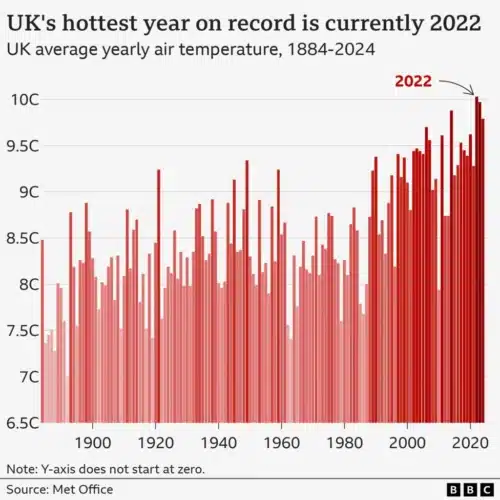
“Annual mean temperature” means the average temperature across the whole year. It’s not the hottest afternoon, and it’s not a single station. It’s a UK-wide figure derived from many measurements.
At a basic level, the Met Office combines daily readings from a network of weather stations, checks them for errors, then averages them into monthly values and finally into a yearly national number.
To determine what counts as “above average,” the Met Office often compares modern temperatures with a long-term reference period, typically 1961 to 1990. Using a baseline helps show how far today’s weather sits from what used to be typical.
A quick way to separate terms:
- Weather is what happens day to day (a frosty morning, a wet weekend).
- Climate is the pattern over decades (the long-term rise in average temperatures).
One hot day doesn’t “prove” a changing climate, but many warmer months stacking up over the years is a different story.
From daily readings to one yearly number: how averaging works
In plain steps, it works like this:
- Stations record daily temperatures, including highs and lows.
- Those daily values are combined into monthly averages.
- Monthly averages are combined into a yearly average.
- That information is used to estimate a UK-wide mean, rather than a single-region figure.
- Quality checks can lead to updates, which is one reason early numbers are provisional.
For readers who like to see an established long-running series, the Met Office also maintains the Central England Temperature record. Monthly figures for 2025 can be viewed at Mean Central England Temperature, 2025.
What “long-term average” means, and why the 1961 to 1990 baseline shows warming clearly
A baseline is a reference period used to define “normal.” The 1961 to 1990 average is widely used because it’s long enough to smooth out year-to-year swings.
In 2025, March through August ran more than 2°C above the long-term average. That’s not a rounding error. Months sitting that far above the baseline tend to show up in daily life through soil drying, heat-health pressures, and higher water demand.
UK climate records since the 1800s: why the long view matters
UK record-keeping goes back well over a century in several datasets. That long view helps in two ways: it puts modern extremes in context, and it shows how often “once rare” conditions now turn up.
The key point is not a single record, it’s the frequency of very warm years happening close together.
Why 2025 felt so intense: heatwaves, dry weather, drought, and wildfires
The year wasn’t just warm. It was persistently warm across long stretches, with repeated hot spells and unusually sunny conditions. That combination speeds up drying.
When warm air arrives under strong sunshine, soils lose moisture faster. Dry soils then make it easier for heat to build again, and harder for rivers and reservoirs to recover if rain stays patchy.
Parts of England and Wales saw official drought declarations during the year, and water scarcity concerns were also raised in parts of Scotland. This wasn’t only about high temperatures. Rainfall patterns mattered too, especially in spring, when low rainfall can create problems that persist into summer.
Wildfires became part of the story as well, with a reported burned area of 47,100 hectares. Early-season fires can surge when vegetation dries out quickly after a warm, dry spring.
Heatwave patterns in 2025: repeated hot spells and heat-health alerts
A heatwave is a run of unusually hot days for that location, not a single hot afternoon. In 2025, there were four declared heatwave events, which helped push overall temperatures higher.
During hot periods, the UK Health Security Agency issued heat alerts. Risk rises for older adults, babies, people with heart or lung conditions, and outdoor workers.
Practical heat safety steps that often make the most significant difference:
- Drink water often, even if thirst feels mild.
- Keep indoor spaces cooler, closing blinds on sunny windows.
- Avoid hard exercise during the hottest part of the day.
- Use shade and light clothing when outside.
- Check on neighbors who may struggle in heat.
- Protect pets, keeping walks shorter and offering cool water.
Drought and wildfire risk: why heat plus low rain is a dangerous mix
A “rainfall deficit” is just a shortfall: less rain than usual over a set period. The impact builds over time. Rivers run lower, reservoirs refill more slowly, and groundwater takes longer to recover.
That’s why the UK rainfall deficit in 2025 became a genuine concern in some areas, especially after a dry spring. Add heat, and water loss speeds up again through evaporation and plant use.
The wildfire side has its own trigger points. With 47,100 hectares burned, the year showed how quickly grassland and heath can ignite and spread when conditions line up. Wind matters too. Strong winds push flames forward and dry vegetation further, which is why wildfire teams watch forecasts closely when a wildfire risk UK hot, dry spring pattern takes hold.
Quick signals that fire risk is rising:
- Parched grass that crunches underfoot
- Several sunny days in a row with little rain
- Gusty winds, especially after a warm spell
Is climate change the reason, and what could the UK weather look like next?
Natural swings still shape UK weather from week to week and year to year. But the long-term rise in temperatures is driven by greenhouse gases warming the atmosphere and oceans.
Warmer background conditions raise the odds that hot spells become more intense, and that “above average” months stack up more often. The same warming also affects rainfall. Warmer air can hold more moisture, increasing the chance of heavier downpours when weather systems deliver rain.
For the global context, Copernicus tracks how warm the planet is each year and how recent years compare to the long-term record. The service is widely used as a reference point for global temperature monitoring. See Copernicus Climate Change Service.
A short 2026 checklist worth watching:
- Final Met Office confirmation of the 2025 annual ranking
- Reservoir levels and river flows going into spring
- Soil moisture after winter rain
- Heat planning for homes, schools, and workplaces
- Local flood plans ahead of wetter spells
For more on the Met Office’s wider outlook framing, see 2025 outlook: in top three warmest years on record.
Why can warming bring both drought and flooding in the same year
Warming pushes in two directions that can feel contradictory.
During warm spells, more water leaves soils and vegetation, which raises drought risk if rain doesn’t keep up. But when rain does arrive, a warmer atmosphere can support heavier bursts, increasing the risk of winter flooding in the UK in some situations.
The outcome depends on timing and storm tracks. Long dry periods followed by heavy rain can also increase runoff, because hard, dry ground can absorb less at first.
Key terms explained (mini box)
- Annual mean temperature: The average temperature across the whole year.
- UK average temperature: A national figure built from many stations, not one city.
- Baseline (1961 to 1990): A reference period used to define “normal,” so anomalies stand out.
- Heat-health alert: A warning that heat could affect health, used by public health services.
- Drought: A prolonged period of low water availability, often from low rainfall combined with high evaporation.
FAQs: the questions people ask about the UK’s hottest year on record
Is 2025 the hottest year on record in the UK?
The Met Office says 2025 is likely to end up as the warmest UK year, based on provisional figures around 10.05°C. The final ranking depends on late-December temperatures and final checks.
How does the Met Office calculate the UK’s average temperature?
It combines daily measurements from a network of stations into monthly averages, then a yearly mean, then a UK-wide figure. The final number can be updated after quality checks.
Why is the UK warming so fast?
The UK is influenced by warming seas and a warming atmosphere, which raises baseline temperatures. Local weather patterns still vary, but the long-term trend is upward.
What was the hottest day in the UK in 2025?
The peak temperature cited for 2025 is 35.8°C. That’s a one-day maximum and doesn’t represent the annual mean.
How many heatwaves were there in 2025?
There were four heatwave events declared during the year. Repeated hot spells can lift the annual average, even if there are cooler breaks.
What causes droughts in the UK, heat or lack of rain?
Both matter. Low rainfall starts the deficit, then heat speeds water loss from soils and reservoirs, worsening the drought.
Will UK winters get wetter because of climate change?
A warmer atmosphere can hold more moisture, which can increase the chance of heavier rainfall events. That doesn’t mean every winter is wet, but it can raise flood risk in some years.
What is the difference between weather and climate?
Weather is short-term conditions like a storm this weekend. Climate is the long-term pattern, measured over decades.
When will the Met Office confirm the final 2025 ranking?
Final confirmation comes after the year ends and the remaining data is processed. That is typically done in early 2026 once the dataset is complete.
Myth vs fact: common mix-ups about the “hottest year” headline
- Myth: A cold week means climate change stopped.
Fact: Cold spells still happen, even as long-term averages rise. - Myth: 10.05°C sounds small, so it can’t matter.
Fact: A national annual average shifting by fractions can still mean big changes in heat risk and water balance. - Myth: Heatwaves are only a summer issue.
Fact: Heat risk is highest in summer, but warm spells outside mid-summer can still affect health and water demand.
Conclusion
The Met Office projection is clear: 2025 is likely to be the warmest year on record in the UK, but final confirmation depends on the last days of December and end-of-year checks. The bigger story is the mix of impacts that come with persistent warmth, higher heatwave risk, greater drought pressure, more favorable conditions for wildfires, and the potential for heavier winter rain that raises flooding concerns.