



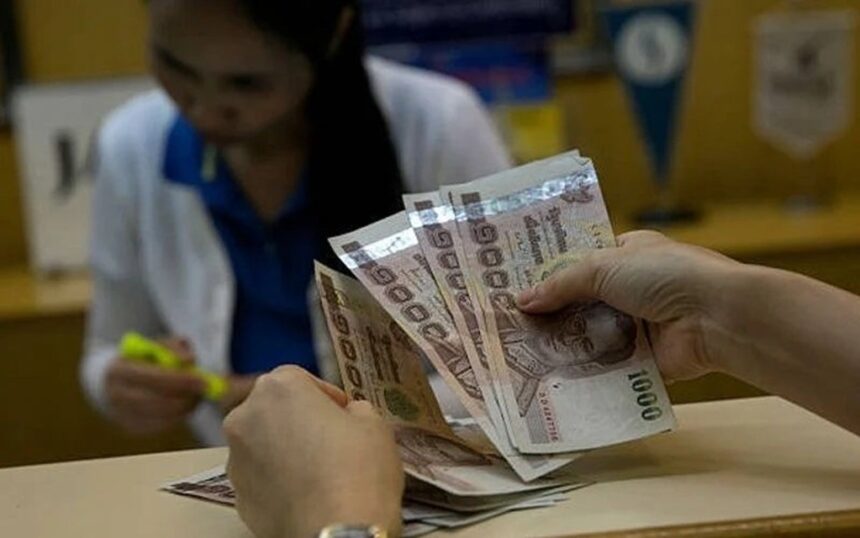
BANGKOK – The Bank of Thailand (BoT) has rolled out tough new measures to tackle the rapid rise of the Thai baht, which has climbed to its strongest level in years and is starting to weigh on the country’s fragile post-pandemic recovery. In a marked shift in policy, the central bank has told commercial banks to apply strict checks on foreign exchange transactions, with a clear focus on US dollar sales tied to Thailand’s booming gold trade.
The baht is now trading at around 31.50 to the US dollar, a gain of almost 9% since the start of the year. While a firm currency can signal confidence in an economy, the speed and scale of this rise have rattled exporters and tourism operators. Many say the baht is now “too strong” and no longer reflects Thailand’s real economic situation.
BoT Governor Vitai Ratanakorn said on Tuesday that gold-related flows are playing a major role in the baht’s sharp moves. In Thailand, gold is more than a luxury product; it is a favourite investment asset. When global gold prices climb, or the dollar weakens, Thai investors and traders often sell gold for US dollars, then quickly switch those dollars into baht.
“Foreign exchange flows linked to gold trading have increased sharply, at times reaching around 20% of total market turnover,” Governor Vitai said. “This activity puts heavy upward pressure on the baht that has little to do with the wider business economy.”
Under the new rules, commercial banks must:
- Tighten document checks: Banks must obtain clear proof of genuine gold sales to overseas buyers for every related FX transaction.
- Enforce a two-day window: Clients must submit invoices and shipping documents within two business days of receiving currency, so the bank can confirm that each deal is tied to physical gold exports and not speculative trades.
- Step up reporting: Large gold traders may soon need to report detailed transaction data directly to the BoT to help the central bank track flows more closely.
The BoT is also working with the Ministry of Finance on a plan to set up a dedicated regulator for the gold market, with a special focus on fast-growing online trading platforms.
Tourism Under Pressure: Thailand Becomes the Costly Choice
While the central bank targets financial flows, the impact on the tourism sector is becoming very clear in destinations such as Chiang Rai, Phuket, and other holiday hotspots. Tourism makes up close to 20% of Thailand’s GDP, so the stronger baht is a serious concern.
For many overseas visitors, the calculation is simple and painful. Travellers from the United States or Europe now receive far fewer baht for their money than they did a year ago. As a result, hotel stays in the Golden Triangle, island tours in the Andaman Sea, and even street food in Bangkok feel more expensive.
“Thailand is fast losing its image as a value-for-money destination,” a spokesperson for the Federation of Thai Industries (FTI) said. “We are seeing visitors shorten their trips or cut back on extras like restaurants and tours, because their home currency just does not stretch as far.”
Analysts warn that if the baht stays near current levels, Thailand risks falling short of its target of 40 million visitors in 2025. The traditional high season, usually a time when hotels and local businesses are full, is softer than expected. The baht is now the second-best performing currency in Asia, behind only the Swiss franc, and that strength is proving to be a double-edged sword.
Vietnam’s Tourism Boom: A Growing Regional Rival
While Thailand wrestles with a strong currency, its neighbour Vietnam is marking a major tourism milestone. The country has welcomed its 20 millionth foreign visitor this year, a record for its tourism industry.
As the baht has climbed, Vietnam has kept its currency, the dong, relatively stable and competitive. This has helped position Vietnam as a very appealing choice for price-conscious travellers looking for good value.
| Feature | Thailand (Dec 2025) | Vietnam (Dec 2025) |
|---|---|---|
| Currency Trend | Strong (baht up ~9% YTD) | Stable and competitive (dong) |
| Tourist Arrivals | Struggling to reach the 40M goal | Record-breaking 21M (estimate) |
| Market Perception | “Premium/Expensive” | “Budget-friendly/High growth” |
| Top Source Market | China, Malaysia, India | China, South Korea, Taiwan |
Vietnam is on course to attract 21 million tourists by year-end, beating its pre-pandemic high of 18 million in 2019. Many visitors, especially from China, now see Vietnam as the better deal, with lower costs and a growing reputation for safety and convenience. Vietnam has overtaken Thailand as the top destination for mainland Chinese tourists, a key market that Thailand long dominated.
The Road Ahead and the Thai Baht
The Bank of Thailand’s latest actions send a clear message that policymakers are no longer prepared to watch the currency climb unchecked while key sectors struggle. Caretaker Finance Minister Ekniti Nitithanprapas voiced the same concern, saying the current economic structure “cannot withstand such a strong currency”.
Attention is now turning to the upcoming Monetary Policy Committee meeting later this week. Many traders expect the BoT to cut its key policy rate by 25 basis points to 1.25%. A lower rate would make Thai assets slightly less attractive to foreign investors and could help ease some of the pressure on the baht.
In northern provinces and along the Mekong, shop owners, hoteliers, and tour operators are hoping these measures will help restore some balance between the currency and the real economy. Until that happens, the “Land of Smiles” may find it harder to compete with the “Land of the Ascending Dragon” next door, especially for travellers and investors who are counting every baht and dong.