



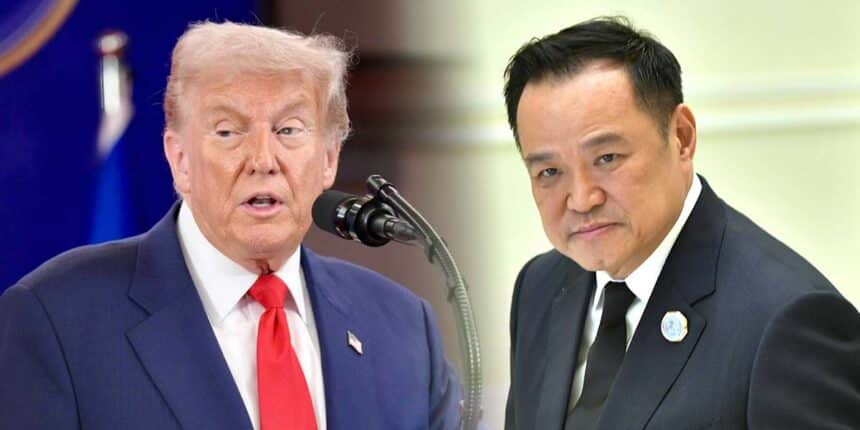
BANGKOK – Thailand’s caretaker government is under intense pressure as a border conflict with Cambodia and a diplomatic row with the United States unfold at the same time. Only hours after speaking on the phone with President Donald Trump, Caretaker Prime Minister Anutin Charnvirakul publicly rejected what was described as a ceasefire agreement with Cambodia.
Economists and political analysts say his hardline stance is putting Thailand’s already fragile economy and key trade negotiations with the US at serious risk. The controversy surged on Saturday when heavy fighting along the Thai–Cambodian border directly contradicted President Trump’s earlier claims of a ceasefire.
Ceasefire Denied: Anutin’s Position and the Thailand–Cambodia Clashes
The latest diplomatic rift follows a fresh round of deadly skirmishes with neighbouring Cambodia. On Friday night, President Trump announced on his social media platform that, after separate calls with Prime Minister Anutin and Cambodian leader Hun Manet, both sides had agreed to “CEASE all shooting” and return to a previous peace deal.
Any sense of relief vanished almost immediately as events on the ground and the response from Bangkok told a different story.
By Saturday, as reported by The Hill and confirmed by Cambodian military sources, Cambodia accused Thailand of launching further attacks, including the use of fighter jets and artillery along the disputed frontier, only hours after Trump’s optimistic statement.
Prime Minister Anutin took a firm line. In a public message, he disputed President Trump’s claim that both countries had agreed to halt hostilities after his calls with the two leaders, insisting that no agreement was made.
“Thailand will continue to perform military actions until we feel no more harm and threats to our land and people,” Anutin wrote on Facebook, insisting Thailand was acting in self-defence. He said the country would keep protecting its sovereignty unless Cambodia stopped its attacks, pulled back its troops, and removed newly laid landmines. He described these steps as Cambodia’s responsibility after breaching the earlier peace arrangement.
Critics view this open challenge to the US President as a serious diplomatic misstep that could damage Thailand’s most important foreign relationships at a time of economic weakness.
High Season at Risk: Economic Fallout Looms
For Thailand, which depends heavily on its tourism and hospitality sector, the timing of this border crisis could hardly be worse. December marks the start of the annual high season, when international arrivals usually surge, and tourism income reaches its peak.
Instead, the renewed fighting, combined with constant global media coverage and fresh travel warnings, including one from the United States advising extra caution near the border, is spreading anxiety through the industry.
- Tourism Slowdown: Even though the clashes are limited to specific border provinces, the wider sense of instability may put off foreign visitors from planning trips to Thailand. Hotels and tour operators, especially in eastern provinces like Trat (which includes Ko Chang and Ko Kood), report cancellations and weaker new bookings, despite being far from the fighting.
- Trade Disruption: The conflict is also hurting border trade. Several key crossings have closed, disrupting the flow of goods into Cambodia, which takes around 2–3% of Thailand’s total exports. Economists warn that if the clashes drag on and land routes stay shut, the drop in export value could put extra pressure on the broader economy.
- GDP Impact: On paper, the direct hit from the skirmishes on overall Thai GDP may seem small at first. But research centres caution that a prolonged conflict spilling into next year, combined with domestic political and financial problems, could shave a clear slice off GDP growth. That would mean billions in lost income and thousands of jobs at risk.
Anutin now has to walk a tightrope. He wants to keep a tough image that appeals to nationalist voters, while trying to avoid an economic slump during the most profitable quarter of the year.
Trump Tariffs and Strained US–Thailand Trade Talks
The border crisis is deeply tied to the fragile state of Thailand’s trade negotiations with the United States. This confrontation is taking place while the Trump administration continues its use of tariff pressure as a political tool, including previous threats linked to the conflict.
The caretaker Prime Minister’s blunt rejection of President Trump’s ceasefire claim has sparked concern that Washington could respond with new Trump tariffs on Thai products.
- Trade Talks at Risk: Thailand and the US are in the middle of sensitive trade discussions. President Trump has publicly promised to cut some tariffs on Thai goods, but the growing diplomatic tension after Anutin denied the ceasefire claim could stall or collapse these talks.
- Tariff Damage: The potential impact of Trump tariffs on Thailand’s economy is severe. Economic projections suggest that US trade restrictions, including a proposed 19% tariff and strict “local content” rules, would hit Thailand’s export-focused manufacturing sector hard. If fully applied, some analysts expect a sharp fall in export earnings, especially in electronics, vehicles, and auto parts, where the US is a key buyer. The knock-on effect on GDP could be large, hitting just as Thailand struggles with a slow post-pandemic recovery and high household debt.
Critics say Anutin’s uncompromising, nationalist rhetoric, including his previous claim that Thailand was not worried about the US walking away from trade talks, is a high-risk strategy that puts domestic political gains above economic stability.
How Thai People See the Crisis
Public opinion is sharply focused on the conflict and on how the caretaker government is handling both the fighting and the international fallout. Many Thais view the clash with Cambodia with a mix of fatigue, patriotism, and mounting doubts about the government’s competence.
- Trust Gap: Military vs Government: Recent polls show a clear split among the public. The military still enjoys strong trust for defending national territory, while the government’s performance during the crisis is rated poorly.
- Desire for Peace: While most people support defending Thailand’s borders, a large share of the population, especially residents in border areas, is losing patience with the continuing tension. They fear ongoing damage to local businesses and daily life. Many say they just want the fighting to stop as soon as possible.
- Nationalist Backing: At the same time, Anutin’s tough stance and resistance to foreign pressure are popular among hardline nationalist groups. They praise him for standing up to both Cambodia and a major partner like the US. This support at home appears to feed into his defiant approach, especially with potential elections on the horizon.
Meanwhile, international agencies such as the Associated Press and Reuters, later followed by outlets like The Hill, reported that fighting not only continued but escalated within hours of President Trump’s phone call.
This period has become a key turning point for Thailand. Below are the details you asked for, presented clearly.
Clarifying “The Hill” Report: Cambodia’s Claim of Thai Strikes on Saturday
The report you mentioned, first carried by agencies like the Associated Press and Reuters and then picked up by The Hill, confirmed that clashes renewed and intensified soon after President Trump stated that a ceasefire was in place.
Here is a clear summary of what happened on Saturday, 13 December 2025:
- Trump’s Statement: Late on Friday, President Trump posted on social media that he had secured an agreement from both Prime Minister Anutin and Cambodian Premier Hun Manet to “CEASE all shooting” at once.
- Cambodia’s Claim: On Saturday morning, Cambodia’s Defence Ministry announced that it had come under Thai attack. Officials said Thai forces had not paused operations and had stepped up strikes with fighter jets, targeting both military positions and civilian areas.
- Thailand’s Response: Prime Minister Anutin, who had already disputed Trump’s ceasefire claim, confirmed that Thai forces were still active. He said, “Our actions this morning already spoke.” The Thai military said it was using precision weapons in response to what it called Cambodian violations of Thai territory.
- Clear Contradiction: Cambodia’s report that it was hit by Thai forces on Saturday served as direct evidence that Anutin had rejected Trump’s version of a ceasefire. This deepened the diplomatic split, and the Thai Foreign Minister later said that Trump’s comments did not “reflect an accurate understanding of the situation,” adding that they had hurt the feelings of the Thai public.
Latest Economic Forecasts and Estimated Damage
Fresh projections from leading Thai economic institutions, including the National Economic and Social Development Council (NESDC) and the University of the Thai Chamber of Commerce (UTCC), show that the combination of border conflict and possible US tariffs is dragging the country towards its weakest growth in years.
Economic Growth Outlook for 2026
- Baseline Growth: Thailand’s economy is expected to slow sharply. Forecasts now put baseline GDP growth for 2026 at about 1.6% to 1.7%, below earlier, more optimistic estimates.
- Worst-Case Scenario: If the major risks hit at the same time, including tariffs, conflict, and political uncertainty, growth could slip to 1.0% to 1.3%.
Two Main Threats: US Tariffs and the Cambodia Conflict
| Economic threat | Key details & severity | Estimated hit to Thailand’s economy |
|---|---|---|
| US trade tariffs | US policy would apply a 19% “reciprocal” tariff and a 50% “local content” rule on selected Thai goods. These measures target Thailand’s key export industries. | About 0.27% of GDP loss if the 19% tariff is in place for a full year. This equals an export drop of more than 50.3 billion US dollars. |
| Cambodia border conflict | The main risk is a year-long shutdown of all land border crossings due to unrest and security concerns. | Around 0.74% of GDP loss, which analysts see as the largest direct GDP risk from this crisis. That is about 141.8 billion baht in lost export value. |
| Tourism and high season | The high season from December to February is usually the most profitable period for tourism. Conflict and travel alerts are weakening demand. | Ongoing worries, along with domestic troubles, are expected to reduce international tourist interest and may cause several billion baht in lost income, especially in border areas and nearby resort provinces. |
In simple terms, economists see a full closure of the Cambodian border due to fighting as a bigger immediate threat to Thailand’s growth figures than the current baseline risk from US tariffs, with a 0.74% GDP loss from border disruption compared with 0.27% from tariffs.
According to critics and economists, by sticking to a hard line over the border clashes, the Prime Minister increases the chances of this worst-case economic outcome. With high season revenue hanging in the balance and the threat of US trade penalties in the background, the choices Caretaker Prime Minister Anutin makes in the days ahead are likely to shape Thailand’s economic path in the coming year.
Related News: