MUMBAI – In Mumbai’s Dharavi, where ambition meets hardship, a different story plays out each day. It is not cinema, it is Kalyan Satta Matka, the underground numbers game threaded into daily life like chai and cricket.
- The Matka Mania: India’s Enduring Love Affair with Numbers
- AI’s Ascendancy: From Code Farms to Innovation Hubs
- Subverting the Shadows: Developers Building the Next Matka Frontier
- The Tech Stack Behind the Guesses
- Case Studies: From Garage to Grey Market Glory
- The Crystal Ball: Matka Guessing in the AI Era
- Ethics in the Odds: Innovation or Exploitation?
- Future Bets: Where AI Meets Matka Next
By 2025, this old vice will have a new skin. With generative AI tools and low-code platforms, a wave of Indian developers is building slick apps that claim to guess winning numbers, spot trends, and even simulate draws. These apps mix rituals from a bygone betting culture with modern silicon, and they raise sharp questions about innovation, ethics, and the thin border between luck and algorithm.
India’s AI push is in full swing, projected to reach $8 billion by year-end with a 40% CAGR. Developers now use edge computing and predictive analytics across sectors like e-commerce and edtech.
On the margins, a small group has targeted Matka, a market said to produce billions in illicit revenue each year despite the Public Gambling Act of 1867. With over 712 million smartphone users spending about 4.7 hours a day on apps, AI-led Matka tools are landing in the hands of users who crave quick wins and constant stimulation.
This is not the notebook version of Matka. In Bengaluru garages and Hyderabad co-working hubs, teams apply machine learning to old charts, use NLP to mine forum chatter, and even roll out generative bots that pose as “experts.” Many apps claim 70 to 80 percent success on guesses, a bold mix of belief and statistics. Their spread has sparked debate. Some see access and information; others see a recipe for more harm in a country facing income gaps and debt traps.
The Matka Mania: India’s Enduring Love Affair with Numbers
To see why Kalyan Satta Matka apps draw attention, it helps to understand the game’s hold. Born in the 1960s during Mumbai’s cotton trade, Matka, meaning “pot” in Hindi, shifted from commodity rate bets to number draws. Players pick combinations from 0 to 9, with open and closed draws creating sums whose last digits decide winners. A small stake can deliver outsized payouts. A ₹10 wager might return ₹9,000 for a jackpot.
Kalyan Matka, named for founder Kalyanji Bhagat, dominates the scene. It runs daily from late afternoon to midnight, pulling players across Maharashtra, Gujarat, and beyond. Forums like DPBoss and SattaMatka.com post live results, while WhatsApp groups share tipped pairs or jodis. Enforcement has teeth, with Mumbai raids reportedly seizing ₹500 crore last year, but demand holds. The barrier to entry is low, the rules are easy, and the dream is immediate. In a country where most people earn under ₹2 lakh a year, the promise of a sudden lift is hard to ignore.
Guessing sits at the heart of the obsession. Fans pore over panel charts, scanning old results for faint patterns, much like astrology meets arithmetic. Online, that habit grows in forums where “fix ank” posts combine dreams, numerology, and simple sums.
Apps like KB SattaMatka Tricks and digital heirs of Ratan Khatri push alerts for hot numbers. With 26.4 billion app downloads in India last year, these tools have turned casual players into number watchers. As one Mumbai bookie put it, luck is still king, while guessing feels like prayer in code.
AI’s Ascendancy: From Code Farms to Innovation Hubs
India’s AI journey began years ago with early chatbots like Haptik’s, but 2025 looks like a tipping point. With 17 million developers on GitHub, private funding in the global top ten, and the IndiaAI Mission planning 10,000 GPUs, the pieces are in place. Mobile app development, a $13.6 billion sector, is the frontline. Deloitte says six in ten firms now use generative AI for code, cutting rollout times by about 30 percent.
Low-code tools are riding this wave. Platforms like Bubble and Adalo, backed by AI, let solo builders ship prototypes in days. Edge computing moves processing to the device, so apps can run in patchy 4G areas. Statista puts smartphone users at 1.2 billion by 2025, a vast market.
Firms like WeblineIndia and SPEC India ship AI-led features across UPI, health, and more. For Matka developers, the toolkit is punchier. SymPy for probability logic, NetworkX for chart graphs, and PyTorch for neural nets trained on old results sit in the mix.
Most of these creators are not big tech. Many are self-funded twenty-somethings using free tiers from Grok or Claude. Take “Raj,” a pseudonymous Bengaluru developer, who reached out on Signal. An IIT Madras grad, he built a Kalyan app that reads forum sentiment to spot trends. “It is like chess with numbers,” he said. “AI does not gamble, it calculates probabilities.” He lists his app as a lucky number tool, offers premium guesses for ₹99, and has 50,000 sideloaded installs.
Subverting the Shadows: Developers Building the Next Matka Frontier
The Tech Stack Behind the Guesses
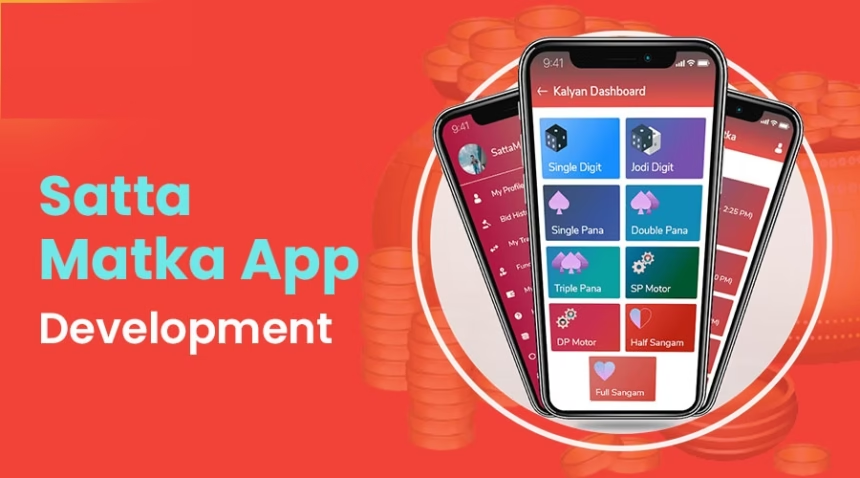
A Kalyan Matka app is often a thin wrapper for AI tricks. First comes data intake. Scrapers pull public numbers from sites like KalyanPanelChart.in, then load DataFrames with opens, closes, and panel history. Some use symbolic regression in SymPy to test formulas, such as digit sums, using modulo 10 for final outputs.
The guess engine sits at the core. Developers train models with scikit-learn or train LSTMs in torch on labelled chart data. Inputs can include recent trends and user “dream numbers.” Outputs might be Jodi probabilities shown as charts. One app, “Matka Guru AI,” displayed “3-7-9 open, sum 19 (9 close)” with a stated confidence of 78 percent, and lined this up with live X chatter using semantic search.
Language models add another layer. Forums pulse with Hindi-English slang, for example, “panna fix ho gaya.” NLP models from Hugging Face parse this and score sentiment for heat. Some fine-tuned models generate personal messages, like “Your lucky colour is red, try 5-8.” It reads like mysticism wrapped in tech, and many users like it.
Security remains a concern in this grey zone. Apps add AES encryption for bets, plug in UPI for payment, and obfuscate code to avoid store bans. With cyber cells watching closely, a few apps ship with a “self-destruct” mode that trips when flagged.
Case Studies: From Garage to Grey Market Glory
Priya Sharma, a 28-year-old freelancer in Hyderabad, built “Satta Smart” and reached 100,000 users in six months. She used Draftbit for low-code and Google Cloud’s Vertex for AI, shipping an MVP in two weeks. Features include voice input for guesses, AR overlays for chart viewing, and a nudge for responsible play. The app earns through affiliate links to bookies, bringing in about ₹5 lakh a month. “AI flattens access,” she said. “Aunties in small towns now guess like seasoned players.”
In Pune, a five-person crew created “Kalyan King AI” as a side project. Their hook is a custom neural net trained on two decades of DPBoss data, served on Flask via Heroku. It runs 1,000 simulations per query and displays outcome heatmaps. They also filter X posts with min_faves:10 for tip mining and claim a 65 percent weekly jackpot hit rate. Copycats drew attention, and a clone was removed from Google Play, so they moved users to Telegram bots.
The Crystal Ball: Matka Guessing in the AI Era
Guessing now looks more like a data game. Some prototypes from Orion InfoSolutions use reinforcement learning that tweaks weights based on user wins and losses. Forums are shifting, too. X threads marked with #KalyanMatkaGuessing host AI-driven polls to crowdsource better picks. A viral post by @MatkaMasterAI claimed a 92 percent hit rate using “quantum-inspired” maths, which often means creative NumPy. Genetic-style methods are also in play, sometimes borrowed from BioPython patterns, to evolve number sets.
Ritual still matters. Many apps fold in Vedic numerology APIs, blending astrology with AI to sell a “complete” prediction flow. Users enter birth details, then get suggested jodis with a karmic slant. It is a cultural move that makes tech feel familiar in a gambling economy worth an estimated ₹1.3 lakh crore.
Ethics in the Odds: Innovation or Exploitation?
There is a clear catch. AI can amplify a harmful habit. The Lancet estimates gambling addiction in India at around 1.2 percent, with Matka tied to debt cycles in poorer areas. App features like win streak alerts, gamify dopamine loops, and behavioural economists warn against that pattern. Regulators are reacting. MeitY’s 2025 ethical AI framework calls for transparency, but enforcement trails behind. Deepfake ads, like the viral clip with a synthetic PM Modi voice pushing a “Paisa Stories Club” Satta app, show how this can go wrong.
Developers feel the tension. Raj said, “We are not bookies, we build tools. But the power is real.” Some have adapted Mindway AI features to flag risky behaviour, yet many ignore them. Global iGaming companies such as RichestSoft talk of responsible AI, but Matka’s underground culture often rejects limits.
The legal ground is tricky. The 2023 IT Rules restrict ads for real-money games, and Matka apps often sit under “entertainment” labels to dodge scrutiny. Section 69A allows blocks, so developers turn to VPNs and distributed hosting. A firm listed on Clutch summed it up: Complianceee is the safe path, or go off the grid.
Future Bets: Where AI Meets Matka Next
NASSCOM expects AI services to reach $17 billion by 2027, helped by fantasy sports and other legal formats like Dream11. For Matka, the next wave could bring VR drawing rooms built in Unity, blockchain-based drawing records, and agent-style models such as Krutrim’s bots that chat in Tamil or Bengali.
People still drive the story. Priya put it simply, “AI guesses, people dream.” With 800 million still offline, India runs at two speeds. These apps can help users make sense of data, or they can trap them in habits they cannot afford. If efforts like BharatGen push stronger guardrails, the balance might shift.
In the crowded lanes of Mumbai, a phone lights up with an alert, “Your AI guess, 4-6-8. Bet big?” Is it luck, code, or both? In the Matka maze, it often feels like the same toss.