



Last Updated on August 25, 2026 by Jeff Tomas
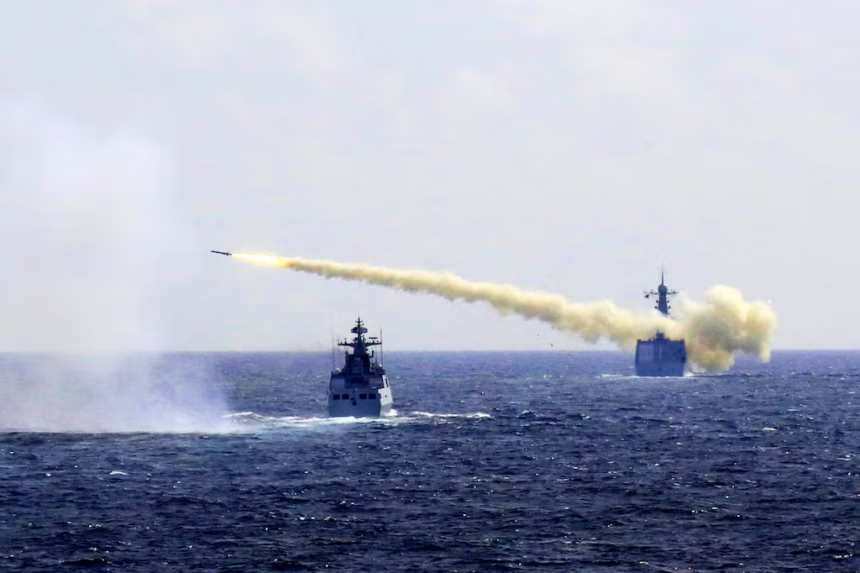
BEIJING – China’s planned five-day live-fire exercise comes at a time when military patrols, coast guard operations, and diplomatic protests already crowd the South China Sea. If you’re following the dispute, the key point is that the training area is not at the main flash points with the Philippines, yet its timing puts it under scrutiny.
The drills run from August 24 through August 28 in waters off southern China. They add to a tense security situation centered on Scarborough Shoal and Second Thomas Shoal.
The Exercise Area and What China Has Announced
Chinese maritime authorities in Guangdong province issued a navigation warning for daytime live-fire drills in waters off the Leizhou Peninsula. The training area sits near the eastern side of the Qiongzhou Strait, which separates mainland China from Hainan Island.
A report on the announced Leizhou Peninsula drills said the exercise is scheduled to last five days. Ships have been told to remain outside the designated zone during the daily training periods.
| Detail | What has been announced |
|---|---|
| Dates | August 24 through August 28 |
| Type of activity | Live-fire military exercise |
| Location | Waters off the Leizhou Peninsula |
| Nearby waterway | Eastern side of the Qiongzhou Strait |
| Timing | Daytime hours |
| Civilian shipping rule | Vessels must avoid the restricted area |
The warning is meant to keep civilian traffic out of the immediate training zone. It does not mean commercial shipping has stopped across the broader South China Sea.
What remains unclear
China has not publicly identified the military units, ships, aircraft, weapons, or other equipment that will take part. The navigation warning provides basic safety information, not a full operational plan.
That lack of detail leaves important questions unanswered, including the size of the exercise and whether the participating forces will conduct naval, air, or joint operations.
The drill zone is away from the most frequent China-Philippines confrontations, but it remains part of the wider South China Sea security environment.
Why the Timing Draws Attention
China regularly conducts military training near its southern coastline, and countries around the world set aside sea areas for live-fire exercises. A scheduled drill alone doesn’t mean a confrontation is expected.
However, military activity carries more political weight when Chinese and Philippine forces are already monitoring one another in disputed waters. Beijing and Manila continue to hold firm, conflicting positions over sovereignty, maritime rights, and access.
Recent Chinese exercises near Scarborough Shoal
Earlier in the month, China carried out joint naval and air exercises around Scarborough Shoal. China calls the feature Huangyan Dao. The Philippines calls it Bajo de Masinloc or Panatag Shoal.
Scarborough Shoal lies relatively close to Luzon, the Philippines’ largest island. Its location and long-running dispute over access make it one of the region’s most sensitive maritime locations.
China’s Southern Theater Command said its earlier training included:
- Reconnaissance, early warning, and patrol operations.
- Air and sea control activities.
- Coordination between naval and air forces.
- Rapid military support.
Chinese officials said those exercises tested real-combat capabilities and supported what Beijing describes as its territorial sovereignty and maritime rights.
Beijing and Manila Disagree Over Maritime Rights
The live-fire drills sit alongside a legal and political conflict that neither government has resolved. China claims Scarborough Shoal and many other features in the South China Sea. It describes its patrols, coast guard operations, and military exercises as lawful actions to protect Chinese sovereignty and maritime interests.
Beijing also says Philippine activity near Scarborough Shoal and Second Thomas Shoal is unauthorized. Chinese authorities have repeatedly called on Manila to stop operations in waters China claims.
The Philippines cites international law and arbitration
The Philippines rejects China’s broad maritime claims. Manila refers to waters within its exclusive economic zone as the West Philippine Sea and maintains that military activity cannot change the legal status of those waters.
Manila bases its position in part on the 2016 South China Sea arbitration. The Permanent Court of Arbitration’s case record describes the proceedings, which addressed historic rights, maritime entitlements, and the status of features in the South China Sea. China rejects the ruling.
Philippine military spokesperson Rear Admiral Roy Vincent Trinidad stated:
“Military activities or demonstrations do not alter the legal status of maritime features or the Philippines maritime entitlements under international law.”
The statement captures Manila’s wider approach. Philippine officials say they will continue operating in areas they regard as part of the country’s lawful maritime zone while seeking to avoid unnecessary escalation.
Airspace Is Also Contested Around Scarborough Shoal
The dispute is not limited to ships and coast guard vessels. China recently said that three small Philippine aircraft entered airspace over Scarborough Shoal without Chinese approval.
According to China’s Southern Theater Command, Chinese naval and air forces tracked the aircraft and issued warnings. Beijing described the flights as a sovereignty violation and said such encounters can increase the risk of misunderstanding or miscalculation.
Two sharply different views of access
Manila does not accept Chinese authority over the airspace and waters around Scarborough Shoal in the way Beijing describes it. That disagreement turns even routine flights and patrols into politically charged events.
| China’s position | Philippine position |
|---|---|
| China says operations near the shoal require its approval. | The Philippines does not recognize China’s claimed authority over the surrounding waters and airspace. |
| Beijing treats unapproved activity as a challenge to sovereignty. | Manila treats access as part of its maritime rights under international law. |
| Chinese forces may track and warn vessels or aircraft. | Philippine forces continue operations in areas Manila considers lawful maritime zones. |
Because the two sides start from incompatible legal positions, the same event can produce two very different official accounts.
Why Civilian Shipping Watches Live-Fire Notices
The South China Sea is one of the world’s busiest maritime regions. Commercial vessels carry energy supplies, manufactured goods, food, and other cargo through these waters each day.
For that reason, navigation warnings matter even when an exercise occurs far from the main disputed reefs and shoals. They give ship operators a defined area and time window to avoid while military training takes place.
What the warning means for ships
During the August 24 through August 28 exercise period, vessels are expected to stay out of the announced training zone during daytime hours. The restriction is a safety measure for the immediate area, rather than a broad closure of the South China Sea.
Military drills become more sensitive when they occur alongside competing patrols, aircraft flights, and coast guard activity. In those conditions, safe distances and clear communications matter as much as the exercise schedule itself.
The Dispute Reaches Beyond China and the Philippines
China and the Philippines are central to the current tensions, but they are not the only parties with claims in the South China Sea. Vietnam, Malaysia, Brunei, and Taiwan also have overlapping claims in parts of the region.
Fishing grounds, possible energy resources, shipping routes, and national security concerns give these disputes consequences beyond any single reef or shoal. A limited confrontation can affect diplomatic relations and military planning across Southeast Asia.
The United States remains part of the security picture
The United States and the Philippines are treaty allies. Their defense relationship includes joint exercises, maritime training, and other military activities, and cooperation has expanded in recent years.
The administration of President Donald Trump has continued to describe the U.S.-Philippines alliance as important to regional security. Philippine officials have also said their defense ties with Washington remain strong, while maintaining that Manila’s goal is to protect Philippine interests rather than widen the dispute.
China takes a different view of outside military involvement. Beijing says external powers raise pressure in the South China Sea. Washington and its partners say their activities support freedom of navigation and regional stability.
Scarborough Shoal and Second Thomas Shoal Remain Flash Points
Scarborough Shoal and Second Thomas Shoal are where the dispute most often becomes visible at sea. Philippine coast guard, military, and civilian vessels operate around both locations. Chinese coast guard and other government ships also maintain a regular presence.
Repeated encounters increase the chance of close approaches, warnings, and disputes over who has the right to operate in a particular area. The core problem is not a lack of activity. It is that both sides view their own activity as lawful and the other side’s activity as a challenge.
Limited agreements can reduce immediate risk.
China and the Philippines previously reached a provisional understanding on Philippine resupply missions to Second Thomas Shoal. Philippine officials said the arrangement helped several missions proceed without major incidents.
That experience shows that practical communication channels can work even while sovereignty claims remain unresolved. Such arrangements do not settle the larger dispute, but they can reduce the chance that a resupply mission or patrol becomes a dangerous encounter.
The Philippine Foreign Service Institute’s summary of the arbitration findings outlines the legal issues that remain at the center of Manila’s position.
What Each Government Is Trying to Protect
China wants to maintain its territorial position, operate throughout waters it claims, and demonstrate that its military can train and respond in the northern South China Sea. The five-day exercise allows Chinese forces to practice while also showing readiness.
The Philippines wants to preserve access to fishing grounds, offshore areas, and military positions under its control. Manila also wants to protect the maritime entitlements it says international law recognizes.
Why the cycle is likely to continue
Neither government has indicated that it will abandon its claims. As a result, military exercises, coast guard patrols, diplomatic protests, aircraft flights, and resupply missions are likely to remain regular features of the dispute.
The issue is larger than military power alone. It also involves competing legal arguments, access to resources, domestic politics, and the role of allies and outside powers.
What to Watch During and After the Drills
The planned exercise will draw attention, but the broader pattern of behavior across the South China Sea matters more. Chinese and Philippine ships or aircraft do not need to enter the Leizhou Peninsula training zone for tensions elsewhere to rise.
Three developments will be especially important:
- Whether military and coast guard forces maintain safe distances during encounters.
- Whether both sides use clear communications and avoid actions that could be read as hostile.
- Whether diplomatic channels remain open after incidents near Scarborough Shoal or Second Thomas Shoal.
For China, the drills are a chance to train forces and display readiness. For the Philippines, they are another development to monitor while it maintains its own maritime operations. For neighboring countries and commercial shipping operators, the central concern is whether competition stays controlled.
The Challenge Is Preventing an Unintended Crisis
China’s August 24 through August 28 live-fire drills are part of a wider period of tension, not an isolated event. The exercise takes place off the Leizhou Peninsula rather than at the main China-Philippines flash points, yet it reinforces China’s continuing military presence in the northern South China Sea.
The stronger concern is miscalculation. China and the Philippines continue to assert opposing claims over the same waters, airspace, and maritime features.
As patrols, exercises, and resupply missions continue, disciplined conduct and reliable communication will help determine whether the dispute remains managed competition or develops into a larger crisis.


