




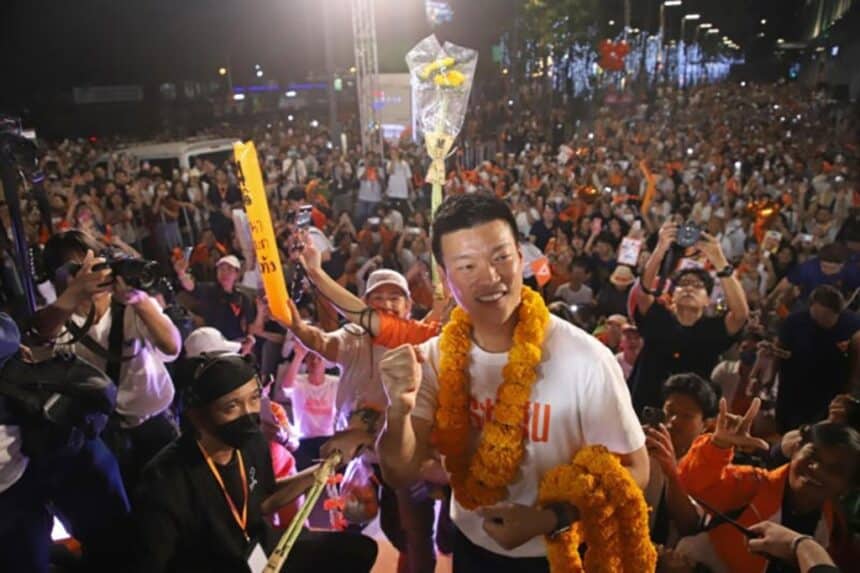
BANGKOK – Thailand has just over a week to go before the snap general election on February 8. National polls still show the reform-focused People’s Party and its prime ministerial pick, Natthaphong Rueangpanyawut, out in front by a wide margin.
The party, formed after the dissolution of the Move Forward Party, has gained support as many voters call for change after months of political shake-ups, including the fall of the former Pheu Thai-led government.
Across multiple surveys, the People’s Party leads the party-list race, usually landing between about 30% and just over 38%. In several recent polls, Pheu Thai has moved into second place, slightly ahead of the governing Bhumjaithai Party in third. The contest shows a country split between reform-minded voters and long-standing political networks with strong regional bases.
Fresh Poll Numbers Point to Continued Momentum for the People’s Party
The latest polling keeps the People’s Party in a strong position. In a second nationwide Rajabhat Poll of 11,700 voters, the party received 38.8% support. Pheu Thai followed with 17.9%, while Bhumjaithai posted 15.6%. On prime minister preferences, Natthaphong Ruengpanyawut (often called “Teng”) ranked first at 36.7%.
Earlier in January, Suan Dusit University polling put the People’s Party at roughly 33.14% to 34.2%. Bhumjaithai came in around 16%, with Pheu Thai close to that level, or slightly behind depending on the release.
A National Institute of Development Administration (NIDA) poll showed the People’s Party at about 30.4%, Bhumjaithai second at 22%, and Pheu Thai third at 16%. A Matichon, Daily News poll also showed Natthaphong leading the PM field at 35.2%, well ahead of other names.
In the Northeast (Isan), long seen as Pheu Thai territory, a Khon Kaen University Isan Poll placed the People’s Party narrowly on top for party-list votes at 30.3%. Pheu Thai stood close behind at 30.1%, with Bhumjaithai at 27.2%. The numbers suggest a real shift from earlier years, when Pheu Thai’s regional support was stronger, including in 2023.
Seat forecasts still differ. Some internal numbers and analyst projections suggest the People’s Party could win 150 or more seats in the 500-member House, with a chance to climb higher if turnout is strong. Other models, including some tied to NIDA-based estimates, give Bhumjaithai an edge in many districts due to local ties.
Even so, the national trend line has favored the progressives in recent polling. Undecided voters and regional differences can still swing results, but the People’s Party and Natthaphong remain the clear front-runners.
Why the People’s Party Has Gained So Much Support From Younger Voters
Support from younger Thais, especially ages 18 to 35, is a major reason the People’s Party is polling well. Many in this group are active online and frustrated with old-style politics. They see the party as a direct path to reform.
Natthaphong Rueangpanyawut, a 37-year-old former tech entrepreneur and a lawmaker known for a strong online presence, fits that image. He presents himself as practical and detail-focused, with strong messages on transparency, anti-corruption, and using technology to address issues such as grey-money networks.
The party’s online outreach, shareable content, and “Trust the People” message have helped it build a loyal base, similar to the Move Forward surge in 2023.
Many younger voters also back the party’s platform, including decentralizing power and pushing for more economic fairness. The party also signals a more moderate approach to military and monarchy reform to widen its reach.
Its promise of a people-led government, free from long-running power groups, speaks to voters who feel past coalitions failed to deliver real reform. Strong participation from younger voters in Bangkok, central provinces, and parts of the North has helped boost both constituency races and party-list support.
Pheu Thai Still Has Deep Roots in the North and Northeast
Even with weaker numbers nationwide, Pheu Thai remains a major player in the North and Northeast. These regions have backed Shinawatra-aligned parties for years.
Many rural and working-class voters continue to favor Pheu Thai’s populist approach, including debt relief, support for household costs, affordable health care, and economic help during tough times.
Pheu Thai also benefits from long-established local networks and relationships with local leaders and groups. In Isan, the party is running an energetic campaign, leaning on its family brand and a message of stability.
While national polls show a slide, some regional surveys show close races. In a few areas, targeted outreach has helped Pheu Thai hold ground or win it back.
That base could still translate into a large number of seats, which may leave Pheu Thai in a key role during coalition talks after the vote. Its move into second place in some polls points to effective campaigning in vote-rich provinces, even as it struggles more with younger and urban voters.
With the February 8 close, the election will show whether the reform wave can beat the long-standing political machines. The People’s Party wants to end the pattern of stalled reforms, with Natthaphong Rueangpanyawut leading the push.
Still, Bhumjaithai’s district strength and Pheu Thai’s regional loyalty mean the final result is far from settled.
Turnout, undecided voters, and coalition math will decide the next government. In Chiang Rai and across the North, where reform ideas meet long-held loyalties, the race feels especially tense. No matter who wins, the outcome is likely to shape Thai politics for years.