




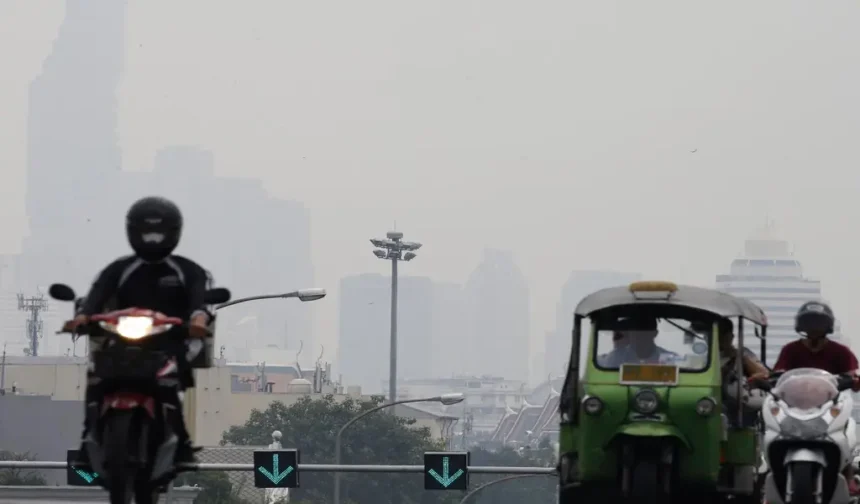
BANGKOK – The air pollution crisis has gotten worse with unsafe levels of fine particulate matter (PM2.5) spreading across the capital and nearby areas. With more than 10 million residents, the city deals with seasonal haze almost every year.
It’s fueled by local emissions, farm burning, and weather that keeps dirty air trapped. By late January 2026, PM2.5 often sits above national safety limits, leading to health alerts and louder calls for tougher action.
Recent readings show that Bangkok’s air quality keeps shifting, but it’s often unhealthy. On January 29, 2026, real-time tracking from sources like AQICN showed a PM2.5 AQI near 116. That falls under “Unhealthy for Sensitive Groups.” At these levels, people who are more at risk, like kids, older adults, and anyone with asthma or heart conditions, can feel the effects sooner.
A day earlier, on January 28, the Bangkok Air Quality Information Center reported an average PM2.5 level of 55.6 µg/m³. That’s above Thailand’s 24-hour standard of 37.5 µg/m³. Some districts recorded the worst numbers, including Nong Chok (80.8 µg/m³), Min Buri (77.3 µg/m³), and Khlong Sam Wa (76.5 µg/m³).
Many places hit “orange” status, which signals early health impacts. Around the same time, IQAir showed snapshots near 30 µg/m³ in parts of the city, which is still about 6 times the World Health Organization (WHO) annual guideline of 5 µg/m³.
Spikes have been common throughout January 2026. Mid-month, the AQI reached “unhealthy” levels, including a reported 161 on January 14. For short periods, Bangkok ranked among the more polluted major cities worldwide.
Reports from the Pollution Control Department (PCD) also showed PM2.5 above standards in 26 provinces. In Bangkok and nearby areas, affected zones recorded roughly 41.9 to 91.8 µg/m³. Forecasts have warned that haze could hang on into early February, since temperature inversions can trap pollution close to the ground.
Why Bangkok Air Pollution Keeps Coming Back
The haze covering Bangkok is packed with PM2.5, tiny particles that can move deep into the lungs and even enter the bloodstream. These particles are linked to breathing problems, heart issues, and long-term health harm. The risk rises during the cooler, dry stretch from December through February, when weak winds limit how much pollution can spread out.
Several sources pile on at the same time. A major driver is agricultural biomass burning in nearby provinces. In places like Nakhon Nayok, satellite tracking flagged unusual hotspots, including burning across more than 13,000 rai in late January.
Forest fires and open trash burning also add smoke that can drift into the capital, pushed by northeast winds. Inside the city, vehicle exhaust, factory emissions, and construction dust make the haze thicker. Heavy traffic adds even more NO₂ and particulate pollution to the mix.
People across Bangkok often report low visibility, itchy eyes, and sore throats during heavy smog days. Hospitals also see more visits tied to breathing complaints when pollution peaks. Health agencies keep urging people to wear N95 or PM2.5-rated masks, cut back on outdoor time, and get medical care if symptoms get worse.
What the Government Is Doing About PM2.5
The Thai government and the Bangkok Metropolitan Administration (BMA) have rolled out several steps, based on past haze seasons. Many upgrades started in late 2025, ahead of the 2026 smog period.
The BMA announced 10 stronger actions for 2026. They include a citywide Low Emission Zone (LEZ) covering all 50 districts, tighter black-smoke limits (capped at 20%), more green space, and support for cleaner transport, including electric vehicles.
Officials also increased vehicle checks and expanded oversight of factory stacks using real-time Continuous Emission Monitoring Systems (CEMS).
A “Single Command” system helps agencies respond faster when PM2.5 crosses set thresholds. This setup allows Bangkok and provinces to coordinate actions, declare disaster areas when needed, protect high-risk groups, and use measures like work-from-home requests.
In late January, Bangkok Governor Chadchart Sittipunt linked pollution spikes to biomass burning and encouraged work-from-home on January 29 to 30 to reduce traffic emissions. Authorities have also worked with farmers in upstream areas, with reports showing hotspot reductions of more than 50% in some comparisons to earlier years.
Thailand’s proposed Clean Air Act
At the national level, officials have pushed stricter factory controls and bans on open burning. Thailand’s proposed Clean Air Act, drafted in 2025 and expected to take effect in 2026, is meant to set clearer rules and stronger enforcement.
It also includes ideas such as citizen rights to clean air, incentives to cut pollution, and penalties for violations.
Officials have pointed to some improvements, including late 2025 periods where PM2.5 dropped around 40%, fewer orange-alert days, and better cooperation from businesses and residents.
Even with these steps, critics want faster progress on the Clean Air Act and stronger cross-border work with nearby regions, since smoke does not stop at provincial lines.
Small weather changes can bring short breaks, but many experts expect the problem to stay until the rainy season returns. For day-to-day planning, residents can track real-time air quality on apps like IQAir, AQICN, or official PCD channels.
Basic health steps still matter when PM2.5 rises. Wear a well-fitted protective mask outdoors, run an air purifier indoors if possible, and avoid hard exercise on high-pollution days.
Bangkok’s fight with air pollution shows how hard PM2.5 is to control without steady action. Long-term progress will take teamwork across Bangkok, the national government, and surrounding regions, with public health as the priority.