




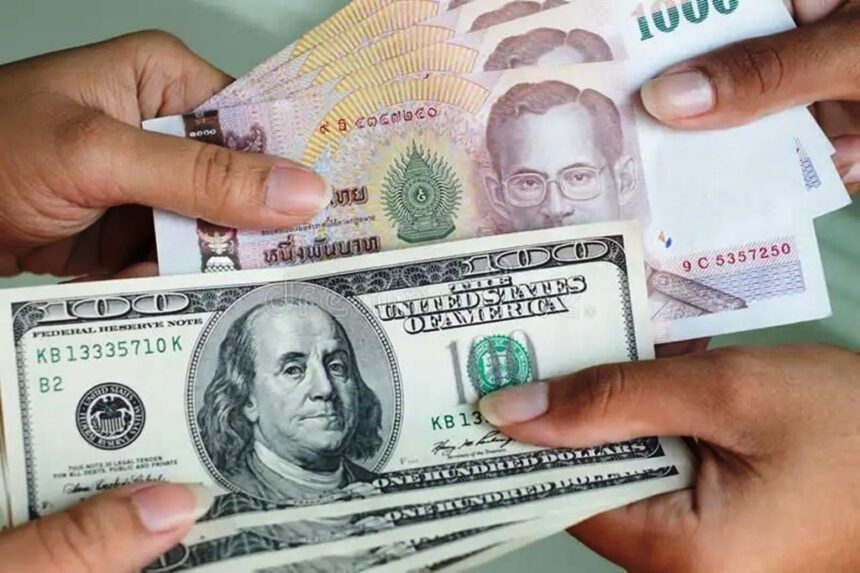
If you live in Thailand on foreign income, the Thai Baht can feel like a silent roommate that changes the rent when you’re not looking. This guide explains what many 2026 forecasts suggest, what could change the story, and how expats can plan without obsessing over every tick on the chart.
A quick reminder before we start: forecasts aren’t guarantees. They’re best treated like a weather report for money, useful, but never perfect.
Also, here’s the plain-English definition you’ll use all year: a stronger baht means USD/THB goes down, so your foreign currency buys fewer baht.
Thai Baht forecast for 2026 in plain numbers (and what “stronger” really means)
As of late January 2026, USD/THB has been trading around the low 31s, after a period of baht strength into late 2025. That matters because many mainstream outlooks for 2026 cluster around about 31 to 32 THB per USD on average, with some more aggressive calls closer to 28 to 30 if the US dollar weakens and capital flows favor Thailand.
One widely cited local projection is Thailand’s Fiscal Policy Office expectation of around 31.8 per USD in 2026, framed as a “stronger baht” scenario tied to a weaker dollar and capital inflows (see the summary at FPO’s stronger baht forecast for 2026).
What does that mean for real expat life?
- If you’re paid in USD and spend in THB, a stronger baht usually feels like a quiet pay cut.
- If you earn in THB but pay US student loans or other USD bills, a stronger baht can help.
- If you keep savings in USD and plan to buy a condo in Thailand, the exchange rate can change your timeline.
A simple example: say you transfer $1,000 a month.
- At 32 THB per USD, you get about 32,000 THB.
- At 30 THB per USD, you get about 30,000 THB.
That 2,000 THB difference can be a couple of nice meals, a utility bill, or a chunk of health insurance.
A quick range to plan around: base case, better case, worse case
Instead of trying to guess one number, it’s smarter to plan around bands. Think of these as budgeting guardrails, not predictions:
| Scenario (planning band) | USD/THB range | What it feels like for expats on foreign income |
|---|---|---|
| Base case | 31 to 32 | Budget feels normal, small swings month to month |
| Strong-baht case | 28 to 30 | Tighter budget, transfers don’t stretch as far |
| Weak-baht case | 33 to 35 | An easier budget, foreign income buys more THB |
If you want regular context on Thailand’s currency and macro headlines, keep an eye on Thailand’s baht market analysis and updates, especially when big policy moves hit the news.
What could move the Thai Baht in 2026 (the few drivers that matter most)
Currencies react to a lot of noise, but a few drivers tend to do the heavy lifting.
US dollar direction and risk mood. When the US dollar is strong (often tied to higher US yields or global risk worries), emerging market currencies can struggle. When the dollar softens and markets feel calm, the baht often has room to strengthen.
Bank of Thailand policy and Thai rates. Thailand cut rates in late 2025 as growth slowed. Lower rates can reduce the baht’s appeal to global investors, all else equal. But rates aren’t the only force; tourism receipts and trade flows matter too.
Thailand’s growth and inflation. Slower GDP growth and very low inflation can pressure the currency if investors think Thailand needs an easier policy. Recent commentary has pointed to soft growth into 2026 (with inflation still low), plus risks like flooding impacts and political uncertainty around early 2026.
Tourism and exports. Tourism brings in foreign currency, which can support the baht. Exports do the same, but a very strong baht can make Thai goods and trips to Thailand feel pricier for foreigners, which can push back over time.
Investor flows and headlines. Big moves sometimes come from positioning and sentiment, not “fundamentals.” A surprise policy shift, a geopolitical flare-up, or a sudden change in risk appetite can move USD/THB quickly.
Interest rates and central banks: Fed vs Bank of Thailand
The rate gap matters because money tends to drift toward higher returns. If Thai rates fall faster than US rates, that can reduce demand for baht assets and can lean toward a weaker baht. If US rates fall faster than Thai rates, the US dollar can lose support, which can help the baht strengthen.
Recent reporting has highlighted a Bank of Thailand rate cut to 1.25% in December 2025, with talk of possible additional easing if growth stays soft. On the US side, the path of Fed policy still shapes the dollar’s tone, especially when markets swing between “higher for longer” and “cuts are coming.”
A simple monthly watch list:
- Fed decision days and the press conference tone
- Bank of Thailand meetings and any hints about more cuts
- US and Thailand inflation prints, because they shape rate expectations
Thailand’s real economy: tourism, exports, and confidence
A stronger baht can be a mixed blessing for Thailand. It helps import costs and can cool inflation, but it can also squeeze exporters and make Thailand feel more expensive for some travelers.
If tourism underperforms expectations, or exports take a hit from trade friction, the baht can lose support. Confidence also matters: high household debt and slower GDP growth can weigh on sentiment, and sentiment can move currencies faster than you’d expect.
Expats feel this beyond exchange rates. A slower economy can show up as a softer job market, more rent negotiation, or more aggressive promotions from private hospitals and schools trying to fill capacity.
How a 2026 Thai Baht move changes your everyday expat budget
Small FX moves add up because you pay life in Thai baht.
A quick rule: if USD/THB moves by 1 baht, your monthly transfer changes by about 1,000 THB for every $1,000 you send.
Here’s where that shows up most:
- Rent and deposits: Many leases reset yearly. A stronger baht can make renewals feel sharper if your income is in USD, even when the THB rent is unchanged.
- Groceries and utilities: Daily costs won’t jump overnight, but over months you’ll feel the squeeze if your monthly THB budget shrinks.
- International school and big bills: Tuition or annual insurance premiums can turn FX into a five-figure decision fast.
- Travel and flights: If you buy tickets priced in USD, a stronger baht can help. If you fund travel from USD transfers, it can hurt.
- Big purchases (car, condo): Timing matters more here. A 2 to 3 baht swing can change the THB you can afford by a lot.
Pensions, remote work pay, and savings: who wins and who loses
Paid in USD/EUR/GBP, spending in THB. A stronger baht reduces your THB spending power. One tip: decide on a minimum THB monthly budget, then build a buffer so you’re not forced to transfer on a bad week.
Paid in THB, paying obligations in USD. A stronger baht helps when you send money out. One tip: consider batching outbound payments when the baht is strong, as long as fees don’t erase the gain.
Mixed income (some THB, some foreign). You can “match” currencies to expenses. One tip: keep Thai bills funded from THB income, and use foreign income for goals that are naturally foreign-priced (US investing, US travel, USD debt).
Simple ways expats can manage Thai Baht risk in 2026 without getting fancy
You don’t need complex hedges to reduce stress. You need a plan that prevents panic transfers.
Start with three basics:
- Keep a THB cash buffer (often 1 to 3 months of essentials) so you can wait out short-term spikes.
- Stagger transfers so one week’s rate doesn’t decide your whole month.
- Know your all-in cost because fees can matter as much as the headline rate.
Be careful with high-leverage FX trading. It’s easy to confuse luck with skill, and losses can land fast. Also watch “great rates” that hide costs in spreads or add-on fees.
A low-stress transfer plan: split, schedule, and set rules
A practical rule-based approach looks like this:
Convert 50% to 70% of your expected monthly spend on a fixed schedule (weekly or biweekly), then top up only if you’re below your THB buffer. If USD/THB hits your target (for example, your “good enough” number), you can transfer a bit extra to rebuild the buffer.
For large one-time payments (tuition, a surgery, a condo deposit), don’t leave it to the last minute. Consider spreading transfers over several weeks, and prioritize certainty over chasing the perfect rate.
A simple monthly checklist:
- Check your THB buffer level versus next month’s bills
- Note the next Fed and Bank of Thailand decision dates
- Review your average transfer rate and total fees
- If you have a big payment due, set a deadline and a transfer plan
- Verify you’re not overexposed in one currency for your needs
For a quick view of where USD/THB is trading and recent history, you can reference USD/THB charts and recent updates as a starting point.
Conclusion
Most 2026 outlooks lean toward a somewhat stronger Thai Baht, often clustering around 31 to 32, with a stronger-band possibility near 28 to 30 and a weaker-band possibility near 33 to 35. Nobody gets to know the future, so the goal is a plan that works across ranges.
Watch three things: the Fed path (and the dollar’s mood), Bank of Thailand rate direction, and Thailand’s tourism and growth signals. Pick a transfer rule, set a buffer, and review it once a month, then get back to living your life in Thailand.