





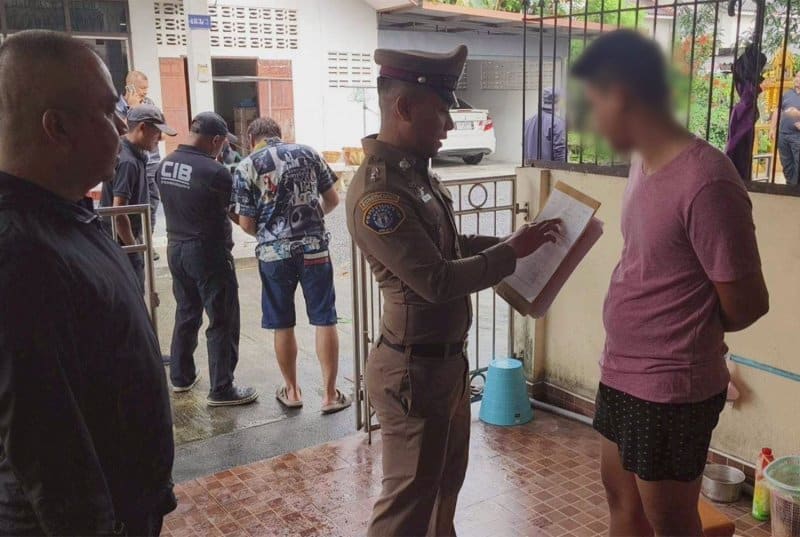
BANGKOK – Crime Investigation Bureau Police (CIB) have arrested in Thailand in a large operation targeting a fake “mule account” ring. The arrests were made on Friday after officers raided seven sites across Phatthalung in the South, Chiang Mai in the North, and Surin in the North-east.
Pol Maj Gen Phatthanasak Bupphasuwan, commander of the Crime Suppression Division (CSD), said the raids led to the suspects being picked up at homes in Muang and Sri Bunphot districts of Phatthalung, and in San Kamphaeng district of Chiang Mai.
The suspects, two men and two women in their mid-30s, are accused of helping, promoting, and supplying bank accounts or electronic cards for use in tech-related crimes.
Police said the group is tied to a number of online scam cases around the country. Investigators followed money trails back to bank accounts opened in Phatthalung, Pol Maj Gen Phatthanasak said.
He added that the network persuaded more than 30 people to open multiple accounts. Officers link the gang to about 70 fraud cases, with losses of roughly 21 million baht. “The group worked as a structured network, led by a foreign organiser,” he said. “They used a clear process to lure people and give them false hope.”

Thai middlemen were sent out to recruit villagers, mainly older people and those with disabilities. They were told they could work as housekeepers at a casino in a nearby country, with pay of 10,000 to 20,000 baht for two to three days’ work.
Those who agreed were then told to open at least five bank accounts each, collect ATM cards, and get passports ready for travel across the border. Other suspects handled transport, moving recruits to meeting spots before handing them to the organiser.
Police said the mule accounts were used until banks froze them. Once the accounts stopped working, the recruits were sent back to Thailand as they were no longer needed. Investigators believe the accounts supported several scam types, including online investment fraud and fake loan schemes.
Some of the suspects admitted they recruited local people, but said they were not directly involved in the scams. Officers said they relied on digital evidence such as transaction records and online chats with the alleged organiser. The suspects are now being held in police custody.


Mule Account Enforcement
Mule accounts in Thailand are bank or digital asset accounts opened in one person’s name but controlled by criminals. They are used to receive, move, or hide illegal money.
The funds often come from online scams such as investment fraud, call-centre schemes, romance scams, and other cybercrimes. Networks often target people through social media job posts that promise easy cash or work-from-home roles. Some people are tricked, others hand over access for a small fee, often a few thousand baht per account.
Thailand has seen a sharp rise in mule accounts, with officials at times estimating up to 1 million active accounts. Since 2022, scam losses have topped 100 billion baht, pushing for tougher enforcement.
Groups including the Anti-Money Laundering Office (AMLO), the Bank of Thailand, the Securities and Exchange Commission (SEC), and police have closed large numbers of suspect accounts, more than 580,000 since late 2023, and arrested thousands of people.
Penalties for mule account offences have become tougher in recent years, including changes tied to the Cybercrime Law and the Digital Asset Business Law in 2025. Key punishments include:
- People who open accounts, let others use them, or sell or rent them out (including digital or crypto accounts) for cybercrime can face up to 3 years in prison, a fine of up to 300,000 baht, or both.
- Recruiters or organisers running “mule farms” (setting up many accounts) can face 2 to 5 years in prison and fines of 200,000 to 500,000 baht.
- If the case falls under money laundering laws in the Anti-Money Laundering Act, penalties can rise to 10 years in prison and fines of up to 200,000 baht (or more, depending on the scale), along with asset seizure.
Even people who claim they did not know what was happening can end up with frozen accounts, police checks, and permanent closures. Courts have also given long jail terms in large cases, including sentences of 14 to 18 years for groups that helped with wide-scale fraud.
Authorities continue to warn the public to stay away from any offer that involves sharing or handing over bank account access, because the small payout is not worth the long-term fallout.