






Thailand has been added to a US government monitoring list for currency practices, and the Bank of Thailand’s US currency watchlist headline has moved quickly through markets. The Bank of Thailand (BOT) has played down the move, saying it won’t change policy just because Washington added Thailand to the list.
The story matters because it can shape Thai baht volatility through sentiment alone. A few headlines can shift expectations about foreign exchange intervention, and that can move USD/THB, even if nothing “big” changes in policy. For exporters, importers, and investors, small FX movements can still erode margins.
Reporting linked Thailand’s addition to its external surpluses, including a current account surplus of about 3.8% of GDP over the July 2024 to June 2025 assessment window, along with trade surplus factors tied to the United States. The BOT’s message remains consistent: it manages volatility in both directions and does not seek an unfair trading advantage.
What the US currency watchlist is, and why it exists
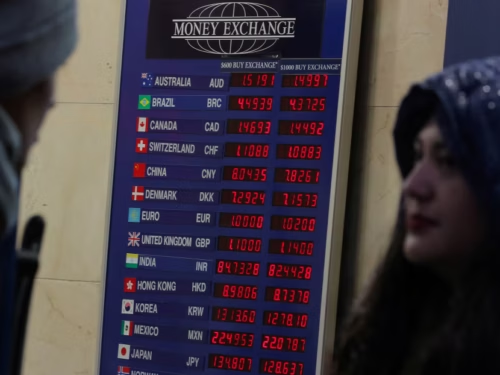

The US Treasury conducts regular reviews of major trading partners to identify currency practices that could distort trade. When a country is added to the “monitoring list,” often called a watchlist, it means the US wants closer monitoring and more discussion, not automatic penalties.
This process appears in the U.S. Treasury’s periodic currency reporting to Congress. The latest publication is the January 2026 Treasury foreign exchange report PDF, which lays out the framework and the economies it monitors.
In simple terms, the US looks for signs that a country’s policies could keep its currency weaker than it would be otherwise, which can make exports cheaper and imports more expensive. The review focuses heavily on large, measurable indicators, such as trade and current account balances, and evidence of one-sided foreign exchange intervention.
For Thailand, the key point is that the list serves as a flag for scrutiny. It can raise questions, draw greater attention to the data, and create political pressure. It does not, by itself, mean Thailand “did something illegal,” and it does not automatically trigger trade action.
Watchlist vs. “currency manipulator”, the difference that matters
A lot of readers see “watchlist” and hear “punishment.” That’s not how US labeling works.
Being on a watchlist means the country sits in a “watch more closely” bucket. It can lead to more meetings, more data questions, and more headlines.
A “currency manipulator” label is a bigger step. It signals the US believes the country meets a higher bar under its criteria and may open the door to stronger trade pressure.
In the latest reporting cycle, the US did not designate any country as a manipulator, according to reporting summarizing the report’s findings, including coverage such as this summary of the US monitoring list update.
Thailand was reportedly assessed as meeting two of three commonly cited criteria, but it was not labeled a manipulator. That distinction reduces the risk of immediate escalation.
What “closer scrutiny” looks like in real life
In practice, scrutiny tends to center on three things.
First, it increases attention on foreign exchange intervention. When a central bank buys or sells foreign currency to smooth market movements, observers may ask whether those actions appear “two-way” (to reduce volatility) or “one-way” (to resist a stronger currency).
Second, it pushes transparency reporting. Markets often respond more favorably when they can see a clear framework and consistent data releases.
Third, it creates a headline risk loop. Even if policy stays steady, repeated stories about a “Thailand currency watchlist” can influence how traders price risk. That can make the baht move more sharply on days with thin liquidity or a rush into or out of the dollar.
Why Thailand was added this time, explained without jargon
Thailand’s addition appears to be driven mainly by surplus measures, based on reporting around the U.S. review. One commonly cited factor is a large bilateral trade surplus with the US, reported as above $15 billion. Another is a global current account surplus, reported at around 3.8% of GDP for the July 2024 to June 2025 window used in the review.
Some reports also frame Thailand’s current account surplus at around $17.7 billion (about 3% of GDP), depending on the timeframe used. These figures can vary by period, tourism season, and import cycles, but the direction matters: persistent surpluses can draw a country into U.S. monitoring, even without a claim of proven manipulation.
This point is often overlooked in public debate. A watchlist entry can reflect mathematical and threshold criteria, not a finding of bad intent.
The “two of three criteria” idea
The US approach is often described as “three checks,” and a country may be added to a watchlist when it meets enough of them.
Here’s the plain-English idea behind each check:
- A large trade surplus with the US can suggest an imbalance that draws political attention in Washington.
- A sizable current account surplus can indicate that the country as a whole saves more than it spends relative to the rest of the world.
- Signs of one-sided intervention aim to capture whether the central bank repeatedly intervenes to keep the currency down.
The report indicates that Thailand met two of these criteria in the latest review cycle. That helps explain the decision without turning it into a moral judgment.
Which Thai export sectors could face more questions
When trade surplus headlines rise, the next question is often “Which products drove it?”
Recent reports indicate strength in exports of electronics components and computers, supported by global demand linked to the AI supply chain. Thailand also exports large volumes of processed foods, including canned fruit, which have already attracted trade attention through tariff measures in some markets.
None of this implies wrongdoing. It reflects a simple dynamic: when export growth outpaces import growth, the surplus widens, and the country becomes more visible in U.S. reviews. That’s why businesses in high-volume sectors should expect more questions about documentation, pricing, and contract structures, even if they come indirectly through banks, buyers, or compliance checks.
What the Bank of Thailand said, and what could change for USD/THB next
The Bank of Thailand’s public line remains steady. It states that it manages the baht to reduce excessive movements in both directions and does not target the exchange rate to gain an unfair trade advantage. Reporting also states that the BOT has continued discussions with the US Treasury and considers Thailand unlikely to be labeled a manipulator under US criteria.
Context also matters. Thailand and the US have already signaled ongoing cooperation on transparency and consultation, including through the BOT’s joint statement on consultations with the US Treasury and the corresponding US Treasury statement on consultations with the Bank of Thailand.
Even if policy remains unchanged, USD/THB can still move quickly. Capital flows, importer demand, exporter conversions, gold-related transactions, and investor positioning can influence the exchange rate. When markets expect a central bank to intervene less frequently, they may price a different path for the currency, even before any real change occurs.
For background on how the BOT has responded to currency strength pressure in recent months, see this related coverage on measures to curb a strong Thai baht.
A quick snapshot of recent baht moves readers can relate to
Reporting said the baht traded around 31.35 per US dollar on Jan 30, 2026, compared with 30.73 at the start of that week.
That’s not a dramatic collapse or surge, but it’s enough to matter. On tight-margin export contracts, a move of less than one baht can change a shipment’s profit. Changes in dollar-denominated imports can affect the landed cost of parts, raw materials, or machinery.
The practical lesson is simple: businesses shouldn’t wait for “big” currency moves before tightening routines.
Gold trading rules and other steps that can reduce sudden baht swings
Reports indicate that the BOT will tighten online gold trading rules from March 1, 2026, including restrictions such as no short selling, no net settlement, no cash payments, and only the sale of gold that the seller already owns.
The link to the baht is straightforward. Gold trading can trigger fast foreign currency conversions. When trading volumes surge, FX flows can also surge, and those flows can amplify Thai baht volatility.
The same theme appears in other recent coverage about tighter monitoring of foreign currency transactions, such as Bangkok Post reporting on scrutiny of foreign cash and additional reporting on stricter checks tied to FX inflows and gold-related flows, including coverage of tighter documentation checks.
Practical steps for exporters, importers, and investors right now
Exporters face the most direct risk: revenue is often denominated in USD, while costs are in baht. A stronger baht can shrink margins fast, and a weaker baht can tempt firms to take on too much FX risk while chasing better rates. The goal is stable cash flow, not perfect timing.
Importers deal with the opposite problem. Many pay suppliers in dollars, so a weaker baht lifts costs. The goal is to plan payments and pricing so one week of FX movement doesn’t force a sudden price hike.
Investors often feel the watchlist story through sentiment. That can show up as faster day-to-day swings in USD/THB, plus shifts in rates expectations and hedging demand. Anyone holding unhedged foreign assets should understand the currency exposure and discuss risk limits with their provider.
Broader monetary policy still shapes the background for these moves. For related context, see this coverage on BOT rate decisions and the local market reaction.
What Thai exporters should do this week
- Map USD exposure by invoice date so the team can clearly see timing risk.
- Set a simple hedge ratio (even a partial one) and review it weekly.
- Shorten quotation validity so pricing doesn’t sit open for weeks.
- Build a small FX buffer into quotes when margins are thin.
- Match USD receivables with USD payables (natural hedging) where possible.
- Ask the bank about forwards and options, including costs, not just the rate.
- Set rate alerts for key levels tied to budgets and covenants.
- Tighten credit terms to prevent collections from drifting when FX is moving.
- Don’t chase headlines with panic conversions; follow a written process.
- Document the FX policy for auditors, lenders, and internal control.

Quick FAQ: clear answers to the questions people are asking
Does the watchlist mean Thailand will be punished?
No. A watchlist mainly signals monitoring and more discussion, not automatic penalties.
Can the BOT still intervene in the FX market?
Yes. The BOT states that the watchlist does not prevent it from managing volatility and has emphasized two-way management.
Will the baht automatically strengthen now?
No. Markets may adjust expectations, but USD/THB continues to move with flows, sentiment, and global dollar trends.
Which businesses feel it first?
Firms with USD invoices and thin margins, plus importers with large near-term dollar payables.
What should be watched in the next US Treasury report?
Monitor whether Thailand continues to meet the same surplus thresholds and how the report describes intervention and transparency.
Should companies change how they hedge?
Many don’t need a new strategy, but they may need stricter discipline, clearer limits, and better timing rules.
Conclusion
Thailand’s watchlist entry adds scrutiny and can affect sentiment, but it is not equivalent to being labeled a currency manipulator. The Bank of Thailand says it will continue to manage baht volatility in both directions and does not aim for an unfair trading advantage.
The checklist ahead remains practical: watch for the next US Treasury currency report on Thailand around mid-2026, track BOT communication on volatility tools and transparency, and monitor sector headlines tied to the US trade balance. The strongest defense is boring but effective, consistent hedging discipline and cash-flow planning, not exchange rate predictions.